What would happen if you dove into Jupiter? Join us on a breathtaking virtual expedition into the clouds of the Solar System’s colossal king. This article will peel back the layers of the gas giant, revealing the awesome and terrifying secrets of what I like to call “Hell’s Theme Park.”
Whenever I look up at the night sky, one celestial body always captures my heart: the undisputed giant, Jupiter. As someone with a deep passion for space, I’ve spent countless hours analyzing data and observing the heavens, but Jupiter evokes a unique feeling—a mix of profound awe and a genuine chill down my spine. If you’ve only ever thought of it as a big, beautiful gas planet, my story today might just change your perspective entirely. Ready to take the plunge into this cosmic theme park with me? 😊
Table of Contents
First Impressions: A Tour of Jupiter’s Stunning Exterior 🤔
When you picture Jupiter, you likely imagine its beautiful stripes and the Great Red Spot. These aren’t just patterns; they’re the result of incredible atmospheric activity. The lighter bands (zones) are areas where warm gas from the interior rises and forms icy clouds, while the darker bands (belts) are where cooler gas sinks, revealing deeper chemical layers.
But how do these bands stay so perfectly defined? The secret lies in ferocious jet streams at their borders, with winds screaming past at over 300 mph (500 km/h). To put that in perspective, the winds of a Category 5 hurricane are about half that speed. And Jupiter’s iconic Great Red Spot? It’s a colossal storm, 1.3 times the size of our entire planet, that has been raging for at least 400 years. Talk about a planetary-scale phenomenon!
💡 Did You Know?
Jupiter is often called a “failed star.” If it had been about 75 to 80 times more massive, it could have ignited nuclear fusion and become a second sun. We might have been living in a binary star system!
The Dive into Hell: Exploring Jupiter’s Atmosphere 🚀
Alright, let’s take the plunge. The first thing we’d encounter is a layer of ammonia ice clouds, where bitter cold of -238°F (-150°C) meets a noxious smell. It would feel like entering a cosmic, frozen chemical locker. Here, baseball-sized hail made of ammonia and water, nicknamed “mushballs,” rains down while winds rage at over 300 mph.
Pushing deeper past this foul layer, we’d find a massive cloud bank made of water (H₂O). But this is no romantic, fluffy cloud. Let’s break down the environment in a quick table:
| Atmospheric Layer | Key Features | Temp / Pressure |
|---|---|---|
| Upper Clouds | Ammonia ice, mushballs, high winds | ~ -238°F / Similar to Earth |
| Middle Clouds | Ammonium hydrosulfide, strong odors | ~ -94°F / 2-3x Earth |
| Lower Clouds | Water (ice, vapor), “superbolt” lightning | Tens of degrees / 10x Earth |
⚠️ Warning!
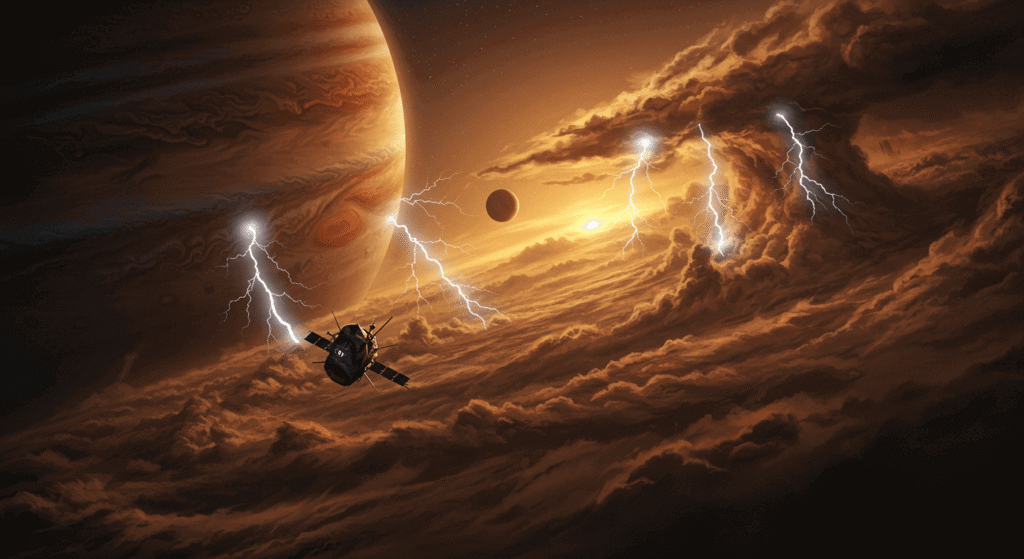
In Jupiter’s water cloud layer, lightning bolts many times more powerful than Earth’s strongest “superbolts” flash constantly. In 1979, the Voyager 1 probe detected radio waves from this lightning, which sounded like a descending whistle and were nicknamed “Whistlers.”
Oceans Beyond Imagination: The Bizarre Seas and Core 🌊
If we could survive the horrific cloud layers, we’d finally reach an ocean. But this ocean is made not of water, but of hydrogen. Under immense pressure and heat, it exists as a “supercritical fluid”—a bizarre state of matter that’s neither liquid nor gas. It has the density of a liquid but flows freely like a gas. It would be a surreal experience, like trying to swim through a “gaseous swamp.”
📝 The Birth of a Metallic Hydrogen Ocean
In an environment with 2 million times Earth’s atmospheric pressure and temperatures of 10,000°F (6,000°C), the structure of a hydrogen atom collapses. The electron is squeezed out from its proton, becoming a “free electron” that can conduct electricity—the defining characteristic of a metal. This sea of liquid metallic hydrogen generates a massive electric current, which in turn creates Jupiter’s magnetic field—an incredible 18,000 times more powerful than Earth’s.
Penetrating this metallic hydrogen ocean for tens of thousands of miles would bring us to Jupiter’s core. The temperature here is estimated to be around 43,000°F (24,000°C), with pressure tens of millions of times that of Earth’s surface. For years, scientists believed it was a solid, rocky core. However, data from the Juno mission since 2016 has pointed to a new theory: a “fuzzy core” that’s diffuse and mixed with the surrounding metallic hydrogen, like ink dissolving in water. It’s an ultimate environment where matter is crushed and dissolved into its atomic components.
The Valiant End of Jupiter’s Probes 🛰️
So, has anything from Earth actually entered Jupiter? Yes. In 1995, a small probe released from the Galileo spacecraft entered the atmosphere. It survived for 58 minutes, sending back invaluable data before it was crushed and vaporized. It only made it about 97 miles (156 km) deep, where the pressure reached 23 times that of Earth, before communication was lost.
The current Juno orbiter, once its mission is complete, is also programmed for a final, fatal plunge into Jupiter’s atmosphere. This is a deliberate act to prevent any chance of it crashing into and contaminating one of Jupiter’s potentially life-bearing moons, like Europa. For humanity’s explorers, Jupiter is both a source of incredible discovery and the ultimate cosmic incinerator.
💡
Jupiter Dive: Key Takeaways
✨ Toxic Cloud Layers: The journey begins through three layers of hell: -238°F ammonia ice clouds, foul-smelling ammonium hydrosulfide, and finally water clouds with intense lightning.
🌊 Gaseous Swamp & Metallic Sea: Below the clouds lies a supercritical fluid hydrogen ocean, and deeper still, an ocean of liquid metallic hydrogen.
⚡️ Powerful Magnetosphere:
Motion of Metallic Hydrogen → Magnetic Field 18,000x Stronger Than Earth’s
❤️ A “Fuzzy” Core: The planet’s center is likely not a solid core, but a 43,000°F “fuzzy core” blended with the materials around it.
This is a hypothetical journey; in reality, any craft would be crushed and vaporized almost instantly.
Frequently Asked Questions ❓
Q: Is there any solid ground to land on at Jupiter?
A: No, as a gas giant, Jupiter has no solid surface like Earth. As you descend, the atmospheric pressure simply increases until the gas transitions into a strange liquid-like state (a supercritical fluid) without ever hitting a solid “ground.”
Q: Why is the Great Red Spot red?
A: The exact cause is still a mystery. Scientists speculate that chemicals from deep within Jupiter’s atmosphere (like sulfur or phosphorus compounds) are churned up by the powerful storm and react with sunlight (UV radiation), creating the distinct reddish color.
Q: Does Jupiter’s powerful magnetic field affect us on Earth?
A: It has no direct effect on us. However, Jupiter’s immense gravity and magnetic field act as a “cosmic bodyguard” for the inner solar system. It helps stabilize the orbits of other planets and often deflects or captures asteroids and comets that might otherwise head toward Earth.
So, what did you think of our thrilling dive into Jupiter? I think you’ll agree that calling it “hellish” might be an understatement. Studying this giant planet fills you with a sense of the universe’s sheer scale and our own fragile place within it. What part of Jupiter’s nature do you find most incredible? Let me know your thoughts or any other questions in the comments below! 😊
핑백: The 4 Most Hellish Planets in the Universe (You Won't Believe They Exist) The 4 Most Hellish Planets in the Universe
핑백: Jupiter: A Deep Dive into Its Storms, Moons, and Secrets