The new interstellar object 3I/Atlas is stumping scientists. Its bizarre CO2 coma, steady speed, and nickel traces have led Dr. Avi Loeb to suggest an alien origin. Is it a probe or a natural comet? We analyze the evidence.
In a thrilling development for astronomy, our solar system is currently hosting a new interstellar visitor. Designated 3I/Atlas, this object is blazing through our cosmic neighborhood at a staggering 60 km/s. But this is no simple comet. Almost from the moment of its discovery, 3I/Atlas has displayed a series of baffling characteristics that defy easy explanation.
Its behavior is so strange, in fact, that it has reignited one of the most provocative debates in modern science. Dr. Avi Loeb, the noted Harvard physicist, has publicly hypothesized that 3I/Atlas may not be a natural object at all, but rather an interstellar probe sent by an alien civilization.
Is this the moment we’ve all been waiting for, or is it a complex natural phenomenon that simply highlights the diversity of the galaxy? As an observer who has closely followed the ‘Oumuamua and Borisov mysteries, I can tell you that 3I/Atlas presents the most compelling—and puzzling—evidence yet. This article will break down the evidence, analyze the competing hypotheses, and explain what to look for as this object makes its closest approach to our sun.
On This Page
- 1. The 3I/Atlas Mystery: An Unprecedented Interstellar Object
- 2. Analyzing the Anomalies: Why 3I/Atlas Defies Explanation
- 3. The Alien Probe Hypothesis: Dr. Avi Loeb’s Provocative Case
- 4. The Scientific Consensus: A ‘Weird’ but Natural Interstellar Comet
- 5. The Path Forward: What’s Next for 3I/Atlas (Perihelion on Oct 30)
- 6. Frequently Asked Questions (FAQ) About 3I/Atlas
1. The 3I/Atlas Mystery: An Unprecedented Interstellar Object
Our solar system has been visited before. 1I/’Oumuamua in 2017 was a bizarre, cigar-shaped object that accelerated without a visible tail. Then came 2I/Borisov in 2019, which was clearly an interstellar comet, but one with a chemical composition (like its high carbon monoxide content) unlike anything in our own system.
3I/Atlas, however, seems to combine the most mysterious elements of both, while adding new puzzles of its own. It presents us with a direct contradiction: it looks and acts like a comet, but it has features that suggest something more.
2. Analyzing the Anomalies: Why 3I/Atlas Defies Explanation
To understand the debate, we have to look at the specific data points that have scientists scratching their heads.
2.1. The ‘Suspicious’ Orbit and Velocity
Here’s the first red flag. Most interstellar objects should, by random chance, enter our solar system at a high inclination—that is, “from above” or “below” the flat plane that all our planets orbit on (the ecliptic).
Yet, 3I/Atlas is traveling almost perfectly within the ecliptic plane, taking it on a trajectory that closely approaches the orbits of Venus, Mars, and Jupiter. As Dr. Loeb has pointed out, this is an ideal path if your goal is to gather data on the solar system’s main planets.
Even more baffling is its speed. It was detected maintaining a near-perfectly constant velocity of 60 km/s. Natural comets are slaves to gravity; they speed up significantly as they fall toward the sun and slow down as they move away. They also get an unpredictable “push” from their own gas jets (non-gravitational acceleration). The steady speed of 3I/Atlas is mechanically precise, almost… artificial.
2.2. The Extreme Brightness and CO2 Coma
When 3I/Atlas was still far out, between the orbits of Mars and Jupiter, it shocked observers by flaring to be five times brighter than models predicted. This extreme activity so far from the sun pointed to one thing: it’s not made of water ice.
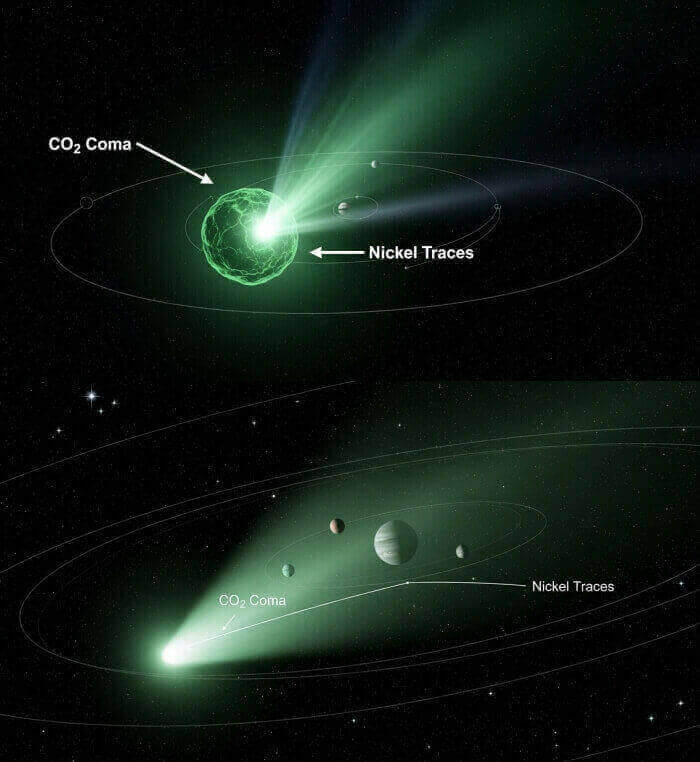
Our comets are mostly water ice, which only “sublimates” (turns to gas) when it gets close to the sun. Data from the James Webb Space Telescope (JWST) confirmed the cause: the coma (the gas cloud) of 3I/Atlas is overwhelmingly dominated by carbon dioxide (CO2). CO2 ice sublimates at much colder temperatures, meaning a CO2-based “comet” would be incredibly active far out in the solar system. This is a major discovery, as no comet from our system has ever shown such a composition.
2.3. The Green Glow and Nickel Detection
Here’s where things get truly strange. The object is glowing with a distinct green light. In 99% of comets, this green glow is the unmistakable signature of diatomic carbon (C2) molecules being broken apart by sunlight. However, spectroscopic analysis of 3I/Atlas shows no C2 molecules. So, what is producing the green light?
This puzzle is compounded by the final, shocking discovery: the detection of nickel in its coma. Nickel is a heavy metal, a primary component in stainless steel and high-temperature rocket engines. It is not something you expect to see boiling off a comet.
3. The Alien Probe Hypothesis: Dr. Avi Loeb’s Provocative Case
For Dr. Avi Loeb, who famously argued that ‘Oumuamua was an alien lightsail, 3I/Atlas is another powerful candidate for technology. His case, built on this evidence, is compelling:
- The Intentional Path: The ecliptic orbit is too convenient to be random. It’s a “fly-by” route.
- The Powered Engine: The constant 60 km/s speed suggests a propulsion system, not natural forces. The CO2 “coma” could be exhaust, and the nickel detection could be the signature of the engine itself.
- Artificial Markings: The green glow with no C2 could be an artificial marker, a heat-shield interaction, or a byproduct of its power source.
Loeb’s argument is that while any one of these anomalies could be a natural curiosity, the *combination* of all of them (suspicious orbit, steady speed, CO2-driven brightness, green glow, and nickel) points to a technological origin.
4. The Scientific Consensus: A ‘Weird’ but Natural Interstellar Comet
However, the broader scientific community, while deeply excited by 3I/Atlas, has reached a different conclusion. Based on data from 14 observatories and the Hubble Space Telescope, the consensus is that 3I/Atlas is a natural, if bizarre, interstellar comet.
Here is the counter-argument, which rests on the principle that “extraordinary claims require extraordinary evidence.”
- It Has a Coma and Tail: This is the single biggest piece of evidence. The mystery of ‘Oumuamua was its acceleration *without* a coma. 3I/Atlas *has* a clear coma and is developing a tail. It is actively shedding material like a comet.
- The Nucleus is Small: Initial estimates were large, but once the bright coma was factored out, the solid nucleus is estimated to be only 5km across. This is a very typical size for a comet.
- The CO2 is the Key: The CO2-dominated composition is not evidence of *fuel*; it’s evidence of its *birthplace*. This object likely formed in an extremely cold, outer region of its home star system, far different from our own. This chemical diversity is exactly what astronomers *hope* to find in interstellar objects, as it teaches us about how other solar systems are built.
- The “Weird” Stuff: The nickel and the mysterious green glow are likely part of this exotic chemistry. Its home system may have been rich in heavy metals, leading to a “metal-rich” comet. The green glow’s origin is still unknown, but it’s more likely to be a new chemical interaction than an alien beacon.
5. The Path Forward: What’s Next for 3I/Atlas (Perihelion on Oct 30)
The debate will soon face its biggest test. 3I/Atlas is scheduled to reach perihelion (its closest point to the Sun) on October 30th.
This intense encounter with solar heat and radiation will be the ultimate truth-teller.
- If it’s a comet: It will likely brighten immensely, its tail will grow, and it may even fragment under the stress, as comet C/2019 Y4 (ATLAS) did.
- If it’s a probe: It will survive the passage intact, perhaps using the sun for a gravity assist, and its trajectory will remain steady.
This is an actionable moment for all of us. While the object is likely too faint for backyard telescopes, the world’s premier observatories (NASA, ESA, and JWST) will be watching. In the days following October 30th, be sure to follow the official news from these agencies. They will release definitive reports on its post-perihelion behavior.
Ultimately, 3I/Atlas is a win for science, no matter the outcome. If it’s a natural comet, it has revealed a new class of CO2-dominated objects we never knew existed. And if it’s not… well, that would change everything.
6. Frequently Asked Questions (FAQ) About 3I/Atlas
Q: What is 3I/Atlas in simple terms?
A: 3I/Atlas is the third confirmed interstellar object (one that originated from outside our solar system). It is currently being debated, but the scientific consensus is that it is an exotic, CO2-rich comet from another star system.
Q: Is 3I/Atlas really an alien spacecraft?
A: It is highly unlikely. Dr. Avi Loeb has proposed this hypothesis based on its suspicious orbit, steady speed, and unusual composition (nickel). However, the vast majority of the scientific community believes these anomalies are features of a natural, but exotic, comet from a different part of the galaxy.
Q: Why is 3I/Atlas so bright and green?
A: It is extremely bright because its coma is made of carbon dioxide (CO2) ice, which turns to gas much farther from the sun than water ice. The green glow is a mystery, as it does not contain the C2 molecule (cyanogen) that normally causes this color in comets.
Q: How is 3I/Atlas different from ‘Oumuamua?
A: The biggest difference is that ‘Oumuamua showed non-gravitational acceleration (a push) *without* a visible coma or tail. This is why it was so mysterious. 3I/Atlas, by contrast, *has a very clear coma and tail*, behaving exactly like a comet (albeit a chemically strange one).
Q: When can I see 3I/Atlas?
A: 3I/Atlas will be closest to the sun on October 30th. However, even at its brightest, it is not expected to be visible to the naked eye. Its discovery and analysis are being handled by professional, high-power telescopes like the JWST and Hubble.