If you have looked up at the winter sky recently, you’ve likely fixed your eyes on the shoulder of Orion. There sits Betelgeuse, a glowing red beacon that has captivated humanity for millennia. But in late 2019, this reliable giant did something terrifying: it started to vanish. The “Great Dimming” sparked a global frenzy. Was this the end? Was a supernova imminent?
While the star eventually brightened again, the mystery remained. Now, armed with the unprecedented infrared capabilities of the James Webb Space Telescope (JWST), astronomers are peeling back the layers of dust to see what is really happening inside this volatile monster. JWST hasn’t just given us pretty pictures; it has provided a forensic analysis of a star on death row.
In this deep dive, we will explore what JWST revealed about Betelgeuse supernova potential, distinguishing between viral hype and astrophysical reality.
Table of Contents
- 1. The Great Dimming: A Prelude to Destruction?
- 2. Why JWST is the Perfect Tool for Betelgeuse
- 3. What JWST Revealed About Betelgeuse Supernova Potential
- 4. Analyzing the “Stellar Burp”: Mass Loss Mechanisms
- 5. The Timeline: When Will Betelgeuse Actually Explode?
- 6. Frequently Asked Questions (FAQ)
The Great Dimming: A Prelude to Destruction?
To understand the significance of the new data, we must first revisit the event that triggered the panic. In late 2019, Betelgeuse dropped in brightness by nearly 60%. For a Variable Star, fluctuations are normal—but nothing of this magnitude had been recorded in modern history. The astronomical community buzzed with one question: Is this the pre-supernova collapse?
Conventional wisdom suggests that before a red supergiant explodes, it sheds massive amounts of material and becomes unstable. The dimming looked suspiciously like a death rattle. However, visible light telescopes (like Hubble) couldn’t see the full picture because they were blocked by the very material the star was ejecting.
Why JWST is the Perfect Tool for Betelgeuse
This is where the James Webb Space Telescope changes the game. Unlike Hubble, which observes primarily in visible light, JWST observes in the infrared spectrum. Why does this matter for what JWST revealed about Betelgeuse supernova potential?
- Penetrating the Dust: Infrared light passes through cosmic dust clouds. While visible light gets blocked, JWST can peer through the hazy veil surrounding Betelgeuse to see the photosphere (the surface) and the immediate circumstellar envelope.
- Chemical Analysis: JWST’s instruments, like MIRI (Mid-Infrared Instrument) and NIRCam, can analyze the chemical composition of the gas and dust. It can tell the difference between oxygen-rich dust and carbon-rich dust, giving us clues about what elements are being fused in the core.
- Thermal Imaging: It allows astronomers to map the temperature of the ejected material, helping to distinguish between a cooling of the star itself and a blockage of light by external dust.
What JWST Revealed About Betelgeuse Supernova Potential
So, what is the verdict? The data from JWST, combined with findings from the VLT (Very Large Telescope), points to a fascinating conclusion that dampens the immediate explosion theory but heightens the scientific intrigue.
1. It Was a “Surface Mass Ejection” (SME), Not a Collapse
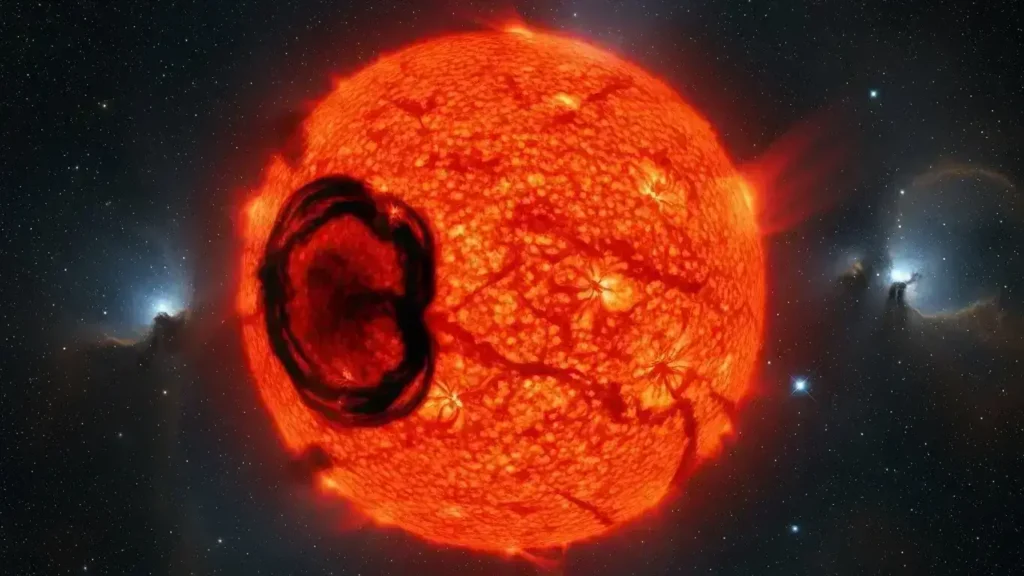
JWST observations support the theory that the dimming was caused by a massive ejection of surface material—essentially a titanic “burp.” A convective plume, bubbling up from deep within the star, broke the surface. This material, roughly several times the mass of our Moon, was shot out into space.
Once this hot gas moved away from the star, it cooled down rapidly. In the cold vacuum of space, heavy elements like silicon and magnesium condensed into solid dust grains. This newly formed dust cloud drifted in front of the star from our perspective on Earth, blocking the light. JWST revealed that the star itself did not fundamentally cool down in preparation for a core collapse; it merely hid behind its own smoke.
2. The Internal Engine is Still Running “Normally”
Crucially, JWST’s spectral analysis indicates that Betelgeuse is likely still fusing helium into carbon and oxygen. If a supernova were imminent (within weeks or years), we would expect to see signs of late-stage fusion, such as silicon burning or a chaotic neutrino flux (though JWST detects photons, not neutrinos). The atmospheric composition suggests a star that is elderly, but not in its final seconds of life.
Analyzing the “Stellar Burp”: Mass Loss Mechanisms
The most valuable insight regarding what JWST revealed about Betelgeuse supernova potential isn’t about when it will explode, but how it loses mass before it dies. This is a critical gap in our understanding of stellar evolution.
JWST imagery has helped astronomers map the complex shockwaves pulsing through the star’s atmosphere. The “heartbeat” of Betelgeuse represents a violent struggle between gravity trying to crush the star and radiation pressure trying to blow it apart. The data confirms that:
- Convection is Key: Giant convection cells (bubbles of plasma) on the surface of Betelgeuse are colossal—some as large as the Earth’s orbit around the Sun.
- Shockwaves Create Dust: These pulsating shockwaves push gas far enough out that it cools and creates dust. This dust is crucial because it eventually seeds the universe with the building blocks for new planets and life.
The violence of the 2019 ejection suggests that mass loss isn’t a steady stream, but a chaotic, episodic process. This implies that estimates of supernova timing based on steady mass loss models might need to be revised.
The Timeline: When Will Betelgeuse Actually Explode?
If JWST tells us it wasn’t an immediate precursor, when can we expect the fireworks?
There is currently a scientific debate, partially fueled by data refined by JWST observations.
The Consensus View: Most astrophysicists believe Betelgeuse is in the helium-burning phase. This means it has approximately 10,000 to 100,000 years left before it runs out of fuel, collapses, and goes Type II Supernova.
The “Late Stage” View: A minority of researchers, analyzing the pulsation periods (how the star beats), argue that Betelgeuse might be fusing carbon. If true, the timeline shortens drastically to a few decades or centuries. However, the dust analysis from JWST leans more toward the consensus view, as the heavy element abundance in the atmosphere doesn’t quite match the profile of a star mere moments from death.
Regardless of the timeline, what JWST revealed about Betelgeuse supernova potential confirms that the star is recovering from its traumatic injury in 2019. The photosphere is still bouncing like a bell that has been struck, but it is stabilizing.
Frequently Asked Questions (FAQ)
Did JWST prove Betelgeuse is about to explode?
No. JWST data suggests the recent “Great Dimming” was caused by a massive dust cloud blocking the light, not a core collapse. The star likely has 10,000 to 100,000 years of life remaining.
What caused Betelgeuse to get dark in 2019?
Observations confirmed by infrared data show it was a Surface Mass Ejection (SME). The star ejected a huge blob of gas which cooled into dust, temporarily obscuring our view.
Will the Betelgeuse supernova hurt Earth?
No. Betelgeuse is roughly 650 light-years away. When it explodes, it will be as bright as the half-moon and visible during the day, but we are too far away to be harmed by the radiation.
Why does JWST look at Betelgeuse in infrared?
Infrared light can penetrate the thick clouds of dust and gas surrounding the star. This allows astronomers to see the structure of the star’s surface and immediate atmosphere, which is hidden in visible light.
The universe is dynamic, and our understanding changes with every new image downlinked from L2. We will continue to update this post as more peer-reviewed papers regarding what JWST revealed about Betelgeuse supernova potential are published.