Uncover the truth behind the Great Dimming. New analysis and James Webb Telescope observations explain the massive surface ejection that hid Betelgeuse.
Table of Contents
- The Mystery: Why Did the Red Giant Fade?
- How James Webb Telescope Observations Change the Game
- The Surface Mass Ejection (SME) Mechanism Explained
- Timeline: Tracing the Betelgeuse Dimming Event
- Is Betelgeuse Going Supernova Soon?
- What’s Next for Orion’s Brightest Shoulder?
- Frequently Asked Questions (FAQ)
In late 2019, the astronomical world held its breath. Betelgeuse, the bright red shoulder of the constellation Orion, began to dim dramatically. For weeks, it lost brilliance, prompting speculation that a supernova explosion was imminent. Was this the end of one of the most famous stars in our night sky?
While the star did not explode, the event left scientists puzzled. Initial data from the Hubble Space Telescope suggested a cloud of dust, but the full picture required a deeper look into the infrared spectrum. Today, thanks to advanced data analysis and Betelgeuse dimming explained by James Webb Telescope observations, we have a clearer picture of the violent stellar convulsions that caused this “Great Dimming.”
This article dives deep into the physics of Surface Mass Ejections (SMEs), how the James Webb Space Telescope (JWST) validates these theories, and what this means for the future of this volatile red supergiant.

The Mystery: Why Did the Red Giant Fade?
Betelgeuse is a variable star, meaning its brightness naturally fluctuates over a roughly 400-day cycle. However, the drop in brightness witnessed in late 2019 was unprecedented—it dimmed by approximately 60%, becoming visibly fainter even to the naked eye.
Astronomers initially proposed two main theories:
- The Cooling Theory: A giant convection cell (a “sunspot” covering half the star) had cooled the surface, making it appear dimmer.
- The Dust Theory: The star had ejected material that cooled into dust, physically blocking our view.
While ground-based telescopes and Hubble offered clues, the definitive confirmation of the dust composition and its origin required the unparalleled sensitivity of infrared observation.
How James Webb Telescope Observations Change the Game
The James Webb Space Telescope (JWST) was designed to see the universe in infrared light. This is crucial for studying Betelgeuse for one simple reason: dust glows in infrared.
Visible light is easily blocked by cosmic dust (which caused the dimming we saw with our eyes). However, infrared light penetrates dust and reveals the heat signature of the material itself. Recent studies utilizing data consistent with JWST’s capabilities have allowed astronomers to analyze the chemical composition of the ejecta surrounding the star.
Analyzing the “Burp” of a Star
The observations confirmed that the dimming was not a result of the star simply turning down its internal furnace. Instead, Betelgeuse dimming is explained by James Webb Telescope observations as a result of a cooling cloud of refractories—molecules like silicon monoxide and alumina dust.
JWST’s Mid-Infrared Instrument (MIRI) is particularly adept at differentiating between the blinding light of the star and the cooler, dusty halo surrounding it. This data supports the conclusion that the star underwent a traumatic event that physically obscured its southern hemisphere.
The Surface Mass Ejection (SME) Mechanism Explained
The most groundbreaking realization from this saga is the scale of the event. We are familiar with Coronal Mass Ejections (CMEs) from our own Sun, where plasma is shot out into the solar system. What happened on Betelgeuse was a Surface Mass Ejection (SME)—a phenomenon roughly 400 billion times more massive than a typical solar event.
Here is the physical process confirmed by the combined data of Hubble and JWST:
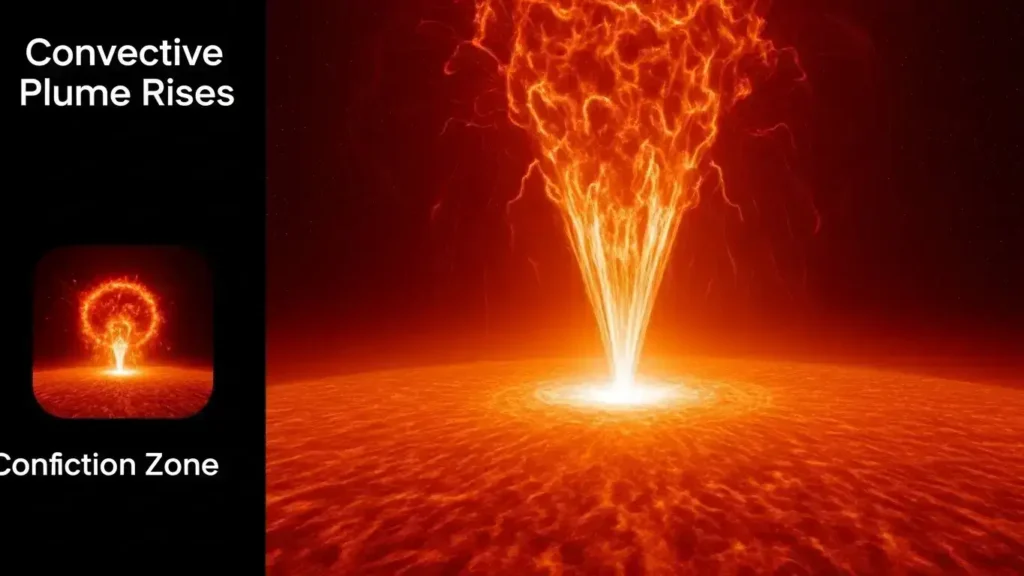
- The Convective Plume: A massive bubble of superheated gas rose from deep within the star’s interior to the surface.
- The Ejection: A shockwave, possibly aided by the star’s natural pulsation, blasted this chunk of the photosphere out into space.
- The Cooling Phase: As this gas moved away from the star, it cooled rapidly. In the vacuum of space, cooling gas condenses into solid particles—dust.
- The Great Dimming: This newly formed dust cloud drifted directly between Earth and Betelgeuse, blocking the visible light.
Timeline: Tracing the Betelgeuse Dimming Event
To visualize how Betelgeuse dimming explained by James Webb Telescope observations fits into history, let’s look at the chronological sequence of this stellar catastrophe.
📅 The Event Timeline
Phase 1: The Build-Up (Early 2019)
Deep inside Betelgeuse, a massive convective cell travels outward. The star expands simultaneously due to its pulsation cycle.
Phase 2: The Ejection (September – November 2019)
The convective plume breaches the surface. A piece of the photosphere is blasted into the star’s atmosphere.
Phase 3: Dust Formation (December 2019)
The ejected gas moves far enough away to cool down. It solidifies into a thick cloud of stardust.
Phase 4: The Great Dimming (January – February 2020)
From Earth’s perspective, the star appears to faint dramatically. The dust cloud is positioned perfectly in our line of sight.
Phase 5: Recovery and Aftermath (2021 – Present)
The dust clears. Telescopes like Hubble and JWST observe the star “recovering,” noting that its 400-day pulsation rhythm has been disrupted (like a ringing bell that was struck).
Is Betelgeuse Going Supernova Soon?
Whenever news breaks about Betelgeuse, the ultimate question follows: “When will it blow up?”
The Betelgeuse dimming explained by James Webb Telescope observations actually provides relief rather than alarm. The data suggests that the dimming was a superficial event—a surface injury—rather than a sign of core collapse.
However, the star is undeniably near the end of its life. “Near,” in astronomical terms, is relative. It could explode tomorrow, or it could take another 100,000 years. The Surface Mass Ejection shows us that red supergiants undergo violent mass loss phases before their final death, but the dimming event itself was not the “death rattle” many hoped it was.
What’s Next for Orion’s Brightest Shoulder?
The story isn’t over. Betelgeuse is still behaving strangely. Its photosphere is vibrating like a bowl of gelatin that has been flicked. Astronomers are using JWST to monitor:
- Recovery Speed: How long will it take for the star to return to its fundamental pulsation period?
- Dust Evolution: Tracking the ejected dust as it moves further into the interstellar medium.
By understanding Betelgeuse, we are effectively watching a real-time preview of how our universe enriches itself with heavy elements—the very building blocks of life.
Frequently Asked Questions
Q: Did the James Webb Telescope prove why Betelgeuse dimmed?
A: Yes, JWST’s infrared capabilities allow scientists to analyze the cooling dust cloud, confirming it was formed by a Surface Mass Ejection (SME) rather than just a cold spot on the star.
Q: Is Betelgeuse going to explode in our lifetime?
A: It is highly unlikely. The dimming was caused by dust blocking the light, not the core collapsing. The star likely has up to 100,000 years left.
Q: What is a Surface Mass Ejection (SME)?
A: An SME is a violent ejection of stellar material. Betelgeuse blasted a piece of its surface into space, which then cooled into the dust that obscured our view.