Discover the mysteries of Venus. Explore its thick atmosphere, volcanic surface, and retrograde rotation. Get the latest facts and mission updates in this complete guide.
Have you ever looked up at the night sky and noticed that one “star” shining brighter than all the others? That’s usually Venus. It’s often called Earth’s “sister planet” because they are almost the same size and mass. But don’t let that fool you. If they are sisters, Venus is the evil twin.
I remember seeing the first photos from the surface taken by the Soviet Venera landers years ago. They showed a yellow, crushing landscape that looked like something out of a sci-fi nightmare. It made me wonder: how did a planet so similar to ours go so wrong?
In this post, we’re going to figure out exactly what makes Venus tick. We’ll explore its crushing atmosphere, active volcanoes, and why it spins backward. Plus, we’ll look at the latest NASA and ESA missions that are finally going back to check it out. Let’s explore.
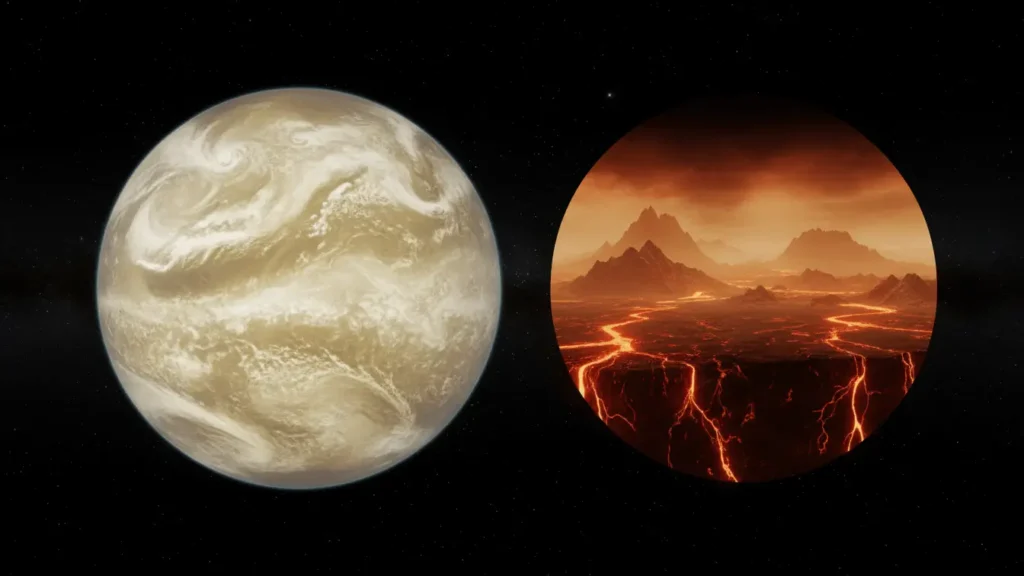
Table of Contents
- The Heavy Atmosphere: A Runaway Greenhouse
- Surface Features: Volcanoes and Lava Plains
- Retrograde Rotation: Why Venus Spins Backward
- Quick Facts: Temperature and Pressure Data
- Future Missions: DAVINCI and VERITAS
- Frequently Asked Questions
The Heavy Atmosphere: A Runaway Greenhouse ☁️
The first thing you need to know about Venus is that the air will kill you instantly. Unlike Earth’s nitrogen-oxygen mix, Venus boasts an atmosphere that is 96% carbon dioxide. This creates the most powerful greenhouse effect in the solar system.
Think about a hot summer day when you leave your car windows up. The heat gets trapped inside. Now, imagine that happening on a planetary scale, for billions of years, with a blanket of CO2 so thick it exerts 90 times the pressure of Earth’s atmosphere. Standing on the surface of Venus would feel like being 3,000 feet (900 meters) underwater. You wouldn’t just be roasted; you’d be crushed.
Sulfuric Acid Clouds
It gets worse. The clouds on Venus aren’t made of water vapor. They consist mostly of sulfuric acid. These thick yellowish clouds reflect about 70% of the sunlight that hits them, which is why Venus appears so bright in our sky. But they also trap the infrared heat radiating from the surface, preventing it from escaping into space.
💡 Did You Know?
Even though Mercury is closer to the Sun, Venus is actually hotter. The thick atmosphere on Venus traps heat so efficiently that surface temperatures stay consistent day and night, regardless of where you are on the planet.
Surface Features: Volcanoes and Lava Plains 🌋
Because of the dense clouds, we can’t see the surface of Venus with regular telescopes. We had to use radar mapping (like the Magellan mission in the 90s) to peek underneath. What we found was a world dominated by volcanism.
About 80% of the Venusian surface is covered by smooth, volcanic plains. It looks like the entire planet was “repaved” by massive lava flows sometime between 300 and 600 million years ago. This was a catastrophic event where heat built up inside the planet until the entire crust melted or was subducted, effectively wiping out any ancient craters.
Is Venus Still Active?
This is the big question scientists are trying to answer right now. Recent studies suggest that Venus is not a dead world. We have seen evidence of:
- Transient hot spots: Thermal anomalies that appear and disappear, suggesting active lava flows.
- Sulfur dioxide spikes: Changes in the atmosphere that could be caused by volcanic eruptions.
- Coronae: Strange, crown-like ring structures that form when hot material rises from underneath the crust.
Retrograde Rotation: Why Venus Spins Backward 🔄
If you could stand on Venus (and survive), you would notice something very strange about the sunrise. The Sun rises in the West and sets in the East. This is called retrograde rotation.
Most planets, including Earth, spin counter-clockwise. Venus spins clockwise. Scientists aren’t 100% sure why, but the leading theory is that a massive object smashed into Venus billions of years ago, knocking it off its axis or reversing its spin entirely.
Another weird fact? Venus spins incredibly slowly. It takes 243 Earth days for Venus to spin once on its axis, but it only takes 225 Earth days to orbit the Sun. That means a “day” on Venus is actually longer than a “year” on Venus.
Quick Facts: Temperature and Pressure Data 📊
Here is a quick breakdown of the extreme conditions you’ll find on our sister planet.
| Characteristic | Data / Description |
|---|---|
| Average Surface Temp | 475°C (900°F) – Hot enough to melt lead |
| Atmospheric Pressure | 92 bar (Similar to 900m underwater on Earth) |
| Day Length | 243 Earth Days |
| Year Length | 225 Earth Days |
| Gravity | 0.904 g (90% of Earth’s gravity) |
Future Missions: Back to Venus 🚀
For a long time, Mars got all the attention. It’s easier to land on, and it doesn’t melt your robot in an hour. But that is changing. NASA and ESA (European Space Agency) have approved three major missions to return to Venus in the late 2020s and early 2030s.
- DAVINCI (NASA): This mission will drop a probe through the atmosphere. It will taste the air, measuring noble gases to figure out if Venus ever had oceans. It will also take high-resolution photos of the descent.
- VERITAS (NASA): An orbiter that will map the surface in incredible detail using radar. It will help us create 3D maps and see if active volcanoes are changing the landscape right now.
- EnVision (ESA): Another orbiter that will look deeper underground using specialized radar to understand the planet’s inner core and geological history.
We are entering a new “Golden Age” of Venus exploration. Keep in mind that understanding Venus helps us understand Earth. If a planet so similar to ours can turn into a hellscape, we need to know why, so we can ensure Earth stays habitable.
If you have any questions about Venus or want to discuss the upcoming missions, drop a comment below. I’d love to hear your thoughts!
Frequently Asked Questions
Q: Is Venus hotter than Mercury?
A: Yes. Even though Mercury is closer to the Sun, it has no atmosphere to hold heat. Venus has a thick CO2 atmosphere that traps heat, making it the hottest planet in the solar system.
Q: Can humans survive on Venus?
A: Not on the surface. The pressure would crush you, the heat would burn you, and the air is toxic. However, some scientists have proposed “floating cities” in the upper atmosphere, where temperatures and pressures are surprisingly Earth-like.
Q: Why does Venus spin backwards?
A: The most accepted theory is that a large protoplanet collided with Venus during the early formation of the solar system, flipping its axis or reversing its rotation.