Why is Jupiter’s moon Europa the top candidate for alien life? Discover the massive subsurface ocean, tidal heating, and the vital missions exploring this icy world.
For centuries, the question, “Are we alone in the universe?” has driven human curiosity. For the longest time, our focus was squarely on Mars. But as our technology has improved, our gaze has shifted to a more mysterious and, frankly, more compelling target: the outer solar system. Specifically, we’re looking at a pale, icy moon orbiting Jupiter called Europa.
At a glance, Europa looks like a quiet, frozen billiard ball, crisscrossed with reddish-brown cracks. But this placid exterior hides one of the most profound secrets in our solar system: a global, liquid water ocean. This isn’t science fiction; it’s a conclusion built on decades of robust scientific data. This hidden ocean is estimated to contain more than twice the amount of water as all of Earth’s oceans combined.
This article explores the evidence-based reasons why Europa, a moon in the distant, frigid reaches of space, has surpassed all other candidates as our best hope for finding extraterrestrial life. We’ll dive into the forces that keep its ocean liquid, the clues on its fractured surface, and the cutting-edge missions, like the Europa Clipper, that are already on their way to unlock its secrets.
Table of Contents
- 1. What is Europa? A Gem Among the Galilean Moons
- 2. The Star of the Show: Europa’s Vast Subsurface Ocean
- 3. The Engine of Life: How Tidal Heating Warms Europa’s Ocean
- 4. The Three Pillars of Evidence for a Habitable Europa
- 5. The Next Frontier: The Europa Clipper and JUICE Missions
- 6. Conclusion: Why Europa Remains Our Best Bet for Finding Life
- 7. Frequently Asked Questions (FAQ) About Europa
1. What is Europa? A Gem Among the Galilean Moons
Europa is one of the four large “Galilean moons” of Jupiter, discovered by Galileo Galilei in 1610. These four moons—Io, Europa, Ganymede, and Callisto—were the first objects found to orbit another planet, and their discovery was a pivotal moment in astronomy.
A Surface of Ice and Mystery
Europa is slightly smaller than Earth’s Moon, but it couldn’t be more different. Its surface is made almost entirely of water ice and is one of the smoothest, brightest objects in the entire solar system. It has very few craters, which tells scientists that the surface is incredibly young in geological terms—only 20 to 180 million years old. This strongly implies it is being actively “repaved” or resurfaced by geological processes from below.
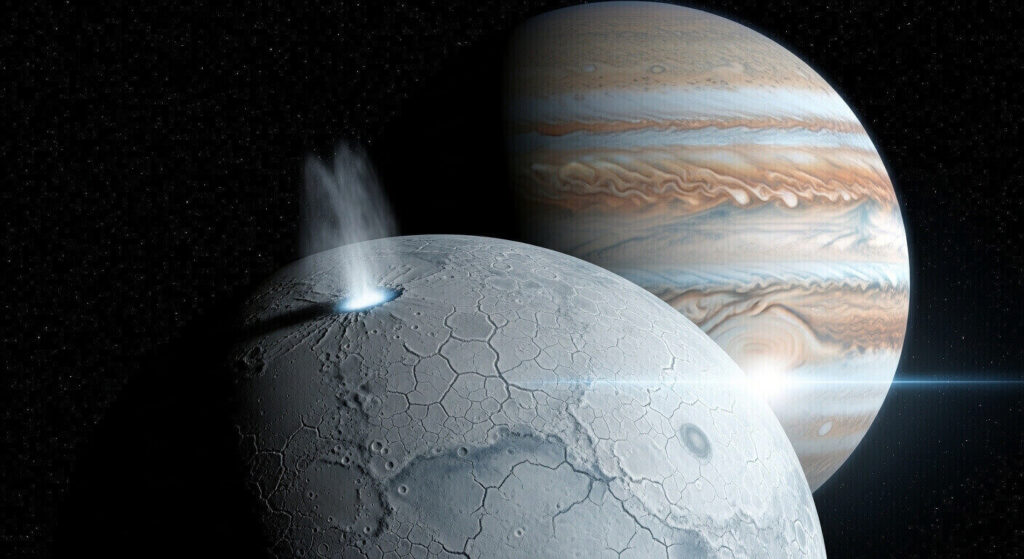
This young surface is covered in a stunning, chaotic network of long, linear cracks called lineae. Even more intriguing are the vast, jumbled regions known as “chaos terrain.” These areas look exactly as if massive sections of the ice crust were broken apart, floated around in a liquid or slush, and then refroze in a haphazard mess. This is a primary piece of visual evidence that a liquid layer exists just beneath the ice.
2. The Star of the Show: Europa’s Vast Subsurface Ocean
The main reason for all the excitement is the overwhelming evidence for Europa’s global subsurface ocean. While we haven’t drilled through the ice (yet!), the data collected by spacecraft, particularly NASA’s Galileo mission (1995-2003), provides a “smoking gun.”
The “Magnetic” Smoking Gun
The strongest evidence for Europa’s ocean comes from magnetism. Europa doesn’t have its own magnetic field the way Earth does. However, as it orbits Jupiter, it passes through Jupiter’s immensely powerful magnetic field. The Galileo probe detected that this interaction creates, or *induces*, a weak magnetic field *within* Europa.
For this to happen, Europa must contain a large layer of electrically conductive material. A solid ice-and-rock moon wouldn’t do this. The best—and really, the only—model that fits the data is a global ocean of salty, liquid water, which conducts electricity perfectly. This single discovery transformed Europa from an interesting ice ball into the prime target for astrobiology.
Water Plumes: A Window to the Ocean
As if a hidden ocean wasn’t enough, scientists using the Hubble Space Telescope (starting in 2012) have repeatedly observed faint evidence of water vapor plumes erupting from Europa’s southern hemisphere. These geysers are thought to be blasting water from the subsurface ocean as high as 200 km (125 miles) into space. This is incredibly exciting because it suggests we might be able to sample Europa’s ocean directly by flying through these plumes—no drilling required.
3. The Engine of Life: How Tidal Heating Warms Europa’s Ocean
A common question is: “How can there be liquid water so far from the Sun?” Europa’s surface is frigid, about -160°C (-260°F). The heat doesn’t come from the Sun; it comes from Jupiter.
This process is called tidal heating. Europa’s orbit around Jupiter isn’t perfectly circular; it’s a slight ellipse. This is due to the gravitational tug-of-war it experiences from the other large moons, Io and Ganymede (a relationship known as a Laplace resonance).
As Europa moves closer to and farther from Jupiter in its orbit, the planet’s massive gravity stretches and squeezes the entire moon. Imagine flexing a metal coat hanger back and forth—it gets hot. The same thing happens to Europa. This constant flexing generates enormous friction and heat within Europa’s rocky mantle and ice shell. This internal furnace is more than powerful enough to maintain a vast liquid ocean (estimated to be 60-150 km deep) beneath an ice shell (estimated 15-25 km thick).
4. The Three Pillars of Evidence for a Habitable Europa
Astrobiologists have a mantra for the ingredients life (as we know it) needs: Liquid Water, Essential Chemicals, and a Source of Energy. The reason Europa is so thrilling is that it appears to have all three.
Ingredient 1: Liquid Water (The Solvent)
Check. As established, Europa has a massive, global, salty ocean that has likely been stable for billions of years. This provides the perfect liquid environment for chemical reactions to occur.
Ingredient 2: Chemical Elements (The Building Blocks)
Check. The “building blocks of life” are the essential elements (Carbon, Hydrogen, Nitrogen, Oxygen, Phosphorus, Sulfur – CHNOPS). Europa’s ocean is believed to be in direct contact with a rocky seafloor. The tidal heating that warms the ocean would almost certainly create hydrothermal vents on that seafloor, just like on Earth. These vents would leach minerals and chemicals from the rock into the water, supplying it with these vital nutrients.
Ingredient 3: A Source of Energy (The Spark)
Check. This is the most crucial, and ingenious, part of Europa’s potential. Life can’t live on heat alone; it needs a *chemical* energy source to power its metabolism. Europa likely has two sources creating a life-sustaining chemical battery:
- From Above (Oxidants): Jupiter’s intense radiation belts constantly slam Europa’s icy surface. This radiation splits water (H₂O) molecules, creating “oxidants” like oxygen (O₂) and hydrogen peroxide. These chemicals could then be cycled down into the ocean from the surface.
- From Below (Reductants): The hydrothermal vents on the seafloor, meanwhile, would release “reductants” (chemicals like hydrogen and methane) from the moon’s core.
The mixing of oxidants from the top and reductants from the bottom creates a powerful chemical disequilibrium (a redox gradient). This is the *exact* type of energy that microbes at Earth’s deep-sea vents use to thrive, a process called chemosynthesis. They don’t need sunlight; they “eat” chemicals. This makes Europa an incredibly robust candidate for life.
5. The Next Frontier: The Europa Clipper and JUICE Missions
This is all fantastic theory, but we need more data. And it’s on the way.
NASA’s Europa Clipper: A Targeted Investigation
NASA‘s Europa Clipper mission is scheduled to launch in October 2024. It is the largest spacecraft NASA has ever built for a planetary mission. Because Europa sits in Jupiter’s lethal radiation belt, Clipper won’t orbit Europa directly. Instead, it will orbit Jupiter in a long, looping path, allowing it to perform dozens of close, high-speed flybys of Europa, dipping in and out of the most intense radiation.
Its nine advanced instruments are designed to answer our biggest questions:
- REASON (Radar): An ice-penetrating radar that will, for the first time, measure the exact thickness of the ice shell and confirm the ocean’s depth and salinity.
- E-THEMIS (Thermal Camera): A heat detector that will scan the surface for “hot spots,” which could be active plumes or areas where the ocean is close to the surface.
- SUDA & MASPEX (Spectrometers): These instruments will “taste” the faint atmosphere and any plume material they fly through, searching for the chemical signatures of life (like organic molecules).
ESA’s JUICE: A Broader Look at Jupiter’s Moons
We also have help from the European Space Agency (ESA). Their JUICE (Jupiter Icy Moons Explorer) mission successfully launched in April 2023 and is currently en route. While JUICE’s primary target is Ganymede (which it will eventually orbit), it will also perform two crucial flybys of Europa. Its instruments, including its own radar (RIME), will provide vital, complementary data to help us understand all the icy moons as a system.
6. Conclusion: Why Europa Remains Our Best Bet for Finding Life
The search for life is a search for habitable environments. While Mars is a fascinating desert world that *may* have had life, Europa is a world that has a stable, massive, liquid water ocean *right now*. It is protected from radiation by a thick ice shell and is powered by an internal chemical furnace that we know supports entire ecosystems on Earth.
Europa offers the tantalizing possibility that life may have started and evolved in a place completely alien to our sunlit world. The answers provided by Europa Clipper and JUICE in the early 2030s won’t just be about one moon—they could fundamentally rewrite our understanding of biology and our place in the cosmos. Europa isn’t just a place to look for life; it’s a place that challenges the very definition of what “life” requires.
7. Frequently Asked Questions (FAQ) About Europa
Q: Is there really a liquid ocean on Europa, or is it just a theory?
A: While we haven’t seen it directly, it is our most supported scientific conclusion. The key evidence is the induced magnetic field detected by the Galileo spacecraft. This phenomenon requires a global, salty, conductive liquid layer (an ocean) to exist. This, combined with the “chaos terrain” surface geology and evidence of water plumes, makes the ocean’s existence the consensus scientific view.
Q: How cold is Europa’s surface if the ocean is warm?
A: The surface is extremely cold, averaging about -160°C (-260°F). The ocean below is kept liquid not by the Sun, but by internal heat generated from tidal heating—friction created by Jupiter’s immense gravitational squeezing and pulling as Europa orbits.
Q: What kind of extraterrestrial life could exist on Europa?
A: Given the environment, scientists are not looking for complex creatures. If life exists, it is most likely microbial (single-celled organisms). This life would be similar to Earth’s “extremophiles,” specifically organisms that practice chemosynthesis. They would live in total darkness, likely clustered around hydrothermal vents on the seafloor, and get their energy from chemical reactions, not sunlight.
Q: What is the difference between NASA’s Europa Clipper and ESA’s JUICE?
A: They are complementary missions. NASA’s Europa Clipper (launching Oct 2024) is a dedicated mission to study only Europa’s habitability and will perform dozens of close flybys. ESA’s JUICE (launched Apr 2023) is a broader mission to study Jupiter and all its icy moons (Europa, Ganymede, and Callisto), with a primary focus on orbiting Ganymede. JUICE will only perform two flybys of Europa, but its data will help us understand Europa in the context of its sibling moons.
Q: When will we know if there is life on Europa?
A: This is a multi-step process. Europa Clipper, arriving in 2030, is designed to assess habitability—that is, if the *conditions* for life are right (ocean depth, chemistry, energy). It is not designed to find life itself. However, by tasting the plumes and mapping the ice, Clipper will identify the best locations for a future lander mission. That future mission would be the one to actually drill into the ice and provide a definitive “yes” or “no.”