Is Betelgeuse hiding a secret? Discover how James Webb Space Telescope is studying the Betelgeuse companion star using infrared spectrum analysis to solve the mystery of the Great Dimming.
If you have been looking up at the night sky over the last few years, you might have noticed something strange about the shoulder of Orion. Betelgeuse, the bright red supergiant that defines the winter sky, has been acting out. First came the “Great Dimming” of 2019, where it famously lost brightness, leading many to speculate it was about to go supernova.
However, the plot has thickened. New research suggests the culprit isn’t just internal instability or a cloud of dust—it might be a hidden partner. Enter the “Betelbuddy” hypothesis. Astronomers now believe a companion star is orbiting this giant, crashing through its dust clouds and causing these rhythmic light fluctuations.
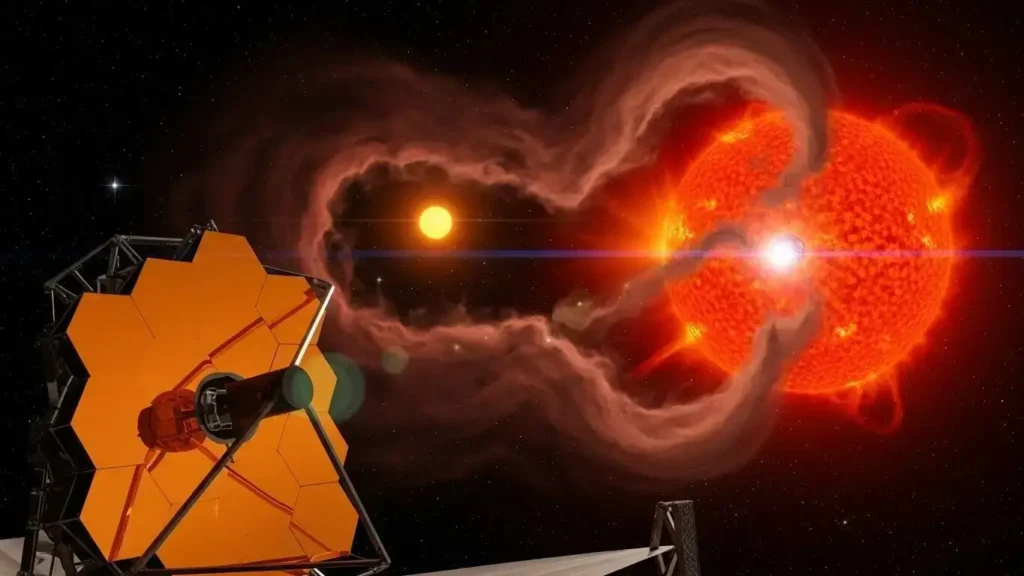
But finding a faint star next to one of the brightest objects in the sky is like trying to spot a firefly buzzing around a lighthouse beam. This is where NASA’s heavy hitter comes in. Today, we are diving deep into how James Webb Space Telescope is studying Betelgeuse companion candidates, utilizing cutting-edge infrared tech to rewrite stellar physics.
Table of Contents
- 1. The Mystery of the “Great Dimming” and the Companion Star Theory
- 2. How James Webb Space Telescope is Studying Betelgeuse Companion
- 3. Unlocking Secrets with Infrared Spectrum Analysis
- 4. Step-by-Step: How Astronomers Detect a Hidden “Betelbuddy”
- 5. Why Confirming the Companion Star Matters
- 6. Frequently Asked Questions (FAQ)
The Mystery of the “Great Dimming” and the Companion Star Theory
To understand why the James Webb Space Telescope (JWST) is pointing its mirrors at Orion, we have to look at the data. Betelgeuse pulsates. It has a primary heartbeat of about 400 days where it brightens and dims. But there is another cycle—a “Long Secondary Period” (LSP) that lasts about 2,170 days (roughly 6 years).
For a long time, scientists argued this LSP was caused by giant convection cells (huge bubbles of hot plasma) on the star’s surface. However, a landmark study led by the Flatiron Institute suggests these bubbles can’t explain the timing. The only model that fits the math perfectly? A companion star.
This hypothetical star, dubbed “Alpha Orionis B,” acts like a celestial snowplow. As it orbits, it likely pushes away dust, creating a window that changes how much light reaches Earth. While ground-based telescopes gave us the clue, we need space-based precision to see the reality.
How James Webb Space Telescope is Studying Betelgeuse Companion
This is where the engineering marvel of JWST shines. Studying a companion star next to a red supergiant is notoriously difficult due to the “contrast ratio.” Betelgeuse is roughly 100,000 times brighter than the sun, and any companion would be significantly dimmer, easily lost in the glare.
JWST tackles this with two primary advantages: unprecedented resolution and Mid-Infrared Instrument (MIRI) capabilities.
Piercing Through the Dust with MIRI
Visible light is easily scattered by the massive clouds of dust Betelgeuse coughs out. If we look in visible light (like with Hubble), the dust obscures the details. JWST observes in the infrared spectrum.
Infrared light has longer wavelengths that pass right through dust clouds. This allows JWST to see “inside” the dusty envelope surrounding the star. If a companion star is heating up the surrounding dust or carving a physical wake through the material, MIRI can detect the thermal signature of that interaction, effectively highlighting the companion’s path.
Unlocking Secrets with Infrared Spectrum Analysis
The phrase “How James Webb Space Telescope is studying Betelgeuse companion” isn’t just about taking a photograph; it’s about spectroscopy. JWST uses its Near-Infrared Spectrograph (NIRSpec) to break down the light coming from the system into its component colors (spectrum).
Here is how this validates the existence of a companion star:
- Doppler Shifts: As the companion orbits, it tugs on Betelgeuse. This gravitational wobble causes the light from the primary star to shift slightly towards red or blue. JWST’s sensitivity can detect these minute shifts, confirming the mass of the hidden partner.
- Chemical Fingerprinting: If the companion is stripping material off Betelgeuse, the chemical composition of the surrounding gas will change. Infrared spectrum analysis can identify specific molecules (like carbon monoxide or water vapor) that are being excited by the companion’s gravity or radiation.
Step-by-Step: How Astronomers Detect a Hidden “Betelbuddy”
You might be wondering how NASA and astronomers put this puzzle together. It is a methodical process that combines historical data with new JWST observations. Here is a guide to the discovery process.
Step 1: Analyzing the Light Curves
Astronomers first reviewed over 100 years of data. They identified the primary pulse (heartbeat) and the secondary, longer dimming event. They ruled out cosmic dust clouds passing in front of the star randomly; the timing was too consistent.
Step 2: Simulation and Modeling
Using computer models, teams like those at the Flatiron Institute simulated various scenarios. The only scenario that matched the 2,170-day cycle was a companion star with a mass roughly up to twice that of our Sun, orbiting at a specific distance.
Step 3: Direct Imaging Attempt with JWST
This is the current phase. Astronomers use a technique called Non-Redundant Masking (NRM) or coronagraphy on JWST. This effectively “blocks out” the blinding light of Betelgeuse itself to reveal faint objects nearby. Think of it like putting your hand up to block the sun so you can see a plane flying near it.
Step 4: Confirmation via Astrometry
Finally, by tracking the position of the “photocenter” (the center of light) over time, JWST can see if the main star is physically wobbling in space. A confirmed wobble is the smoking gun for a companion star.
Why This Discovery Matters for Stellar Physics
Why should we care if Betelgeuse has a buddy? Because it changes everything we know about how red supergiants die. Betelgeuse is destined to go supernova. If it has a companion star, that companion could be influencing the timing of the explosion, the shape of the nebula it creates, and even the chemical elements it scatters into the universe.
Furthermore, understanding how James Webb Space Telescope is studying Betelgeuse companion candidates provides a blueprint for studying other massive stars. It proves that even the most well-known stars in our sky still hold secrets waiting to be uncovered by the infrared gaze of JWST.
Frequently Asked Questions (FAQ)
Q: Has JWST officially taken a picture of the Betelgeuse companion?
A: As of the latest updates, JWST is being used to gather data to confirm the companion. While high-resolution data is being analyzed, a definitive “portrait” of the companion separate from the main star is incredibly difficult to produce due to the extreme brightness of Betelgeuse.
Q: What is the Betelgeuse companion star called?
A: Astronomers informally refer to it as the “Betelbuddy,” but scientifically it would likely be designated as Alpha Orionis B.
Q: Will the companion star save Betelgeuse from exploding?
A: No. Betelgeuse is a red supergiant at the end of its life cycle. The companion star affects the light we see and potentially the dust distribution, but it cannot stop the nuclear fusion processes inside Betelgeuse that will eventually lead to a supernova.