Mercury is often the most overlooked planet in our cosmic neighborhood. Overshadowed by the brilliance of Venus or the potential habitability of Mars, this small, cratered world holds some of the most extreme secrets in the solar system. It isn’t just a hot rock floating near the Sun; it is a planet of extremes, scientific anomalies, and geological wonders.
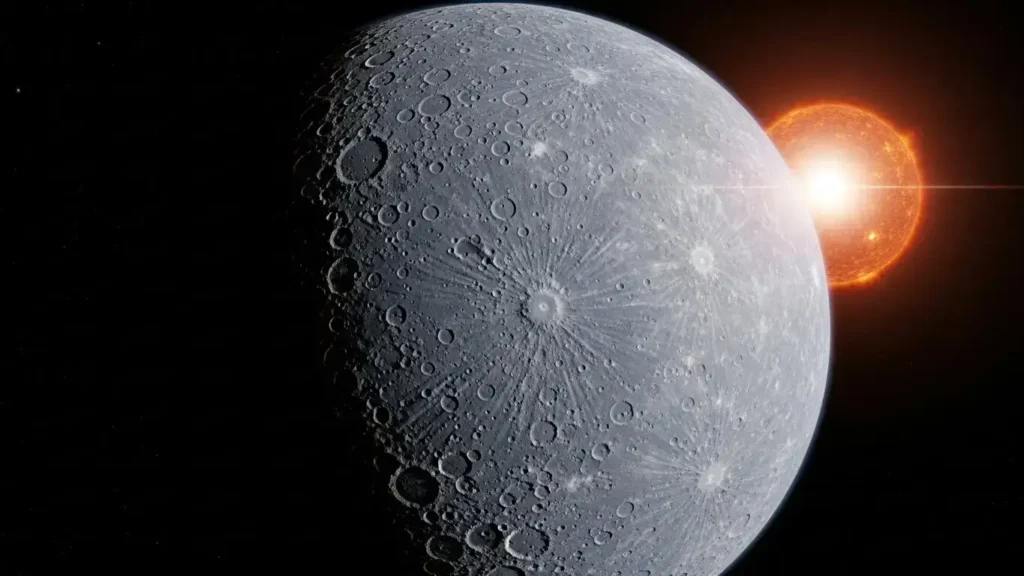
If you are looking for in-depth Mercury planet facts, you have come to the right place. From understanding why Mercury has no moons to analyzing its extreme temperatures, this guide covers everything you need to know about the closest planet to our Sun.
Table of Contents
- 1. The Position of Mercury in the Solar System
- 2. Extreme Temperatures on Mercury: A World of Fire and Ice
- 3. Why Does Mercury Have No Moons?
- 4. Mercury’s Surface and Geological Facts
- 5. Key Facts About Mercury Planet (Data Summary)
- 6. NASA and International Missions to Mercury
- 7. Frequently Asked Questions (FAQ)
1. The Position of Mercury in the Solar System
Mercury holds the title of the innermost planet. Its solar system position dictates almost everything about its behavior, from its scorching days to its frantic orbit. Being the closest planet to the Sun, it orbits at an average distance of roughly 36 million miles (58 million kilometers). However, this distance varies wildly because Mercury has the most eccentric (oval-shaped) orbit of all the planets.
The Swift Planet’s Orbit
Named after the Roman messenger god known for speed, Mercury lives up to its name. It speeds around the Sun at a staggering 29 miles (47 kilometers) per second. This speed means a year on Mercury—one complete orbit around the Sun—takes only 88 Earth days. [Image of Mercury’s orbit around the Sun]
However, while its years are short, its days are incredibly long. For a long time, astronomers believed Mercury was tidally locked (always showing the same face to the Sun). We now know that Mercury rotates in a unique 3:2 spin-orbit resonance. For every three times Mercury spins on its axis, it orbits the Sun twice. This means a single “solar day” (from sunrise to sunrise) on Mercury lasts 176 Earth days—twice as long as its year!
2. Extreme Temperatures on Mercury: A World of Fire and Ice
One of the most common misconceptions is that Mercury is the hottest planet because it is closest to the Sun. That title actually belongs to Venus due to its thick atmosphere. However, Mercury definitely wins the award for the most extreme temperature fluctuations in the solar system.
Why is Mercury Not the Hottest Planet?
To understand Mercury’s temperature, you have to understand its atmosphere—or lack thereof. Mercury possesses a very thin exosphere made of atoms blasted off the surface by the solar wind and striking meteoroids. This exosphere is too thin to trap heat.
Here is the reality of Mercury’s extreme temperatures:
- Daytime Highs: Facing the Sun, temperatures can soar to a scorching 800°F (430°C). This is hot enough to melt lead.
- Nighttime Lows: Because there is no atmosphere to retain that heat, as soon as the sun sets, the temperature plummets to a freezing -290°F (-180°C).
This swing of over 1,000 degrees Fahrenheit creates a harsh environment that makes colonization or extended exploration incredibly difficult for spacecraft electronics.
Wait, Ice on Mercury?
Perhaps the most ironic fact about Mercury is that despite these hellish daytime temperatures, the planet hosts water ice. NASA’s MESSENGER mission confirmed that deep craters at Mercury’s north and south poles remain in permanent shadow. These “cold traps” preserve water ice that likely arrived via comets and meteorites billions of years ago. It is a stark reminder of how complex this small world truly is.
3. Why Does Mercury Have No Moons?
When we look at the outer planets like Jupiter and Saturn, they boast dozens of moons. Even Earth and Mars have satellites. This leads to a very common question in AEO (Answer Engine Optimization) searches: “Why does Mercury have no moons?”
The answer lies in gravity and Mercury’s position in the solar system relative to the Sun. Here is the scientific explanation simplified:
The Hill Sphere Problem
For a planet to hold onto a moon, it needs a region of space where its gravity dominates over the Sun’s gravity. This region is called the Hill Sphere. Because Mercury is so close to the massive gravitational pull of the Sun and is relatively small (low gravity), its Hill Sphere is very small.
If Mercury did have a moon in the past, one of two things likely happened:
- If the moon was too far away, the Sun’s gravity would have pulled it away from Mercury’s orbit.
- If the moon was too close, it would have eventually crashed into Mercury due to tidal decay.
This is the same reason Venus possesses no moons. The gravitational competition with the Sun is simply too fierce so close to the star.
4. Mercury’s Surface and Geological Facts
At first glance, photos of Mercury look remarkably like Earth’s Moon. It is a grey, barren world heavily scarred by impact craters. However, a closer look reveals a unique geological history.
The Caloris Basin
Mercury is home to one of the largest impact basins in the solar system, the Caloris Basin. Measuring about 960 miles (1,550 km) in diameter, this scar was left by a massive asteroid impact early in the solar system’s history. The impact was so violent that it sent shockwaves through the entire planet, creating chaotic terrain on the exact opposite side of Mercury.
The Shrinking Planet
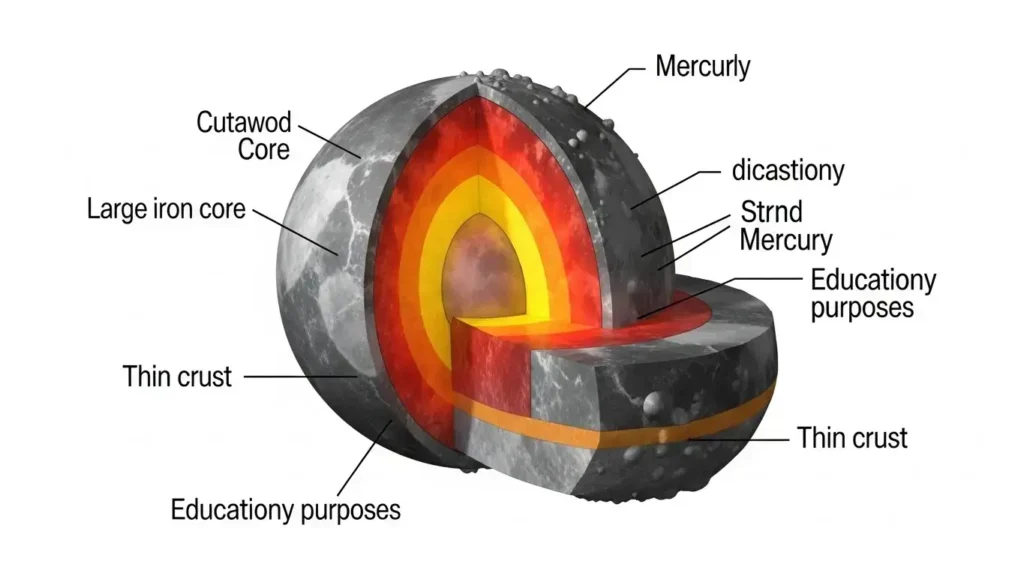
One of the most fascinating Mercury planet facts is that the planet is shrinking. Mercury has a massive iron core—making up about 85% of its radius—which is slowly cooling. As the core cools, it contracts. This causes the planet’s crust to buckle and wrinkle, creating massive cliffs called lobate scarps. These cliffs can be hundreds of miles long and over a mile high. This tells scientists that Mercury is still technically geologically active as it continues to cool and shrink.
5. Key Facts About Mercury Planet (Data Summary)
For students and enthusiasts looking for quick data, here is a summary of the essential facts about Mercury:
- Diameter: 3,032 miles (4,879 km) — slightly larger than Earth’s Moon.
- Distance from Sun: ~36 million miles (58 million km).
- Year Length: 88 Earth days.
- Day Length: 59 Earth days (rotation), 176 Earth days (solar cycle).
- Moons: None (0).
- Rings: None (0).
- Atmosphere: Thin exosphere (Oxygen, Sodium, Hydrogen, Helium, Potassium).
- Gravity: 38% of Earth’s gravity (A 100lb person would weigh 38lbs on Mercury).
6. NASA and International Missions to Mercury
Due to the intense heat and the speed required to reach it, Mercury is difficult to visit. However, human ingenuity has allowed us to map and study this extreme world.
Mariner 10 (1974-1975)
The first spacecraft to visit Mercury was NASA’s Mariner 10. It performed three flybys and mapped about 45% of the surface, confirming the existence of a magnetic field (a surprise to scientists, given Mercury’s small size).
MESSENGER (2004-2015)
The MESSENGER mission revolutionized our understanding of Mercury facts. It was the first probe to orbit the planet. It confirmed the existence of water ice at the poles, analyzed the exosphere, and provided 100% mapping of the surface. It ended its mission by crashing into the surface in 2015.
BepiColombo (Current Mission)
The latest chapter in exploration is BepiColombo, a joint mission between the European Space Agency (ESA) and the Japan Aerospace Exploration Agency (JAXA). Launched in 2018, it is performing flybys and is scheduled to settle into orbit around Mercury in late 2025. This mission aims to study Mercury’s magnetosphere and internal structure in unprecedented detail.
Understanding Mercury helps us understand the formation of rocky planets not just in our solar system, but across the galaxy. As we uncover more about its shrinking surface and icy poles, Mercury continues to prove that even the smallest planets can hold the biggest surprises.

7. Frequently Asked Questions (FAQ)
Why does Mercury have no moons?
Mercury has no moons primarily due to its close proximity to the Sun and its small size. Its gravity is too weak to hold onto a moon against the massive gravitational pull of the Sun. Any moon too far away would be pulled into a solar orbit, and any moon too close would eventually crash into Mercury.
What are the extreme temperatures on Mercury?
Mercury experiences extreme fluctuations. Daytime temperatures reach up to 800°F (430°C), while nighttime temperatures plummet to -290°F (-180°C) because there is no atmosphere to trap the heat.
Is Mercury the hottest planet in the solar system?
No. Even though it is closest to the Sun, Venus is hotter. Venus has a thick atmosphere that traps heat, while Mercury has almost no atmosphere, allowing heat to escape into space.
Can humans survive on Mercury?
Currently, no. The extreme temperatures, intense solar radiation, and lack of breathable atmosphere make it impossible for humans to survive on the surface without advanced technology.