Explore the Sun: essential facts on composition, temperature, and size. Discover Solar Cycle 25 trends for 2026 and the Sun’s vital role in our Solar System.
When you look up at the sky (safely, of course), it is easy to take that glowing orb for granted. Yet, the Sun is a dynamic, magnetic, and explosive celestial powerhouse that dictates the rhythm of our solar system. It is not just a light bulb in the sky; it is a raging nuclear reactor that sustains all life on Earth.
As we navigate through 2026, our understanding of the Sun is evolving faster than ever. Following the intense solar maximum of Solar Cycle 25 in late 2024 and 2025, we are now entering a fascinating phase of high-energy solar activity that continues to impact space weather and illuminate our night skies with auroras. Thanks to missions like the Parker Solar Probe and the James Webb Space Telescope (JWST), we are peeling back the layers of our star’s mysteries.
This guide goes beyond basic trivia. We will dive deep into the Sun’s composition, temperature, size, and its evolving role in the cosmos, providing you with the most accurate, up-to-date science available.
Table of Contents
- 1. How Big is the Sun? Size and Scale
- 2. What Is the Sun Made Of? Composition and Structure
- 3. How Hot Is the Sun? From Core to Corona
- 4. The Engine: Nuclear Fusion Explained
- 5. Solar Cycle 25 Update: What to Expect in 2026
- 6. The Sun’s Role in the Solar System
- 7. Touching the Sun: Modern Exploration
- 8. Frequently Asked Questions (FAQ)
How Big is the Sun? Size and Scale
To understand our place in the universe, we first have to grasp the sheer magnitude of our star. The Sun is a G-type main-sequence star (specifically G2V), often called a “Yellow Dwarf,” though that name is misleadingly small.
Mass and Volume
The Sun contains 99.86% of the total mass of the entire Solar System. Jupiter, Saturn, and all the other planets combined are merely “rounding errors” compared to the Sun. It is about 109 times wider than Earth. To visualize this: if the Sun were a hollow basketball, you could fit approximately 1.3 million Earths inside it.
- Diameter: Approx. 864,000 miles (1.39 million kilometers).
- Distance from Earth: Approx. 93 million miles (150 million kilometers), defined as 1 Astronomical Unit (AU).
What Is the Sun Made Of? Composition and Structure
The Sun is not a solid body like the Earth; it is a giant ball of plasma—hot, ionized gas.
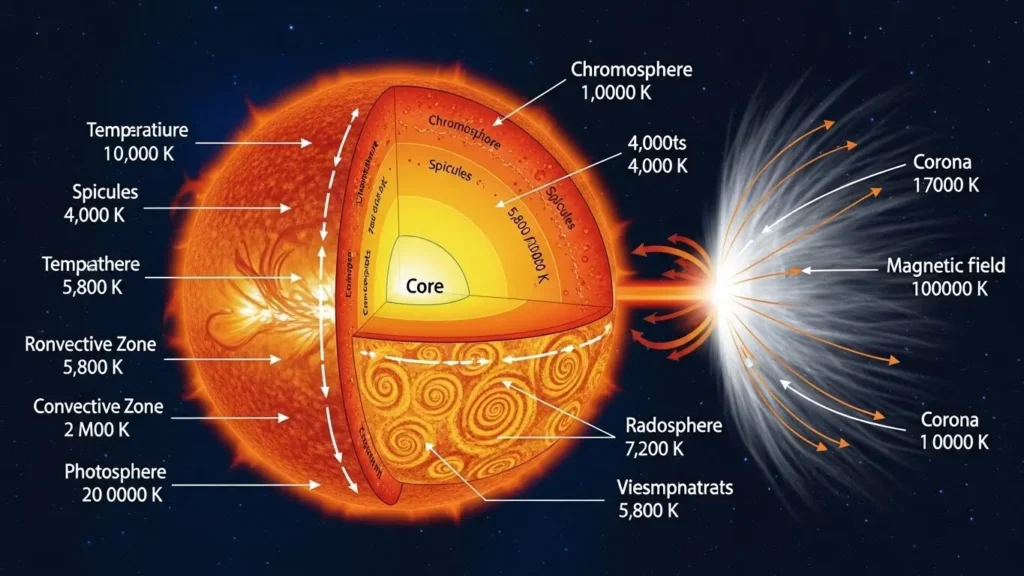
A cross-section of the Sun’s internal and external layers.

Elemental Composition
In terms of mass, the Sun is roughly:
- 73% Hydrogen: The primary fuel for fusion.
- 25% Helium: The byproduct of fusion.
- 2% Heavier Elements: Including oxygen, carbon, neon, and iron. Astronomers call anything heavier than helium a “metal.”
The Sun’s Layers
1. The Core: The powerhouse where nuclear fusion occurs.
2. Radiative Zone: Energy travels outward as photons, bouncing around for up to 170,000 years before escaping.
3. Convective Zone: Hot plasma rises, cools, and sinks, creating currents similar to a boiling pot of soup.
4. Photosphere: The visible “surface” we see. This is where sunspots appear.
5. Chromosphere: A layer above the photosphere, often glowing red during eclipses.
6. Corona: The tenuous, outermost atmosphere that extends millions of miles into space.
How Hot Is the Sun? From Core to Corona
The temperature of the Sun varies drastically depending on where you measure. It is not a uniform heat source.
The Core: This is the hottest part, reaching a staggering 27 million°F (15 million°C). This immense heat and pressure are necessary to force hydrogen atoms to fuse.
The Surface (Photosphere): By the time energy reaches the surface, it has cooled significantly to about 10,000°F (5,500°C). While “cool” compared to the core, it is still hot enough to melt diamonds instantly.
The Mystery of the Corona: Here is where physics gets strange. As you move away from the surface into the outer atmosphere (Corona), the temperature skyrockets back up to 1.8 to 3.6 million°F. This is known as the “Coronal Heating Problem.” Recent data from the Parker Solar Probe suggests that magnetic waves (Alfvén waves) and “nanoflares” are responsible for superheating this outer layer.
The Engine: Nuclear Fusion Explained
The Sun does not “burn” like a campfire; it fuses. In the core, gravity crushes hydrogen atoms together so violently that they merge to form helium. This process is called the Proton-Proton Chain.
According to Einstein’s famous equation, E=mc², a tiny amount of mass is lost during this fusion and converted into a massive amount of energy. Every second, the Sun converts 600 million tons of hydrogen into helium, releasing energy equivalent to exploding billions of nuclear bombs. This energy eventually reaches Earth as sunlight and heat.
Solar Cycle 25 Update: What to Expect in 2026
The Sun goes through an 11-year cycle of activity, shifting from quiet (solar minimum) to active (solar maximum). We are currently in Solar Cycle 25.
[IMAGE: solar cycle 25 sunspot activity 2026 graph – Chart showing the peak in 2024/2025 and the slight decline curve into 2026]
Solar Cycle 25 prediction vs. observed activity.

Status Check: Post-Peak Activity
Solar Cycle 25 was predicted to be mild, but it has outperformed expectations. The “Solar Maximum”—the period of highest sunspot activity—likely occurred between late 2024 and early 2025.
What 2026 Looks Like:
As we move through 2026, we are entering the declining phase. However, do not let that fool you. Historically, some of the most massive solar storms and Coronal Mass Ejections (CMEs) occur just after the peak.
- Auroras: Expect continued, vibrant displays of the Northern and Southern Lights, potentially visible at lower latitudes than usual.
- Space Weather: Satellite operators and power grids remain on high alert. The magnetic field of the Sun is currently flipping (the poles reverse every 11 years), creating complex magnetic knots that can launch flares toward Earth.
The Sun’s Role in the Solar System
The Sun is the anchor of our neighborhood. Its massive gravity holds everything from giant Jupiter to the smallest asteroid in orbit.
The Heliosphere
The Sun blows a constant wind of charged particles called the Solar Wind. This creates a bubble called the Heliosphere, which extends far beyond Pluto. This bubble acts as a shield, protecting the planets from high-energy cosmic radiation originating from outside our solar system.
Touching the Sun: Modern Exploration
We are living in the golden age of solar physics.
NASA’s Parker Solar Probe
Launched in 2018, this spacecraft is making history. By 2025 and 2026, it is performing its closest approaches, effectively “touching” the Sun’s atmosphere. It is flying through the corona at speeds exceeding 430,000 mph, sending back data that rewrites textbooks on solar wind and magnetic fields.
Solar Orbiter (ESA/NASA)
This mission gives us our first-ever look at the Sun’s poles—regions crucial for understanding the solar magnetic cycle.
Conclusion
The Sun is more than just a timekeeper or a source of warmth. It is a complex, magnetic beast that connects directly to the Earth’s environment. From the hydrogen fusing in its core to the auroras painting our skies in 2026, the Sun remains the most significant object in our lives.
As we continue to monitor Solar Cycle 25 and analyze data from the Parker Solar Probe, we are reminded that we live in the atmosphere of a star. Understanding the Sun is not just astronomy; it is essential for protecting our technology-dependent society.
Frequently Asked Questions (FAQ)
Q: How old is the Sun?
A: The Sun is approximately 4.6 billion years old. It is currently in the middle of its life cycle and will continue to burn hydrogen for another 5 billion years before swelling into a Red Giant.
Q: Will Solar Cycle 25 cause problems in 2026?
A: While the peak activity occurred around late 2024, the declining phase in 2026 often produces strong solar flares. These can cause radio blackouts, disrupt GPS, and impact satellite operations, though catastrophic damage is rare.
Q: Why is the Sun’s atmosphere hotter than its surface?
A: This is known as the “Coronal Heating Problem.” Scientists believe it is caused by magnetic reconnection and magnetic waves transporting energy from the surface outward, superheating the corona.
Q: How long does it take sunlight to reach Earth?
A: It takes photons approximately 8 minutes and 20 seconds to travel from the Sun to Earth.