SpaceX’s Starship Flight 11 marked a perfect end to its first era. But the real story is what’s next: the V3 rocket, orbital refueling, and the final push for Mars.
This week, we witnessed what felt like the perfect sendoff for the first era of Starbase. Starship’s Flight 11 was the closest thing to perfection we’ve ever seen from a test flight. It’s almost hard to believe how far SpaceX has come. But as incredible as that launch was, the biggest story of the day isn’t just the success of Flight 11; it’s the profound promise of what comes next. This launch wasn’t a finale; it was a graduation. Now, the real journey to Mars begins.
We’re moving from the rocket we’ve come to know and love to a completely new generation of hardware. Flight 12 will feature a new ship, a new booster, and even a new launchpad. Let’s break down the flawless final flight of Starship’s first chapter and explore the revolutionary V3 system that will define the next era of space exploration.
Table of Contents
- Flight 11: A Picture-Perfect Finale for SpaceX
- The Booster’s New Landing Trick: A Test for the Future
- Starship’s Re-entry: Dancing Through the Atmosphere
- Enter the V3: The Next Generation of SpaceX Power
- Super Heavy V3: More Power, Smarter Design for Mars
- Starship V3: The Vehicle for Mars and Beyond
- The Road to Mars: Orbital Refueling Explained
- Stage Zero Evolves: A New Tower for a New Rocket
- Conclusion: The End of an Era, The Start of a Journey
- Frequently Asked Questions (FAQ)
Flight 11: A Picture-Perfect Finale for SpaceX
Everything about Flight 11 felt… smooth. The launch vehicle was powered by a previously flown Super Heavy booster, the very same one we saw launch Flight 8 back in March 2025. This is a huge testament to SpaceX’s progress in reusability. The booster was returned to the Starfactory, refurbished (which included replacing some engines), and sent back to the pad. Amazingly, 24 of the original Raptor engines from Flight 8 were still on this booster, and they performed beautifully.
The launch itself was exactly what we’ve come to expect from a successful Starship ascent: a stunning climb into a clear blue evening sky, followed by a clean hot-stage separation, and the booster’s graceful return to the surface.
The Booster’s New Landing Trick: A Test for the Future
This time, SpaceX had a new experiment up its sleeve for the booster’s landing burn. Like the previous two flights, this was never intended to be a tower catch. Instead, they brought the rocket down over the water, giving them the freedom to try something new without risk. This is how real engineering progress is made: testing in the field.
Instead of the usual procedure—starting the landing burn with 13 engines and then dropping to 3—SpaceX tried a new sequence. They went from 13 engines, to 5, and then down to 3 engines right at the very end. Why? SpaceX says this is a test run of the new procedure for the next-generation V3 booster. This 13-5-3 sequence uses less fuel for the landing burn, which means more precious propellant can be dedicated to liftoff, ultimately increasing payload capacity.
Starship’s Re-entry: Dancing Through the Atmosphere
Meanwhile, in space, the Starship vehicle flawlessly made its way onto its suborbital trajectory. The main goal here was simple: maintain control and don’t blow up. Not only did Starship maintain perfect control during its coast phase, but it also gave us a stunning demonstration of what those wing flaps can do when they don’t melt away during re-entry.
At around 58 minutes into the flight, at an altitude of 50 km, Starship began its first-ever planned dynamic banking maneuver. This was their first attempt at changing course in mid-flight. Instead of just falling in a straight arc, the ship was actively steered in a “semicircle” path as it descended. This is an absolutely critical test for future landings. When the ship returns to its launch site, it needs to be able to steer itself from its re-entry point (perhaps over Mexico) all the way to Starbase, Texas.
Then, just above the ground, we saw it practice its final move: the twist. At T+1 hour and 5 minutes, the ship spun itself 180 degrees to align with the (hypothetical) tower and catch arms, before making its final downward flip and igniting its engines. It was a beautiful sight, ending in a soft splashdown right on target before tipping over and exploding, as planned. It was the last time a Starship launch will ever look like that.
Enter the V3: The Next Generation of SpaceX Power
Flight 12 is where the new chapter begins. Everything is changing: the ship, the booster, and the launchpad. This is the hardware designed not just for orbit, but for the Moon and Mars.
Super Heavy V3: More Power, Smarter Design for Mars
The next iteration of the Super Heavy booster brings a new look and a lot more power. It will still have 33 engines, but these will be the new Raptor V3s. These engines increase thrust from 230 tons to 280 tons each, but more importantly, they feature a dramatically simplified design. Nearly every hose and wire from the V2 engine has been brought inside the casing. This is not only easier to build, but it’s far more reliable in flight, with less external “spaghetti” exposed to the violence of launch and re-entry.
Here are the other key changes to the booster:
- Stretched Tanks: The booster is slightly longer to accommodate larger fuel tanks to feed those hungrier Raptor 3 engines.
- New Transfer Tube: A massive internal tube, about the size of a Falcon 9 booster itself, will allow liquid methane to flow from the top tank down to the engine bay.
- Three Grid Fins: SpaceX has removed one grid fin, going from four to three in a “T” pattern. Their main reason seems to be integrating the catch pin for the “chopstick” arms directly into the fin’s structure. By making the three remaining fins about 50% bigger and stronger, they have enough confidence to delete one entirely.
- Integrated Hot Stage: Since Flight 2, SpaceX has used a hot-stage adapter ring. This ring protected the booster from the ship’s engines during separation but weighed about 10 metric tons and was expended. The new V3 booster has a reinforced dome (the top of its methane tank) and an open triangular support structure, allowing the ship’s exhaust to vent without needing the heavy adapter ring. It’s a more sustainable, fully-reusable solution.
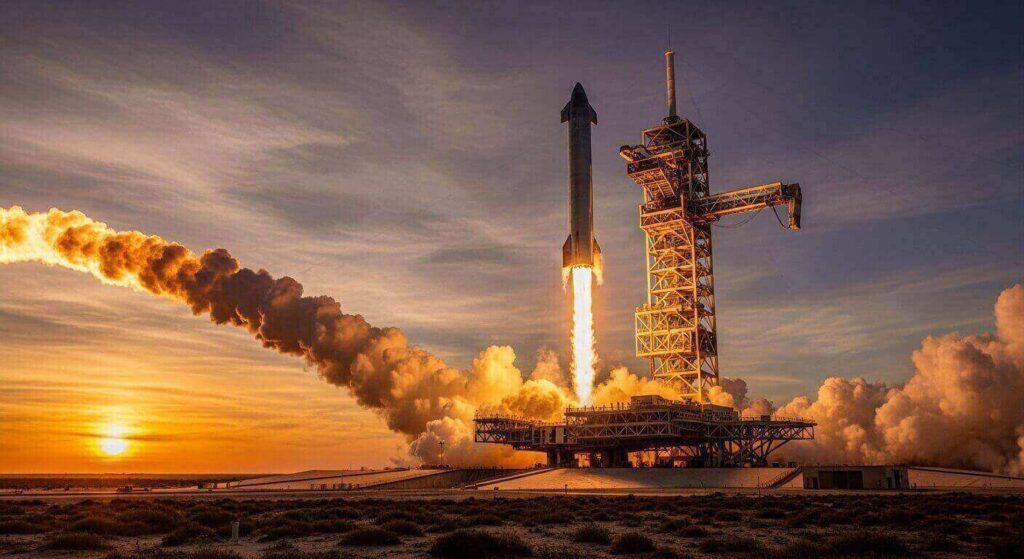
Starship V3: The Vehicle for Mars and Beyond
The V3 ship itself will look similar, but its internals are completely upgraded. The V2 ships were known for reliability issues—as we saw on Flight 10, which was mostly successful but was rocked by an engine compartment explosion that shredded its rear flaps. SpaceX has spent this year in a grueling process: finding problems, fixing them, and finding new problems. It’s the “desperate struggle for freedom” in engineering form.
After learning from all those mistakes, engineers have completely redesigned the fuel delivery system for Starship V3. Combined with the more reliable Raptor 3 engines, this new Starship Super Heavy will be capable of deploying 100 to 150 tons of payload into low Earth orbit. To put that in perspective, that’s on par with the capability of the legendary Saturn V moon rocket, but with the game-changing advantage of being fully reusable.
The Road to Mars: Orbital Refueling Explained
This is the key. This is the architecture that unlocks Mars. The V3 ship will be fitted with new docking adapters on its backside (opposite the heat shield). SpaceX’s plan involves two types of Starships: one “sender” and one “receiver” (or male and female adapters). After connecting in orbit, the two ships will transfer liquid propellant. This allows the “receiver” ship to top off its tanks in space and fly to new destinations like the Moon and Mars. SpaceX has said this V3 design will be the one that first attempts to land on both.
Stage Zero Evolves: A New Tower for a New Rocket
Finally, all of this new hardware will be supported by a new and improved “Stage Zero” launchpad and catch tower. Flight 11 was the final launch from Tower 1 and the last time we’ll see the “upside-down shower head” flame diverter. Tower 2 has a more traditional flame trench and water deluge system, just like a Falcon 9 pad. The tower itself will be taller and stronger, but the “chopstick” arms will actually be much shorter. The reason is simple: smaller arms can move faster and are more stable. When they built the first “Mechazilla,” they’d never caught a rocket before. Now, they are building smarter.
Conclusion: The End of an Era, The Start of a Journey
Flight 11 was the end of Starship’s childhood. It was the culmination of years of rapid, iterative testing that often ended in fire. But that fiery process worked. It taught SpaceX everything they needed to know to build the real thing. The next chapter, starting with Flight 12 and the V3 system, is the one that takes us to Mars. The times ahead are going to be new and exciting all over again. Stay tuned.
Frequently Asked Questions (FAQ) ❓
Q: What was special about SpaceX’s Starship Flight 11?
A: Flight 11 was considered a “near-perfect” test flight. It successfully used a refurbished booster, tested a new 13-5-3 engine landing burn, and, most importantly, the Starship vehicle completed its first-ever dynamic banking maneuver and flip during re-entry to prove its landing accuracy.
Q: What is the new SpaceX Starship V3?
A: The V3 (Version 3) is the next generation of Starship. It features more powerful and reliable Raptor 3 engines, a redesigned fuel system, a booster with only three (but stronger) grid fins, and an integrated hot-stage separation system. This version is designed to be the one that travels to the Moon and Mars.
Q: Why did SpaceX change the Super Heavy booster to three grid fins?
A: SpaceX reduced the number of grid fins from four to three to simplify the design and integrate the “catch pin” (the part the tower arms grab) into the fin structure itself. The three remaining fins are larger and stronger, providing enough control while reducing weight and complexity.
Q: How will SpaceX refuel Starship in orbit?
A: SpaceX will launch a “tanker” Starship that will meet a “receiver” Starship in orbit. The two ships will connect using new docking adapters, and the tanker will transfer liquid methane and liquid oxygen to the receiver, refilling its tanks for long-distance journeys to the Moon or Mars.
Q: When will Starship go to Mars?
A: While there is no exact public date, SpaceX is developing the Starship V3 specifically for this purpose. The successful testing of orbital refueling and re-entry is the primary focus before an uncrewed cargo mission to Mars can be attempted, potentially in the coming years.