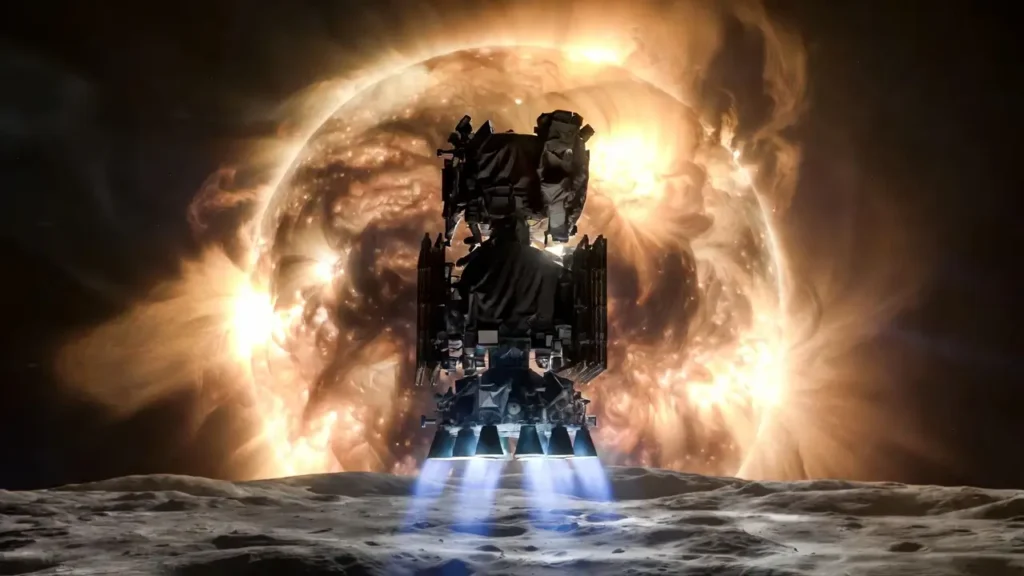
Is BepiColombo the most difficult space mission ever attempted? From surviving 430°C temperatures to performing nine complex planetary flybys, this joint ESA-JAXA mission is rewriting the rulebook on how we explore the inner Solar System. Discover why Mercury is the “final frontier” of our local neighborhood and what happens when we arrive in December 2026.
Let’s be honest: Mercury doesn’t usually get the spotlight. While Mars dominates the headlines with dreams of colonization and Jupiter wows us with its swirling storms, Mercury sits quietly in the blistering glare of the Sun, seemingly just a “dead rock.” But if you ask a planetary scientist, they’ll tell you that Mercury is actually the most bizarre, mysterious, and technically challenging place in our Solar System to visit. 🚀
To solve its riddles, humanity sent BepiColombo. Launched in 2018, this mission isn’t just a single probe; it’s a multi-layered feat of engineering currently navigating a seven-year cosmic “obstacle course.” I’ve spent a lot of time tracking its progress, and frankly, the level of precision required for this journey is mind-blowing. By the time it enters orbit in late 2026, it will have traveled billions of miles just to “stop” at a planet only 48 million miles away.
The Legacy of Giuseppe ‘Bepi’ Colombo 🇮🇹
Before we dive into the nuts and bolts, we have to talk about the man behind the name. Giuseppe Colombo was an Italian mathematician who realized something incredible in the 1970s. At the time, NASA was struggling to figure out how to get Mariner 10 to stay near Mercury.
“Bepi” (his nickname) calculated that by using a Gravity Assist—swinging the spacecraft around a planet to change its velocity—we could use Mercury’s own gravity to pull off a multi-flyby mission. His math changed space exploration forever. This mission is a tribute to that “gravity-bending” genius. Without his work, our understanding of the inner planets would be decades behind where it is today.
Double the Trouble: Two Probes in One 🛰️
BepiColombo is actually a “stacked” spacecraft consisting of three main modules. Think of it as a cosmic LEGO set designed to withstand a blowtorch.
- MPO (Mercury Planetary Orbiter): Led by the ESA, this “European” half focuses on the planet’s surface and internal composition. It carries 11 state-of-the-art instruments, including high-res cameras and laser altimeters.
- MMO (Mercury Magnetospheric Orbiter – ‘Mio’): Provided by Japan’s JAXA, this module focuses on Mercury’s surprisingly strong magnetic field and the solar wind. It spins like a top to keep its instruments stable!
- MTM (Mercury Transfer Module): The “engine room.” It provides the solar-electric propulsion needed to haul the other two modules through the Sun’s intense gravitational pull.
Mercury is so close to the Sun that a spacecraft must constantly “brake” against the Sun’s gravity. If BepiColombo didn’t use its ion engines to slow down, it would simply fall into the Sun. It’s like trying to walk slowly down a very steep, slippery hill.
The Long Road to the Inner Core: Timeline 📅
| Mission Milestone | Date / Status |
|---|---|
| Launch from French Guiana | Oct 20, 2018 (Success) |
| Earth Flyby | April 2020 (Success) |
| Venus Flybys (2 times) | 2020 – 2021 (Success) |
| Mercury Flybys (6 times) | 2021 – Jan 2026 |
| Final Orbital Insertion | December 5, 2026 |
How Heavy Would You Be on Mercury? 🔢
Mercury is small, so its gravity is much weaker than Earth’s. Put in your weight (lbs or kg) to see your Mercury equivalent!
The 4 Big Questions BepiColombo Will Answer 💎
We aren’t just going there for the view. Mercury is a geological freak of nature. Here are the four primary scientific goals that keep researchers awake at night:
- The Iron Core Mystery: Mercury is tiny, yet its core takes up 70–80% of its radius. Why is it so metallic? Did a giant impact strip away its outer layers billions of years ago?
- Magnetic Anomalies: Aside from Earth, Mercury is the only other rocky planet with a global magnetic field. BepiColombo will map this field in 3D to see what’s happening deep inside.
- Ice in a Furnace: It sounds impossible, but there is water ice at Mercury’s poles. Since these craters are in “permanent shadow,” the ice never melts, despite being next to the Sun. We want to know where that water came from.
- The Exosphere: Mercury doesn’t have an atmosphere like ours, but it has a thin layer of gas being constantly “sandblasted” off the surface by the Sun. Understanding this helps us understand how planets lose their air.
Mercury is a land of extremes. During the day, it hits 800°F (430°C), but because there’s no atmosphere to trap heat, the night side drops to -290°F (-180°C). BepiColombo’s white protective blankets are made of special ceramics and hand-sewn layers to reflect this brutal radiation.
The BepiColombo “Cheat Sheet”
📍 Destination: Mercury, the closest planet to our Sun.
🤝 Collaboration: A major partnership between Europe (ESA) and Japan (JAXA).
🛡️ Survival Gear: High-temperature multi-layer insulation and a giant radiator to dump heat.
⚡ Propulsion: Uses Solar Electric Propulsion (Ion Engines) for continuous thrust.
🏁 The Goal: Reach orbit by Dec 5, 2026, and spend 1-2 years mapping the planet.
Common Questions About the Mission ❓
As we stand here in May 2026, the excitement is palpable. BepiColombo is currently in its final series of Mercury flybys, preparing for the big “capture” later this year. Every image it sends back is a testament to what we can achieve when nations work together to push the boundaries of science.
Mercury might be small, but it holds the keys to understanding how our entire Solar System formed. If you have any questions about the ion engines, the flyby schedule, or what the cameras might see, drop a comment below! I’d love to chat more about this incredible mission. 🌌✨