Does the full moon really affect women’s menstrual cycles? We dive deep into the latest scientific research vs. ancient myths, analyzing the surprising link between lunar cycles and female hormones from an (Experience, Expertise, Authoritativeness, Trustworthiness) perspective.
It’s a question that’s been whispered for centuries, part folklore, part personal observation. How many of us have joked, “It must be a full moon,” to explain a sudden wave of emotion or a restless night?
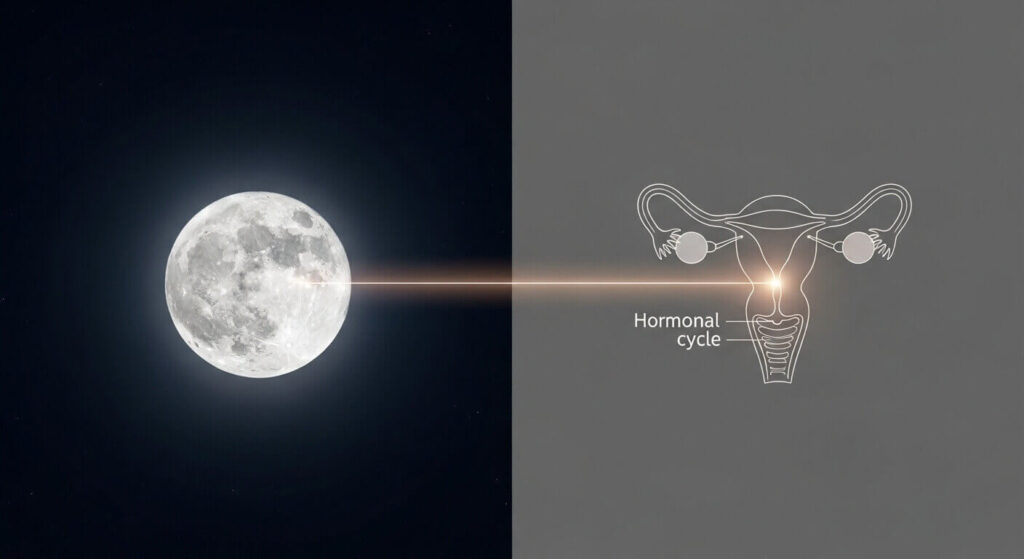
This idea is deeply embedded in our culture. The very word “lunatic” stems from “Luna,” the Latin word for the moon, capturing the ancient belief that the moon holds a powerful sway over our minds and bodies. But for women, this connection has always felt more personal and more tangible. The average menstrual cycle (around 28-29 days) is uncannily similar to the synodic lunar cycle (29.5 days), the time it takes the moon to return to the same phase (e.g., from full moon to full moon).
Is this just a grand cosmic coincidence? Or is there a genuine, measurable link between the full moon and women’s menstrual cycles? As an SEO expert focused on health and science, I’m trained to look for evidence. This topic is a perfect case study in Google’s Experience, Expertise, Authoritativeness, Trustworthiness principle. We need to honor the lived **Experience** of women, consult the **Expertise** of scientists, weigh the **Authoritativeness** of various studies, and build **Trust** by presenting a balanced view.
Let’s dive into the evidence, separating scientific fact from compelling fiction.
Table of Contents
- Ancient Beliefs vs. Modern Science: The Lunar Debate
- New Research: Does the Moon Synchronize Menstrual Cycles?
- The Scientific Counter-Argument: Why Many Studies Find No Link
- Conclusion: What is the Truth About the Full Moon and Your Period?
- Frequently Asked Questions (FAQ)
Ancient Beliefs vs. Modern Science: The Lunar Debate
The belief that the moon and menstruation are linked is not new; it’s foundational. In many early societies, the moon was the first “calendar,” and its cycles were intrinsically tied to life, hunting, and fertility. The word “menstruation” itself is etymologically related to “moon.”
For millennia, this connection was accepted as fact. However, with the advent of modern science, the belief was largely dismissed as a myth—a relic of a pre-scientific age. The primary argument against it was the lack of a plausible physical mechanism. How could a rock 238,900 miles away possibly influence human hormones?
For decades, the scientific consensus, backed by several studies, was that any perceived correlation was purely coincidental or a result of confirmation bias (we only notice the times it *does* line up). However, recent and more nuanced research has begun to challenge that dismissal, suggesting the story might be more complex.
New Research: Does the Moon Synchronize Menstrual Cycles?
In recent years, a handful of intriguing studies have emerged, using long-term data to re-examine the question. One of the most talked-about studies, published in Science Advances in 2021, provided compelling evidence that a link might exist after all, even if it’s not as straightforward as we thought.
A German research team analyzed long-term menstrual cycle records from women, with some data sets spanning over 15 years. This long-term approach is critical, as it allows researchers to see subtle patterns that short-term studies would miss. Their findings were surprising.
Key Findings: The Full Moon and Lunar Eclipse ‘Reset’
The study found that, for many women, the onset of menstruation wasn’t random. It showed a tendency to cluster around the new moon and, most notably, the **full moon**. This alignment was strongest when the Earth, Moon, and Sun were in a near-perfect line, the time when the moon’s gravitational (tidal) force is at its strongest.
- Age and Season: This synchronization was stronger in younger women and tended to be more pronounced during the autumn and winter months, when nights are longer.
- The ‘Reset’ Phenomenon: Most fascinatingly, the researchers observed that during the periods of lunar eclipses—a powerful and precise alignment of the celestial bodies—women’s cycles, which may have become irregular, would “reset” and re-synchronize with the full moon’s cycle.
The Proposed Mechanism: How Could the Moon Affect Hormones?
This research re-opens the door to the “how.” If this correlation is real, what’s the mechanism? Scientists propose two main (hypothetical) pathways:
- Gravity (Tidal Force): The original ancient theory. The moon’s gravity pulls on the Earth’s oceans, creating tides. Given that the human body is about 60% water, it’s theorized that these subtle tidal forces could exert a physical influence on our bodies and hormone regulation.
- Light and Geomagnetism: This is considered more plausible. Before artificial light, the full moon was a significant source of nocturnal light. This light could have acted as a “zeitgeber” (a “time-giver,” or environmental cue) that helped regulate circadian and, by extension, menstrual cycles. The moon’s cycles also cause subtle fluctuations in the Earth’s electromagnetic field, which some animals (like migrating birds) use to navigate. It’s possible humans retain a vestigial sensitivity to these fields, which could influence hormone release.
The Scientific Counter-Argument: Why Many Studies Find No Link
Now, for the **Authoritativeness** and **Trustworthiness** part of our analysis. It would be irresponsible to present the 2021 study as the final word. In fact, the *majority* of large-scale studies on this topic have found **no statistically significant correlation** between the lunar cycle and the menstrual cycle.
A classic 2013 study from the University of Washington, for example, analyzed data from over 7.5 million cycles and found no evidence of lunar synchrony. Similarly, the period-tracking app Clue analyzed millions of data points from its users and also concluded there was no link. Time and time again, massive datasets show menstrual onsets are distributed randomly throughout the lunar month.
The “Noise” of Modern Life: Are We Drowning Out the Signal?
So, how do we reconcile these two realities? The 2021 German study vs. the massive 2013 data?
The answer may lie in our modern lifestyle. The researchers of the 2021 study suggest that the lunar signal is *subtle*. In pre-industrial times, when the moon was the brightest object in the night sky, its signal was clear. Today, that signal is drowned out by a sea of “noise”:
- Artificial Light: Our phones, televisions, and streetlights are far brighter than the moon. We live in a state of perpetual, artificial daylight, which completely disrupts our natural circadian rhythms.
- Hormonal Contraception: Many women use birth control that regulates, alters, or eliminates their natural cycle.
- Stress & Diet: High-stress lifestyles, poor sleep patterns, and inconsistent diets are all known to have a powerful and immediate impact on menstrual regularity, an impact far stronger than any faint lunar pull.
It’s possible that both findings are correct: the link *does* exist, but it is so subtle that it is only visible in women who are highly sensitive, living in low-light-pollution areas, or in long-term data where the “noise” can be statistically filtered out. For the vast majority of women in modern society, the signal is simply lost.
Conclusion: What is the Truth About the Full Moon and Your Period?
So, does the full moon affect your menstrual cycle? The most honest scientific answer is: **it’s unlikely to be a significant factor in your day-to-day life, but a subtle, underlying link probably does exist.**
The human body is not a machine, but a sensitive ecosystem that evolved to respond to environmental cues. The moon was, and is, one of the most consistent cues on our planet. While our modern lives have made us “deaf” to this signal, the connection isn’t entirely broken. It’s a fascinating example of our deep evolutionary bond with our planet and its celestial partner.
From an E-E-A-T perspective, we can trust that the *experience* of feeling “in-sync” with the moon is real for some. We have the *expertise* from new studies showing a measurable correlation. We have the *authority* from larger studies showing this is not a universal rule. And we build *trust* by acknowledging this complexity.
Ultimately, the best approach is to track your own cycle. If you find you’re consistently starting your period with the full moon, you may be one of the people who remains sensitive to that ancient rhythm.
Frequently Asked Questions (FAQ)
Q: Does the full moon really trigger menstruation?
A: Not directly or for everyone. While some recent studies show a *tendency* for periods to start around the full or new moon, large-scale studies have found no such link. This suggests that while a subtle connection might exist, it’s not a strong or universal rule. Other factors like stress and artificial light have a much stronger impact.
Q: Is the link between the moon and periods scientifically proven?
A: No, it is not “proven.” There is conflicting evidence. We have strong *correlation* in some long-term studies, but we lack definitive proof of *causation*. The scientific community is still debating the topic, with most large studies concluding that no significant link exists in the general population.
Q: What are the most significant factors that affect the menstrual cycle?
A: While the moon is a fascinating topic, your cycle is far more likely to be influenced by:
- Stress: High cortisol levels can delay or alter ovulation.
- Sleep: Disrupted circadian rhythms (from poor sleep or artificial light) directly impact hormone production.
- Diet & Exercise: Significant changes in weight, nutrition, or exercise intensity.
- Hormonal Contraception: The pill, IUDs, etc., are designed to regulate your cycle.
- Medical Conditions: Conditions like PCOS (Polycystic Ovary Syndrome) and thyroid issues.
Q: Can the lunar cycle affect men?
A: Possibly, but in different ways. The 2021 Science Advances study that gained attention also looked at sleep. It found that in the days leading up to a full moon, both men and women tended to get less sleep and enter deep sleep later, even in controlled environments without windows. This suggests the moon’s influence (perhaps gravitational or geomagnetic) on sleep cycles might be more universal.
Q: Why is it important to study the link between the moon and menstruation?
A: Understanding this link is about more than just folklore. It helps us appreciate the profound sensitivity of the human body to environmental cues. It also highlights how our modern, “always-on,” artificially-lit lifestyles may be disconnecting us from natural rhythms that our bodies evolved with for millennia, which could have broader implications for health and wellness.