Discover the staggering reality of TON 618, the most massive black hole ever recorded. Learn about its 66-billion-solar-mass scale, its role as a hyperluminous quasar, and how it challenges our understanding of the early universe through NASA data and peer-reviewed astrophysics.
When we think about the cosmos, we often imagine serene stars and distant galaxies. But deep within the cosmic fabric lies a category of objects so massive they defy conventional physics: Ultramassive Black Holes (UMBHs). At the very top of this hierarchy sits TON 618, a celestial titan that makes our entire solar system look like a microscopic speck. Let’s be honest—trying to wrap your head around something that weighs 66 billion times more than our Sun is a daunting task, but understanding this “behemoth of the abyss” is crucial to uncovering how our universe evolved. 😊
In this comprehensive guide, we aren’t just looking at numbers. we are diving into the heart of a hyperluminous quasar located over 10 billion light-years away. We will analyze the peer-reviewed data, the historical discovery at the Tonantzintla Observatory, and the sheer physical impossibility of its growth. Whether you are an amateur stargazer or a seasoned astrophysicist, TON 618 offers a humbling perspective on the limits of gravity and time.
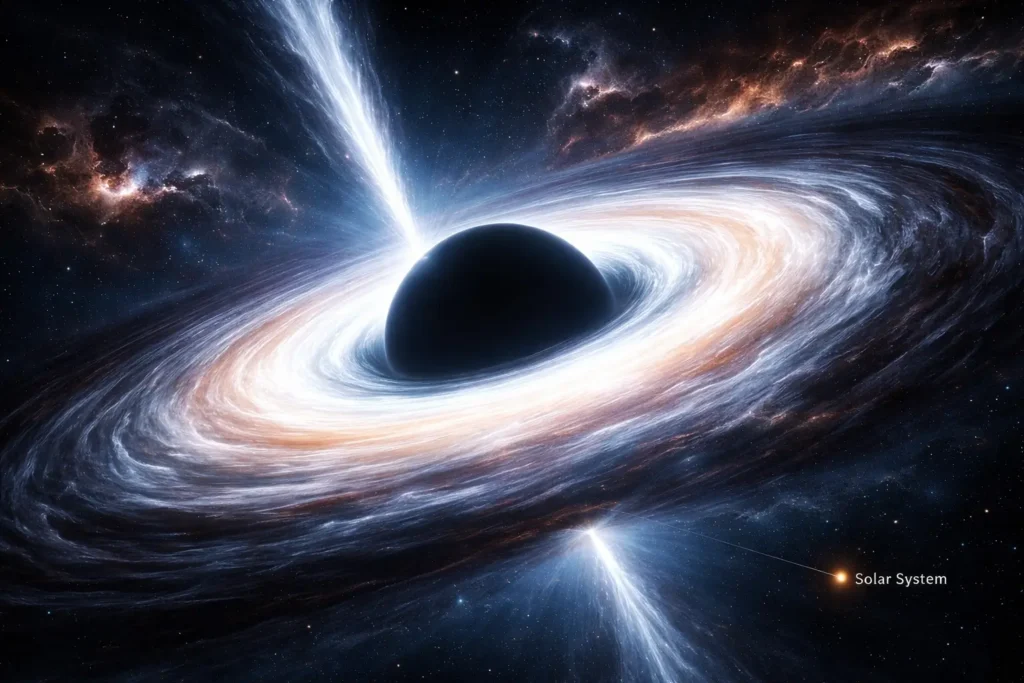
The Scientific Definition of TON 618: More Than a Black Hole 🌌
Technically speaking, TON 618 is a hyperluminous, broad-absorption-line, radio-loud quasar. While the term “black hole” describes the central singularity, the “quasar” is the visible manifestation of its appetite. As matter spirals into the event horizon, it accelerates to near-light speeds, friction heating it to millions of degrees and releasing more energy than hundreds of galaxies combined.
The Historical Context: From Faint Blue Star to Cosmic King
The journey of TON 618 began in 1954. It was originally cataloged during a survey of faint blue stars that didn’t align with the Milky Way’s plane. Astronomers at the Tonantzintla Observatory in Mexico (hence the “TON”) initially had no idea they were looking at the most powerful engine in the known universe. It wasn’t until the 1970s, with the advent of radio astronomy and redshift measurements, that we realized this “star” was actually a quasar located 10.4 billion light-years away.
Analyzing the 66 Billion Solar Mass Figure: Fact or Fiction? ⚖️
The number “66 billion solar masses” is often thrown around in headlines, but where does it come from? Astronomers use a method called virial mass estimation. By analyzing the Hydrogen-beta emission lines in the quasar’s spectrum, researchers can calculate the velocity of the gas orbiting the black hole.
🔍 Authority Check: According to the study “Estimating the Masses of Supermassive Black Holes” (Shemmer et al., 2004), the broad emission lines of TON 618 indicate a gravitational pull so immense that only a 66-billion-solar-mass singularity could explain the gas velocities. This remains one of the most cited figures in high-energy astrophysics.
Comparing the Scale: Sagittarius A* vs. TON 618
To put this in a relatable perspective, consider Sagittarius A*, the supermassive black hole at the center of our Milky Way. It has a mass of about 4 million Suns. TON 618 is 15,000 times more massive. If Sagittarius A* were a small marble, TON 618 would be the size of a professional football stadium. The scale shift is so radical that it requires a new classification of “Ultramassive.”
TON 618: Quick Vital Stats 📊
Mass: 66 Billion $M_\odot$
Schwarzschild Radius: ~1,300 AU
Luminosity: 140 Trillion $L_\odot$
Distance: 10.4 Billion Ly
*1 AU = Distance from Earth to Sun. TON 618 could swallow 40 Solar Systems side-by-side.
The Event Horizon and the Impossible Diameter 🌌
The Schwarzschild Radius of TON 618 is roughly 390 billion kilometers. For context, Neptune orbits the Sun at a distance of only 4.5 billion kilometers. This means the dark silhouette of the black hole itself is over 80 times wider than the distance from the Sun to its farthest planet.
The Paradox of Density and Spaghettification
Interestingly, because the volume of a black hole grows with the cube of its radius while mass grows linearly, the “average density” of a hypermassive black hole like TON 618 is actually quite low—less than the density of air! Furthermore, the tidal forces at the event horizon are surprisingly weak. Unlike a small stellar-mass black hole that would “spaghettify” you instantly, you could theoretically cross the event horizon of TON 618 without feeling a thing… until you reached the singularity deep inside.
How Did TON 618 Grow So Large? The Cosmological Mystery 🧬
According to the Big Bang theory, the universe is about 13.8 billion years old. TON 618 was already a giant when the universe was less than 4 billion years old. This presents a massive challenge for current models of Stellar Evolution. How did it accumulate so much mass so quickly?
- Direct Collapse: Massive gas clouds might have collapsed directly into “seed” black holes of 100,000 solar masses, bypassing the star phase.
- Hyper-Accretion: Feeding at rates far exceeding the Eddington Limit, where radiation pressure usually stops matter from falling in.
- Hierarchical Mergers: Early galaxies colliding and their central black holes merging into a single titan.
⚠️ Critical Fact Check: While TON 618 is the “confirmed” king, recent data regarding Phoenix A* suggests a potential mass of 100 billion solar masses. However, measurement uncertainties for Phoenix A* are much higher than for TON 618, keeping TON 618 as the gold standard for verified hypermassive scale.
Luminosity and Energy Output: A Light in the Dark 💡
TON 618 is one of the brightest objects in the observable universe. Its luminosity is estimated at 140 trillion times that of our Sun. If this quasar were positioned 32 light-years away (roughly the distance to the star Arcturus), it would shine as brightly as the Sun in our sky. The radiation would be so intense it would vaporize our atmosphere and sterilize the planet in seconds.
The Role of the Host Galaxy
What’s truly eerie is that we cannot even see the galaxy that hosts TON 618. The quasar’s light is so overwhelming that it completely outshines the billions of stars within its own host. This “feedback mechanism” likely prevents the galaxy from forming new stars, as the intense heat blows away the gas needed for star birth—a process known as Quasar Quenching.
The Ultimate Summary of TON 618 📝
To sum up our journey into the abyss, here are the core takeaways about this cosmic titan:
- Unmatched Mass: At 66 billion solar masses, it is the most massive black hole with a highly reliable measurement.
- Ancient Origin: It formed in the very early universe, challenging our understanding of how quickly matter can aggregate.
- Visual Scale: Its event horizon is large enough to contain our entire solar system many times over.
- Extreme Physics: It pushes the limits of the Eddington Limit and serves as a natural laboratory for General Relativity.
Frequently Asked Questions About TON 618 ❓
Q: Could TON 618 ever reach Earth?
A: No. TON 618 is 10.4 billion light-years away. Because the universe is expanding, it is actually moving away from us at incredible speeds. It poses zero threat to our solar system.
Q: Is TON 618 the absolute biggest thing in the universe?
A: It is the most massive single object (black hole). However, galaxy clusters and the “Great Attractor” are much larger structures, though they are composed of many individual objects.
Q: How do we know it’s still there?
A: We don’t! We are seeing light that left TON 618 10 billion years ago. It may have merged with another galaxy or stopped feeding by now, but we won’t know for another 10 billion years.
TON 618 stands as a monument to the mystery of our universe. It challenges our theories, humbles our scale, and reminds us that there is so much more to discover in the dark reaches of space. If you found this cosmic journey fascinating, feel free to share your thoughts or ask more questions in the comments below! Let’s keep exploring the unknown together. 🚀