There is a primal feeling that washes over you when you stand in the dark, looking up at a comet streaking across the sky. It is a mixture of awe and, perhaps, a deep-seated ancestral fear. Recently, as the world turned its eyes to the skies to witness the spectacular traverse of Comet C/2023 A3 (Tsuchinshan-ATLAS)—and as astronomical communities buzz about potential interstellar candidates like a theoretical “3I”—a fascinating conversation has ignited.
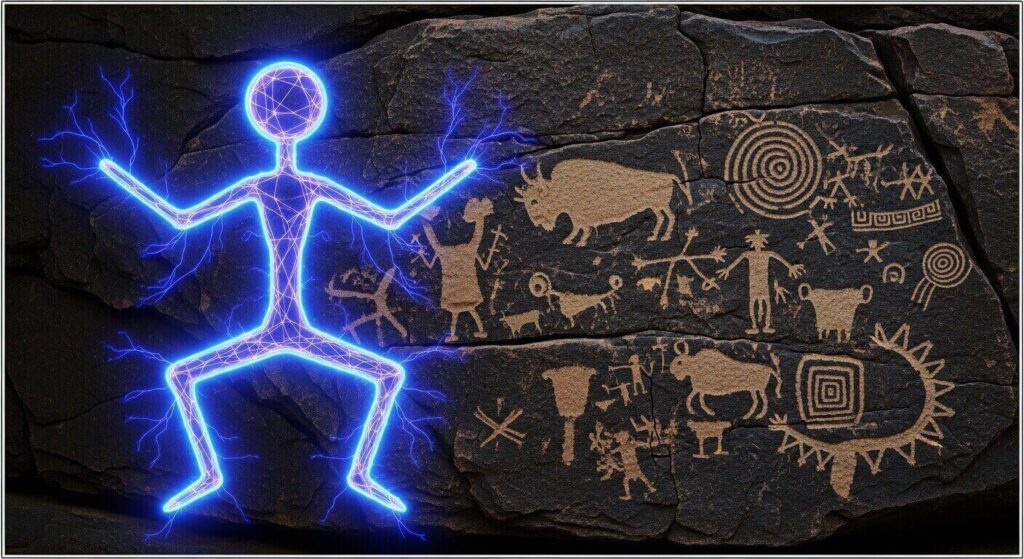
Observers and archaeoastronomers alike have begun to notice striking similarities between the shape of these modern celestial visitors and the enigmatic symbols etched into stone by our ancestors thousands of years ago. Are we seeing the same phenomena that terrified and inspired the artists of the Paleolithic era?
In this deep dive, we will bridge the gap of millennia. We will explore the fascinating intersection of plasma physics, astronomy, and archaeology to understand the ancient cave paintings resembling 3I/ATLAS comet structures. This isn’t just about rocks and ice; it’s about decoding the warning signs left by those who came before us.
Table of Contents
- 1. The Celestial Archetype: Why Ancient Cave Paintings Resemble 3I/ATLAS Comet Shapes
- 2. Decoding Göbekli Tepe: The Vulture Stone and Cometary Impacts
- 3. The Plasma Connection: “Squatter Man” Petroglyphs and Comet Tails
- 4. C/2023 A3 (Tsuchinshan-ATLAS): A Modern Glimpse into the Past
- 5. Conclusion: The Universal Language of the Sky
- 6. Frequently Asked Questions (FAQ)
The Celestial Archetype: Why Ancient Cave Paintings Resemble 3I/ATLAS Comet Shapes
When we discuss “3I,” we are often referring to the classification of Interstellar Objects (like 1I/’Oumuamua and 2I/Borisov). While the astronomical community eagerly awaits a confirmed “3I,” the visual archetype of comets discovered by the ATLAS survey (like the recent C/2023 A3) provides a tangible visual reference that helps us understand ancient art.
Many ancient cave paintings resembling 3I/ATLAS comet tails do not look like the standard “snowball” we imagine. Instead, they often depict complex, multi-tailed structures, horned discs, or anthropomorphic figures. Why?
The answer lies in perspective and plasma. When a comet approaches the sun, it interacts with the solar wind. If viewed head-on or at specific angles, the coma and the tails (ion and dust) can create a shape that looks like a winged disc or a figure with raised arms. Ancient cultures, lacking telescopes but possessing keen observational skills, recorded these “gods” appearing in the sky.
Decoding Göbekli Tepe: The Vulture Stone and Cometary Impacts
To understand the connection between ancient cave paintings resembling 3I/ATLAS comet phenomena and history, we must look at Göbekli Tepe in Turkey. Often cited as the world’s oldest temple, it features the famous “Vulture Stone” (Pillar 43).
Recent research by archaeoastronomers suggests that the carvings on this pillar are not merely decorative animals. They are likely an astronomical map. The symbols correlate with star constellations as they would have appeared roughly 12,900 years ago—the exact time of the onset of the Younger Dryas cooling period.
- The Vulture/Eagle: Likely represents the constellation Sagittarius or a specific cometary configuration visible at the time.
- The Headless Man: A symbol of death or catastrophe, potentially linking to a fragmented comet impact that caused a mini-ice age.
This stone serves as a prehistoric memorial to a devastating event, proving that ancients didn’t just draw what they saw; they tracked celestial mechanics with frightening accuracy.
The Plasma Connection: “Squatter Man” Petroglyphs and Comet Tails
One of the most compelling theories linking ancient cave paintings resembling 3I/ATLAS comet structures is the “Plasma Universe” theory championed by plasma physicist Dr. Anthony Peratt. He noticed that high-energy plasma discharges in the laboratory form specific shapes—one of which is a stick figure with raised arms and two dots at the side, often called the “Squatter Man.“
Remarkably, this exact shape is found in petroglyphs on every inhabitable continent on Earth. How could isolated cultures all draw the same figure?
The theory posits that in ancient times, extreme solar activity or a close pass by a massive charged cometary body (like a massive ATLAS comet or an interstellar visitor) could have created visible high-energy plasma formations in the Earth’s ionosphere. The ancients weren’t drawing a human; they were drawing a colossal plasma discharge in the sky that looked like a glowing, horned deity—a shape strikingly similar to the intense coma and anti-tail of major comets viewed from specific angles.
C/2023 A3 (Tsuchinshan-ATLAS): A Modern Glimpse into the Past
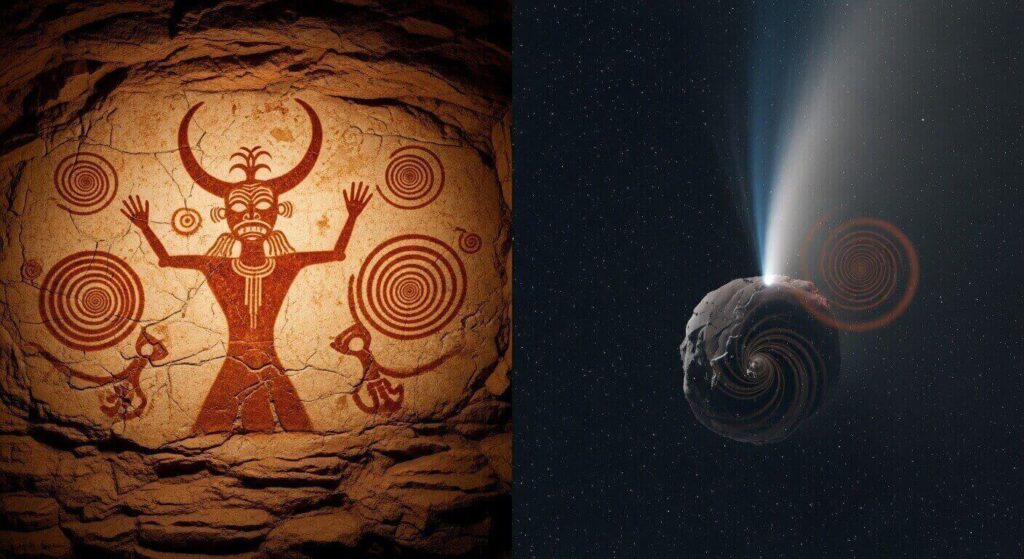
In late 2024, observers witnessed C/2023 A3 (Tsuchinshan-ATLAS). At its peak, it displayed a pronounced “anti-tail”—a spike of dust that appears to point toward the sun due to geometric perspective. To the naked eye, this can give the comet a “horned” or winged appearance.
When we overlay images of this modern comet against ancient cave paintings resembling 3I/ATLAS comet motifs, the resemblance is undeniable. The “horns” of the comet match the “horns” of deities depicted in Neolithic art. This modern visual confirmation helps validate the idea that ancient artists were strict realists. They were recording the terrifying beauty of the cosmos that dictated their survival.
Conclusion: The Universal Language of the Sky
Whether we are looking at the hypothetical 3I interstellar traveler or the very real ATLAS comets of our time, the connection to the past is profound. The ancient cave paintings resembling 3I/ATLAS comet shapes are not myths; they are data. They are the black-box recordings of humanity’s journey through a dangerous and beautiful shooting gallery.
As we continue to scan the skies for the next great comet or interstellar object, we are essentially doing what our ancestors did in caves 12,000 years ago: watching, waiting, and wondering.
Frequently Asked Questions (FAQ)
What is the significance of the “Squatter Man” in relation to comets?
The “Squatter Man” is a ubiquitous petroglyph found globally. Plasma physicists suggest it depicts a high-energy plasma discharge in the sky, likely caused by intense solar or cometary activity, resembling the shape of a comet’s tail or coma viewed from Earth.
Are there actual cave paintings of comets?
Yes. The most famous example is possibly the Vulture Stone at Göbekli Tepe, which is believed to record a comet impact around 10,950 BC. Other sites, such as Lascaux in France and Chaco Canyon in the USA, also feature symbols interpreted as cometary events.
What does 3I mean in astronomy?
The designation “I” stands for “Interstellar.” 1I was ‘Oumuamua, and 2I was Borisov. “3I” refers to the hypothetical or future discovery of the third confirmed interstellar object passing through our solar system.
Why do ancient petroglyphs look like the ATLAS comet?
Recent comets like C/2023 A3 (Tsuchinshan-ATLAS) often display “anti-tails” or distinct coma shapes due to viewing angles. These shapes (horned disks, winged spheres) match the geometric patterns recorded by ancient cultures, suggesting they witnessed similar celestial mechanics.