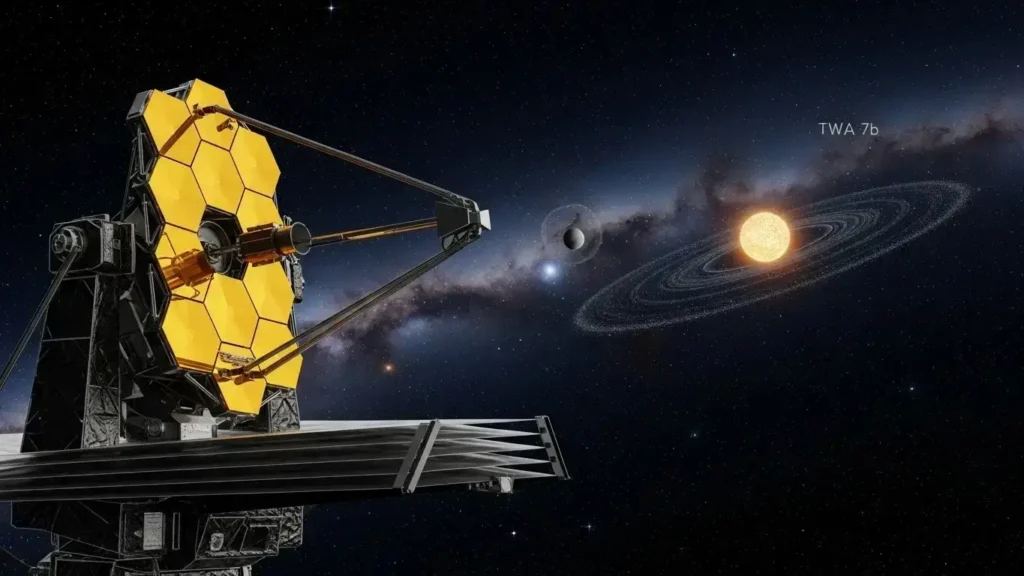
Learn how James Webb Telescope finds exoplanets using transit spectroscopy and coronagraphs. Explore 2025’s TWA 7b discovery and Alpha Centauri planet hunt.
The quest to find “Earth 2.0” has entered a golden era. While previous telescopes could only tell us a planet existed, the James Webb Space Telescope (JWST) is doing something far more profound: it’s sniffing their atmospheres and taking their pictures. By mid-2025, the JWST has already redefined our place in the cosmos, moving beyond simple detection to deep characterization.
But how exactly does this $10 billion “Golden Eye” pull off such a feat? It involves a mix of cosmic shadows, chemical fingerprints, and high-tech “star-shades.” Whether it’s the record-breaking discovery of the lightweight TWA 7b or the high-stakes hunt around Alpha Centauri, the methods used by JWST are a masterpiece of modern physics. Let’s break down the science of finding alien worlds. 🚀
Exoplanet Discovery Guide
- 1. Transit Spectroscopy: Sniffing Alien Atmospheres
- 2. Direct Imaging: The Power of the MIRI Coronagraph
- 3. 2025 Spotlight: The Discovery of TWA 7b
- 4. Alpha Centauri A: Hunt for the Closest Solar Twin Planet
- 5. Step-by-Step Guide: How NASA Identifies a Planet
- 6. Expert FAQ & Scientific Insights
1. Transit Spectroscopy: Sniffing Alien Atmospheres
Most exoplanets are found through the transit method. When a planet passes in front of its host star, it blocks a tiny fraction of starlight. While older telescopes like Kepler used this to measure a planet’s size, JWST takes it a step further with transmission spectroscopy.
As starlight filters through the planet’s atmosphere, the gases there (like water vapor, methane, or CO2) absorb specific wavelengths of infrared light. By analyzing this “missing” light, JWST creates a chemical barcode of the planet’s air. This is how we’ve recently detected complex chemistry in the atmospheres of distant gas giants and even began probing the rocky surfaces of the TRAPPIST-1 system.
2. Direct Imaging: The Power of the MIRI Coronagraph
Imagine trying to photograph a firefly hovering next to a searchlight from miles away. That is the challenge of direct imaging of exoplanets. Stars are billions of times brighter than the planets orbiting them.
To solve this, JWST uses coronagraphs—internal masks that block the star’s overwhelming glare. This allows the telescope’s Mid-Infrared Instrument (MIRI) to see the faint heat signature of the planet itself. Because JWST operates in the infrared, it is uniquely suited to find young, warm planets that are still glowing from their formation.
3. 2025 Spotlight: The Discovery of TWA 7b
In June 2025, the scientific community was rocked by the discovery of TWA 7b. This wasn’t just another planet; it became the lightest exoplanet ever directly imaged. Located 111 light-years away in the TW Hydrae association, TWA 7b is roughly the mass of Saturn (0.3 times the mass of Jupiter).
What makes this discovery a landmark for the James Webb Telescope exoplanet mission is that TWA 7b was found “carving” through a debris disk. By observing the gaps in the dust rings, scientists predicted the planet’s location, and JWST’s MIRI confirmed it. This proves that Webb can see much smaller, cooler planets than we previously thought possible through direct imagery.
4. Alpha Centauri A: Hunt for the Closest Solar Twin Planet
Perhaps the most exciting news of late 2025 involves our nearest neighbor. Researchers using JWST have found strong evidence for a gas giant orbiting Alpha Centauri A, a star remarkably similar to our Sun just 4.4 light-years away.
While preliminary data from early 2025 showed a “warm” candidate, subsequent MIRI observations have provided the compelling evidence needed to support its existence. If confirmed, this would be a historic milestone, showing that even our closest stellar neighbors harbor massive worlds that were once hidden from our view.
5. Step-by-Step Guide: How NASA Identifies a Planet
The Discovery Workflow
Step 1: Targeting – Astronomers select stars with “wobbles” or known dust disks (like TWA 7).
Step 2: Masking – The Coronagraph is deployed to block the host star’s light (99.9% suppression).
Step 3: Infrared Capture – NIRCam or MIRI captures the heat signature of the candidate planet.
Step 4: Spectral Analysis – The light is split into a spectrum to check for methane, water, or silicates.
Step 5: Orbital Verification – Multiple observations (months apart) confirm the object is moving with the star and isn’t a background galaxy.
6. Expert FAQ & Scientific Insights
Q: Can James Webb see Earth-sized planets?
A: Yes, it can detect them (like the TRAPPIST-1 system) via the transit method, but directly imaging an Earth-sized planet is still extremely difficult due to their faintness. Webb is currently best at imaging “Super-Earths” and gas giants.
Q: What is the significance of the 2025 TWA 7b discovery?
A: It proves Webb’s sensitivity is high enough to see planets with much lower masses than Jupiter. It opens the door to seeing “Saturn-class” worlds across the galaxy.
Q: How does infrared help find planets?
A: Planets are relatively cool and glow brightest in infrared. Infrared light also passes through cosmic dust, allowing Webb to see planets forming inside “stellar nurseries” that are opaque to visible light telescopes like Hubble.
The Future is IR-Bright
As we move into 2026, the James Webb Telescope continues to peer further into the darkness. Each new image of an exoplanet brings us one step closer to answering the ultimate question: Are we alone?