Is the newly discovered blue cloud near the Andromeda Galaxy a sign of a collision with the Milky Way? Discover the truth behind DSO1 and the secrets of our cosmic neighborhood.
Table of Contents
- 1. The Discovery of DSO1: A Cosmic Anomaly
- 2. Is It a Precursor to the Andromeda-Milky Way Collision?
- 3. Debunking the Myths: The Scientific Reality of the ‘Blue Cloud’
- 4. The “Ghost Nebula” Within Our Own Galaxy
- 5. Why This Discovery Matters for Modern Astronomy
- 6. Frequently Asked Questions (FAQ)
Space has a way of reminding us how little we truly know. Recently, the astronomical community was sent into a frenzy when a massive, ethereal blue gas cloud was spotted right next to the Andromeda Galaxy (M31). For a moment, headlines whispered of a terrifying possibility: were we seeing the first physical evidence of the impending collision between our Milky Way and Andromeda? As someone who has followed galactic evolution for years, I find this story particularly fascinating because it blends cutting-edge science with the raw passion of amateur observers. 🌌
The Discovery of DSO1: A Cosmic Anomaly 🔭
The discovery of this object, now cataloged as DSO1 (Deep Sky Object 1), is a testament to the power of modern amateur astronomy. It wasn’t found by the Hubble or James Webb Space Telescope initially, but by a dedicated team of amateur astrophotographers. By using specialized [O III] (Oxygen III) filters—which isolate the faint glow of ionized oxygen—they captured a signal that had remained hidden for decades.
After over 111 hours of exposure time, a magnificent blue arc appeared, seemingly cradling the Andromeda Galaxy. This wasn’t just a faint smudge; it was a structure spanning several degrees across the sky. The immediate question was: What is it doing there?
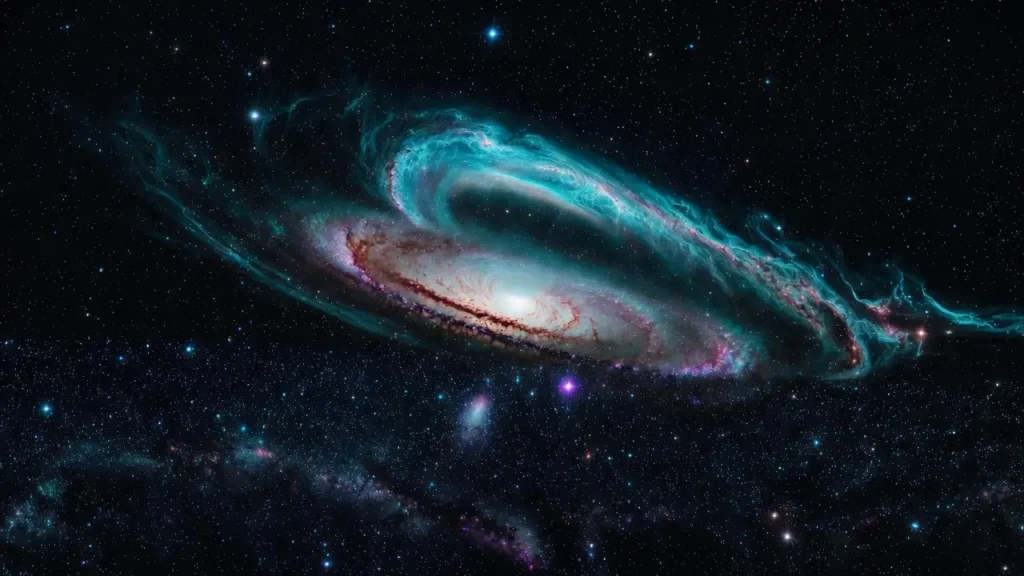
💡 Expert Insight: The use of narrowband filtering has revolutionized how we see the “invisible” universe. Oxygen III emissions are typical of high-energy environments, such as supernova remnants or planetary nebulae.
Is It a Precursor to the Andromeda-Milky Way Collision? 💥
For a long time, we have known that the Milky Way and Andromeda are on a crash course, set to merge in about 4.5 billion years. The Andromeda-Milky Way collision is a staple of galactic dynamics. When DSO1 was first observed, the most exciting hypothesis was that we were witnessing the “shock front” of the two galaxies’ halos interacting.
If the gaseous halos of these two giants were already touching, it would mean the collision had effectively “begun.” This would change our entire timeline of galactic interaction. However, in science, the most exciting answer isn’t always the correct one.
Debunking the Myths: The Scientific Reality of the ‘Blue Cloud’ 🧪
To determine if the mysterious blue cloud was part of Andromeda, astronomers measured its “radial velocity”—how fast it is moving toward or away from us. Andromeda is hurtling toward us at roughly 110 kilometers per second. If DSO1 were part of it, it should share a similar velocity.
| Object Name | Observed Velocity | Likely Location |
|---|---|---|
| Andromeda Galaxy (M31) | ~110 km/s (Incoming) | 2.5 Million Light Years |
| Blue Cloud (DSO1) | Significantly Different | Inside the Milky Way |
The data was clear: the blue cloud was moving at a speed that didn’t match Andromeda at all. Instead, it was consistent with objects found within our own Milky Way’s outer reaches. The “collision precursor” theory was officially debunked, but the true identity was even more intriguing.
The “Ghost Nebula” Within Our Own Galaxy 👻
If it’s not Andromeda, then what is it? Recent peer-reviewed studies suggest that DSO1 is actually a Planetary Nebula or a shock-ionized gas cloud located within the Milky Way’s halo. Specifically, it appears to be linked to a fast-moving “runaway” star.
Imagine a white dwarf—the remnants of a star like our Sun—traveling at incredible speeds through our galaxy. As it moves, it plows through the thin gas of the interstellar medium, creating a “bow shock.” This shock wave ionizes the oxygen gas, causing it to glow with that eerie, beautiful blue light. It’s essentially a cosmic “ghost” haunting the foreground of our view of Andromeda.
⚠️ Crucial Note: The alignment is purely coincidental! It’s a bit like taking a photo of a mountain and having a tiny insect fly right in front of your lens. The insect looks huge and close to the mountain, but it’s actually right in your face.
Why This Discovery Matters for Modern Astronomy 🌟
This discovery is significant for two major reasons:
- The Hidden Milky Way: It proves that our own galaxy’s halo is much more active and populated with structures than we previously imagined. We are finding “ghostly” remains of stars in the most unexpected places.
- Citizen Science: It highlights the critical role of amateur astronomers. By spending hundreds of hours on single targets, they provide data that professional observatories, with their tight schedules, often miss.
So, while we don’t need to worry about the Andromeda collision just yet, this blue cloud discovery has given us a new window into the violent life cycle of stars within our own home galaxy.
Frequently Asked Questions ❓
Q: Is the blue cloud next to Andromeda dangerous?
A: Not at all. It is a faint, ionized gas cloud located thousands of light-years away within our own galaxy. It has no physical impact on Earth or the Andromeda Galaxy.
Q: When will the Andromeda and Milky Way galaxies actually collide?
A: Current estimates suggest the collision will begin in approximately 4 to 5 billion years. The two galaxies will eventually merge into a single elliptical galaxy often called “Milkomeda.”
Q: Who discovered DSO1?
A: It was discovered by a group of amateur astronomers (Bray Falls, Marcel Drechsler, and Xavier Strottner) using deep-sky imaging techniques.
The universe never ceases to amaze. Whether it’s a distant galaxy or a hidden cloud in our own backyard, there’s always something new to see. What do you think about this discovery? Does it make you want to grab a telescope and look up? Let me know in the comments below! 😊