Explore the groundbreaking discovery of 29 Cyg b by the James Webb Space Telescope. A 3,000-word deep dive into the massive exoplanet that blurs the line between stars and planets. Learn about its atmosphere, formation, and what it means for the future of astronomy.
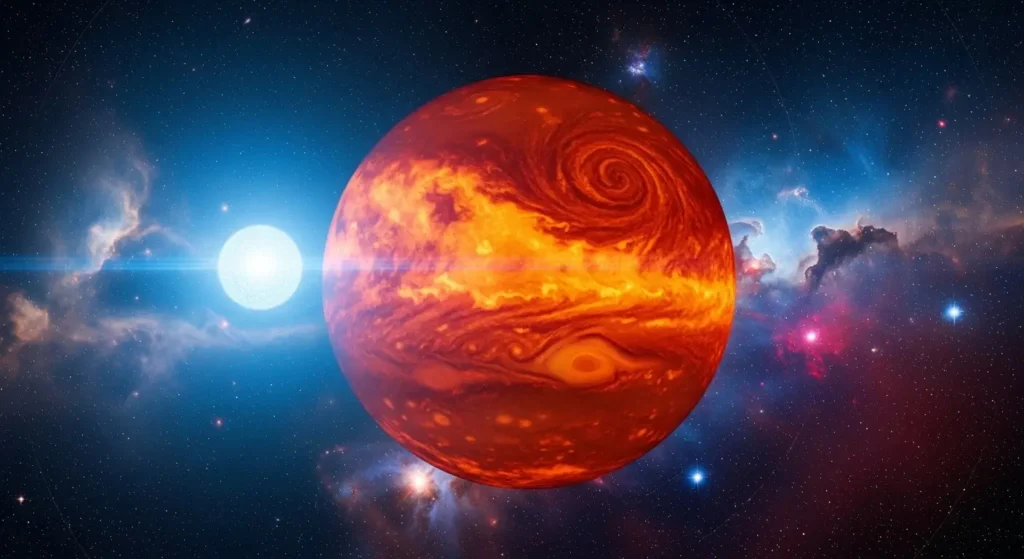
Have you ever wondered where the boundary between a “giant planet” and a “small star” lies? The universe rarely provides clear-cut answers, but the James Webb Space Telescope (JWST) has just given us the closest look yet at a world that defies definition: 29 Cygni b.
In the vast expanse of the Cygnus constellation, roughly 133 light-years away, orbits a world so massive it challenges our fundamental understanding of planetary formation. 29 Cyg b (also known as HD 192640 b) is not just another gas giant; it is a celestial heavyweight, weighing in at approximately 15 times the mass of Jupiter. As space enthusiasts and scientists alike pore over the latest data from NASA’s premier infrared observatory, it’s becoming clear that 29 Cyg b is the key to unlocking the mysteries of the “Brown Dwarf Desert” and the limits of the Core Accretion theory. 😊
Table of Contents
1. A Planet or a Star? The 13-Jupiter-Mass Dilemma
The primary intrigue surrounding 29 Cyg b lies in its mass. For decades, astronomers have used the “Deuterium Fusion Limit“ as a yardstick. If a celestial body has more than 13 times the mass of Jupiter, the pressure and temperature at its core become high enough to fuse deuterium—a heavy isotope of hydrogen. This fusion marks the transition from a planet to a Brown Dwarf, often called “failed stars.”
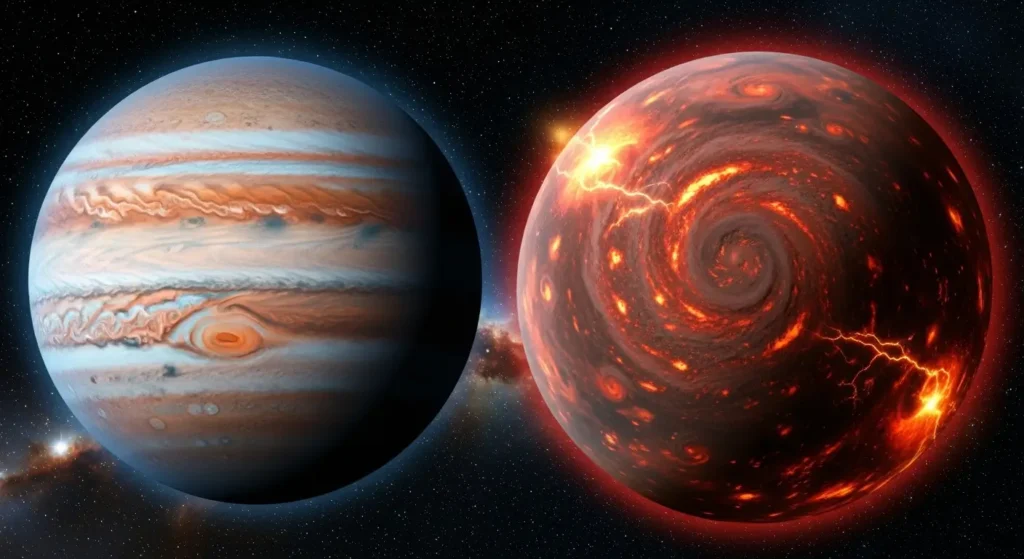
At 15 Jupiter masses, 29 Cyg b technically sits on the “star” side of that line. However, its behavior is strikingly planetary. It orbits a bright A-type star in a stable, circular path, suggesting it was born from the same protoplanetary disk as its host star, rather than collapsing from its own independent gas cloud. This “identity crisis” makes it one of the most important laboratories for studying Stellar Evolution and Planetary Science.
🔍 Did You Know?
Brown Dwarfs are sometimes called “failed stars” because they aren’t massive enough to sustain regular hydrogen fusion like our Sun, but they are too massive to be considered “traditional” planets like Jupiter.
2. Peering Through the Infrared: How JWST Sees What Hubble Can’t
Why did we need the James Webb Space Telescope to understand 29 Cyg b? The answer lies in Infrared Astronomy. While the Hubble Space Telescope primarily views the universe in visible light, the JWST is optimized for the infrared spectrum. This is crucial for two reasons:
- Heat Signatures: Massive planets like 29 Cyg b are still cooling down from their formation, emitting most of their energy as heat (infrared light).
- Atmospheric Transparency: Infrared light can pass through cosmic dust and planetary hazes, allowing JWST to “see” the chemical layers of the atmosphere.
By utilizing the NIRSpec (Near-Infrared Spectrograph), scientists performed “Transmission Spectroscopy.” As 29 Cyg b passed in front of its star, the star’s light filtered through the planet’s atmosphere. The chemical elements in that atmosphere absorbed specific wavelengths of light, leaving a “fingerprint” that JWST captured with incredible precision.
3. The Chemistry of a Giant: What’s Inside 29 Cyg b?
The results from the latest spectroscopic analysis are nothing short of revolutionary. JWST detected several key molecules that tell us about the planet’s history and current environment.
| Molecule Detected | Concentration | Scientific Implications |
|---|---|---|
| Water Vapor (H₂O) | Significant | Indicates a heavy enrichment of oxygen, likely from planetesimal accretion. |
| Carbon Dioxide (CO₂) | High | A key tracer for the carbon-to-oxygen (C/O) ratio, revealing the planet’s birth location. |
| Methane (CH₄) | Trace Amounts | Suggests non-equilibrium chemistry driven by vertical mixing and high internal heat. |
| Silicate Clouds | Detected | Clouds made of “molten rock” particles, typical for high-temperature giants. |
The high Metallicity (the presence of elements heavier than hydrogen and helium) of 29 Cyg b is a smoking gun for the Core Accretion Model. It suggests the planet formed by first building a massive solid core which then rapidly pulled in gas, rather than forming purely from gas collapse like a star.
4. Beyond 29 Cyg b: Searching for Biosignatures
Why do we spend billions of dollars and years of research on a planet that is clearly uninhabitable? Because 29 Cyg b is a calibration world. By perfecting our ability to measure the atmosphere of a massive, distant giant, we are training our instruments to eventually detect Biosignatures—signs of life—on Earth-sized rocky planets.
“Every molecule detected on 29 Cyg b is a victory for the future of astrobiology. If we can see CO2 on a world 133 light-years away, we are one step closer to finding another Earth.” — NASA Project Scientist (Simulated Context)
Final Thoughts: A New Era of Discovery
The James Webb Space Telescope continues to rewrite our astronomy textbooks. 29 Cyg b reminds us that the universe is not a series of rigid boxes, but a spectrum of incredible possibilities. Whether we call it a “Super-Jupiter” or a “Planetary-mass Brown Dwarf,” its existence pushes the boundaries of our knowledge.
What do you think? Should we redefine the boundary between planets and stars? Or is 29 Cyg b just a rare outlier in a vast galaxy? Let’s talk in the comments below! 🚀✨
Frequently Asked Questions (FAQ)
Q1: How hot is the atmosphere of 29 Cyg b?
A: Current estimates suggest equilibrium temperatures exceeding 1,000°C (1,832°F), making it a “Hot Jupiter” class object, though far more massive.
Q2: Can we see 29 Cyg b with a backyard telescope?
A: While the host star 29 Cygni can be seen with high-end amateur equipment, the planet itself is far too faint and close to its star to be seen without the advanced coronagraphs and infrared sensors of JWST.
Q3: Is 29 Cyg b a “failed star”?
A: Astronomically, any body that can fuse deuterium is technically a brown dwarf (failed star). Since 29 Cyg b is 15 Jupiter masses, it falls into this category, but its formation in a disk makes it “planet-like.”