Unveiling R136’s Secret: Have you ever wondered what cosmic dramas unfold in the glittering starscapes we admire? We’re diving deep into the R136 cluster, where 55 colossal stars were just caught making a dramatic escape. This isn’t just a stellar soap opera; it’s a clue that could unlock one of the biggest mysteries of the early universe.
As someone who has spent countless nights gazing at the cosmos, I’ve always seen the night sky as a canvas of epic stories. But nothing could have prepared me for this one. It’s a tale of cosmic runaways, a high-speed chase across galaxies, and a profound connection to our own origins. We’re not just talking about a few wandering stars; we’re talking about a mass exodus from one of the most extreme places in the universe, and it’s happening right in our cosmic backyard. Let’s journey together to the heart of the Large Magellanic Cloud and uncover the incredible story of R136 and its 55 ‘hypervelocity‘ fugitives. It’s a discovery that truly changes how we see the dawn of the universe. 😊
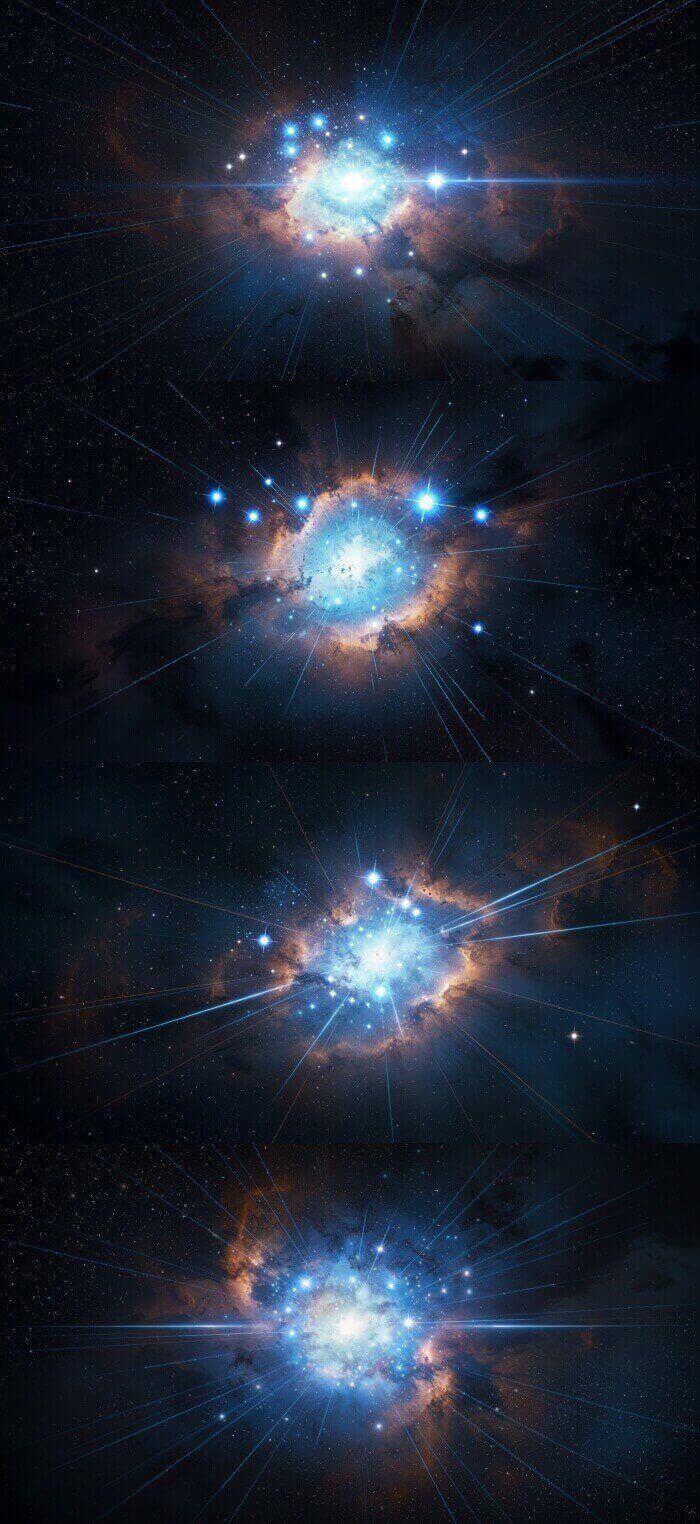
R136: The Universe’s Most Extreme Star Nursery 🤔
Imagine a place crammed with the biggest, brightest, and most massive stars known to exist. That’s the R136 star cluster for you. Located about 160,000 light-years away in the heart of the Large Magellanic Cloud, a satellite galaxy of our own Milky Way, R136 is a true cosmic metropolis. I often think of it as a ‘cosmic pressure cooker.’ The density of stars here is unbelievable—many of which are over 100 times the mass of our Sun.
In such a crowded and chaotic environment, gravitational interactions are incredibly intense. It’s a place where stars are constantly pushing and pulling on each other in a complex cosmic dance. It’s this very intensity that sets the stage for one of the most spectacular phenomena in the universe: the creation of runaway stars.
💡 What’s a Runaway Star?
A ‘runaway star’ (or a hypervelocity star) is a star that has been ejected from its home cluster and is traveling through space at incredibly high speeds. This usually happens due to gravitational encounters with other stars or the supernova explosion of a binary companion. They are cosmic cannonballs, shot out into the vastness of space.
The Great Escape: Gaia Spots 55 Fugitives 🔭
Recently, astronomers using data from the European Space Agency’s Gaia space telescope made a groundbreaking discovery. They identified a staggering 55 runaway stars being violently ejected from R136. This isn’t a slow drift; these are colossal stars hurtling through space at extreme velocities. Gaia’s incredible precision allowed scientists to track their movements and trace their origins right back to the chaotic heart of R136.
By analyzing the trajectories of these stellar fugitives, researchers have pieced together the story of their escape. The evidence points to two major events:
- Initial Gravitational Chaos: About 1.8 million years ago, during the cluster’s formation, intense gravitational interactions in the dense core likely flung the first wave of stars out.
- A Close Encounter: More recently, around 200,000 years ago, a neighboring star cluster passed by, causing a gravitational disturbance that ejected even more stars.
📝 A Tale of Two Ejections
The discovery of two distinct timing events for the ejections provides a fascinating look into the dynamic history of star clusters. It shows that these environments are not static but are shaped by both internal dynamics and external influences over millions of years.
Solving the Mystery of Cosmic Reionization 🌌
So, why is this cosmic jailbreak so important? Because it might just solve one of the biggest puzzles about the early universe: the era of Cosmic Reionization. After the Big Bang, the universe was a dark, neutral fog. But something happened that ionized this gas, making the universe transparent to light—the universe we see today. For years, we’ve debated what could have produced enough energy to do this.
The leading theory is that the first massive stars were responsible. And here’s where the R136 runaways come in. These massive stars, ejected from their clusters, would have traveled far and wide across the early cosmos. They live fast and die young, ending their lives in spectacular supernova explosions. These explosions release immense amounts of high-energy ultraviolet (UV) radiation.
⚠️ The Connection is Key!
If countless massive stars, just like the ones escaping R136, were ejected across the early universe, their combined UV radiation from their supernova deaths could have been powerful enough to ionize the neutral gas everywhere. This would have effectively lifted the cosmic fog and ended the cosmic dark ages. The drama in R136 could be a small-scale model of a process that transformed the entire universe.
💡
R136’s Great Escape Explained
The Location:R136, a massive star cluster in the Large Magellanic Cloud, 160,000 light-years away.
The Discovery:The Gaia telescope identified 55 massive stars being ejected from the cluster at high speeds.
The Cause:
Intense Gravity + Cluster Dynamics = Stellar Ejections
The Implication:These runaway stars could be a modern analog for the stars that ended the universe’s Dark Ages.
This discovery connects the lifecycle of stars to the grand history of the cosmos.
Conclusion: A Treasure Trove in Our Backyard 📝
For me, this is what makes astronomy so thrilling. We don’t always have to look billions of light-years away to find answers to the biggest questions. Sometimes, the clues are right next door, in cosmic laboratories like the Magellanic Clouds. The great escape from R136 is a powerful reminder that the universe is an incredibly dynamic, interconnected place, where the life and death of stars in a nearby galaxy can tell us about the dawn of everything.
It’s a beautiful, violent, and awe-inspiring story, and we are incredibly fortunate to be able to witness it. What do you think about this cosmic drama? Do you believe these runaway stars hold the key to our universe’s history? Share your thoughts in the comments below! 😊
Frequently Asked Questions ❓
Q: What exactly is a runaway star?
A: It’s a star that has been ejected from its original star cluster due to strong gravitational interactions. Think of it like a slingshot effect, where a close encounter with another massive star or a binary system flings it out into space at very high speed.
Q: How did the Gaia telescope find these stars?
A: The Gaia telescope is on a mission to create the most precise 3D map of the Milky Way. It measures the positions, distances, and motions of billions of stars with incredible accuracy. By analyzing this motion data, astronomers could identify the stars moving rapidly away from R136 and trace their paths backward to the cluster.
Q: What is Cosmic Reionization and why is it important?
A: It was a major event in the early universe, about 13 billion years ago. The universe, which was filled with a fog of neutral hydrogen gas after the Big Bang, was “re-ionized” by the first sources of light. This made the universe transparent, allowing light to travel freely and enabling the formation of the galaxies and structures we see today. It essentially marks the end of the cosmic “dark ages.”
Q: How many stars are in the R136 cluster?
A: R136 is an extremely dense cluster containing hundreds of young, massive, and luminous stars. It is famous for containing some of the most massive stars ever discovered, several exceeding 150 times the mass of our Sun.