What is the Sun’s life cycle? Explore the complete journey of our star, from its current main-sequence stability to its future as a red giant, planetary nebula, and white dwarf.
It’s the most constant thing in our lives. Every morning, we’re greeted by its light, a celestial engine that has faithfully powered our planet for billions of years. Our Sun is the heart of our solar system, the source of all energy and life on Earth. It feels permanent, eternal. But it’s not.
Like all stars, the Sun is a dynamic, evolving object with a finite lifespan. It had a birth, it is currently in its long “adulthood,” and it will one day have a dramatic and spectacular death. Understanding the Sun’s life cycle isn’t just an astronomical curiosity; it’s the story of our own solar system’s past, present, and ultimate future.
So, what exactly is the story of our Sun? As a stellar astrophysicist, this is one of the most fundamental questions we explore. We’re going to walk through the complete, scientifically-backed timeline of our star’s life—from its stable prime to its final, quiet exit.
Table of Contents
- The Sun Today: A Main-Sequence Star in its Prime
- The Beginning of the End: The Subgiant Phase
- The Great Expansion: The Sun’s Red Giant Phase
- The Final Stages of the Sun’s Life Cycle
- The Long Goodbye: The Sun’s Theoretical End
- Conclusion: Our Place in the Sun’s Vast Timeline
- Frequently Asked Questions (FAQ) About the Sun’s Life Cycle
The Sun Today: A Main-Sequence Star in its Prime
Right now, our Sun is in the most stable and longest phase of its life: the main sequence. It has been in this phase for about 4.6 billion years and is currently about halfway through its main-sequence lifespan.
This stability is defined by a perfect, elegant balance.
How Nuclear Fusion Powers the Sun
At the Sun’s core, where temperatures soar to 27 million degrees Fahrenheit (15 million degrees Celsius), the immense pressure and heat force hydrogen atoms to fuse together, creating helium. This process, called nuclear fusion, releases an unimaginable amount of energy.
This energy, in the form of light and heat, pushes outward from the core. This outward pressure perfectly counteracts the crushing inward pull of the Sun’s own gravity. This balance is known as hydrostatic equilibrium, and it’s what keeps our Sun a stable, consistent size and brightness.
The Sun’s Current “G2V” Status and Lifespan
Astronomers classify the Sun as a G-type main-sequence star, or “G2V”—a yellow dwarf. It’s a fairly average, low-mass star in the grand scheme of the cosmos, which is great for us. Its stability has allowed complex life to evolve on Earth over billions of years.
The Sun will continue to burn hydrogen in its core for another 5 billion years. But as it ages, it is gradually getting hotter and more luminous (about 10% brighter every billion years). This slow change will one day make Earth uninhabitable, long before the Sun’s life cycle truly ends.
The Beginning of the End: The Subgiant Phase
In about 5 billion years, the Sun will face its first major crisis: it will run out of hydrogen fuel in its core.
When the core’s hydrogen fusion ceases, the outward pressure stops. Gravity instantly wins the battle, and the core—now composed of inert helium “ash”—will begin to contract and heat up.
This contraction will heat the layers *around* the core, until a shell of hydrogen surrounding the core becomes hot and dense enough to ignite. This is the Subgiant Phase. The Sun will begin burning hydrogen in a shell, and its outer layers will start to expand. It will grow larger and its surface will cool slightly, becoming more orange. This is the transition period, and it marks the end of the Sun’s stable main-sequence life.
The Great Expansion: The Sun’s Red Giant Phase
As the hydrogen-burning shell dumps more and more helium “ash” onto the contracting core, the core gets hotter and denser. This, in turn, makes the hydrogen shell burn even more furiously.
This runaway process forces the Sun’s outer envelope to expand to a monstrous size. The Sun will swell to over 100 times its current diameter, becoming a Red Giant. Its surface will be cooler (hence the red color), but its total luminosity will be thousands of times greater due to its immense size.
During this phase, the Sun will engulf the orbits of Mercury and Venus. Earth’s fate is less certain; it may be consumed, or it may be pushed into a wider orbit. Even if it survives being swallowed, the intense radiation will boil away our oceans and strip our planet of its atmosphere.
The Helium Flash: A New Beginning
While the outer layers are expanding, the inert helium core continues to contract and heat up. Eventually, after hundreds of millions of years in the Red Giant phase, the core will reach the critical temperature of 100 million degrees Celsius.
At this point, helium fusion ignites. In a low-mass star like the Sun, this happens in a runaway event called the Helium Flash. For a few minutes, the core produces more energy than all the stars in the Milky Way combined, but this energy is absorbed by the star’s upper layers.
This new energy source causes the Sun to shrink, becoming smaller and hotter than it was as a Red Giant. It will now be stably burning helium into carbon and oxygen in its core.
The Asymptotic Giant Branch (AGB) and Earth’s Fate
This helium-burning stability is short-lived, lasting only about 100 million years. When the *core* helium runs out, the core (now made of carbon and oxygen) will contract again.
This triggers a second expansion. The Sun will have two burning shells: an inner helium-burning shell and an outer hydrogen-burning shell. This is the Asymptotic Giant Branch (AGB) phase. The Sun will become even larger and more luminous than its first Red Giant phase. It is during this final expansion that Earth’s orbit is almost certain to be enveloped by the Sun.
This double-shell burning is unstable, leading to “thermal pulses” that puff off the Sun’s outer layers into space.
The Final Stages of the Sun’s Life Cycle
The Sun’s core is not massive enough to ignite carbon fusion. After the AGB phase, its life as an energy-producing star is over. What happens next is a beautiful, cosmic farewell.
The Cosmic Artwork: A Planetary Nebula
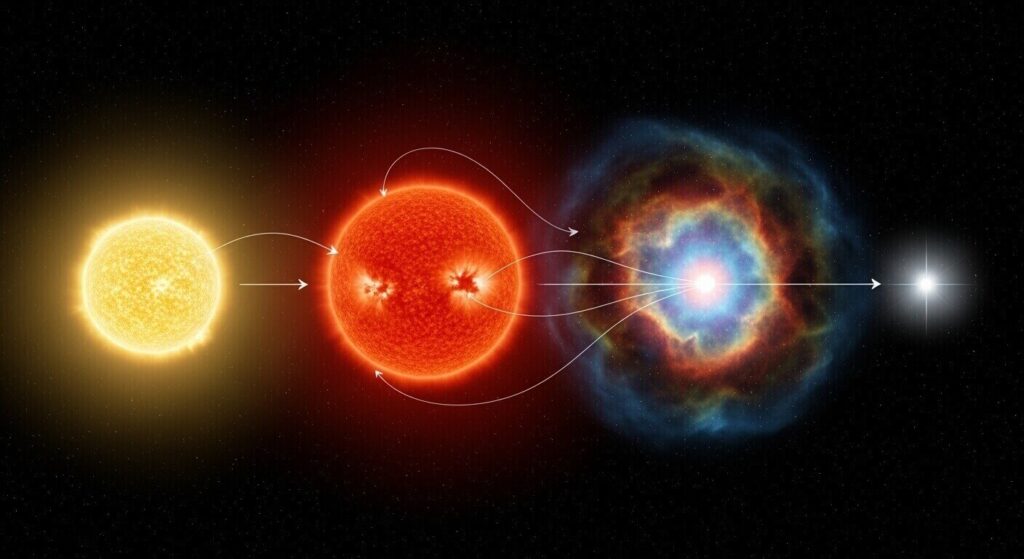
The thermal pulses during the AGB phase will have ejected all of the Sun’s outer layers. These shells of gas will drift outward, expanding into space to form an intricate, glowing structure called a Planetary Nebula. (The name is a historical misnomer; it has nothing to do with planets).
The nebula glows because the hot, exposed core at its center illuminates it with intense ultraviolet radiation, causing the gases to fluoresce in brilliant colors.
The Stellar Remnant: A White Dwarf
Left behind at the center of the nebula is the Sun’s dead core: a White Dwarf.
This stellar remnant will be incredibly dense—it will contain about 50-60% of the Sun’s original mass crushed into an object roughly the size of Earth. A single teaspoon of white dwarf material would weigh several tons.
The White Dwarf no longer produces new energy. It’s simply a “stellar ember,” shining brightly due to the immense residual heat from its past life.
The Long Goodbye: The Sun’s Theoretical End
Over an almost unimaginable timescale—tens of billions, then trillions of years—the Sun’s White Dwarf will slowly radiate its remaining heat into the void of space.
Its glow will fade from white-hot to yellow, to orange, to red, and finally, it will become cold, dark, and invisible. Scientists theorize this final state is a Black Dwarf—a cold, dead stellar remnant.
However, the universe is only 13.8 billion years old. The time it takes for a White Dwarf to cool into a Black Dwarf is longer than the current age of the universe. Therefore, no Black Dwarfs are thought to exist… yet.
Conclusion: Our Place in the Sun’s Vast Timeline
The Sun’s life cycle is a 10-billion-year epic. We are fortunate to exist during its long, stable, main-sequence phase. This stability provided the predictable environment necessary for life to arise and flourish.
While the Sun’s eventual end in 5 billion years is a dramatic one, it’s not something we need to worry about. What it does give us is perspective. It underscores the preciousness of our planet and the specific, fleeting moment in cosmic time that we inhabit. Understanding stellar evolution shows us that the universe is in a constant state of change, birth, and death—and that the very elements in our bodies were forged in the hearts of stars that lived and died long ago.
Frequently Asked Questions (FAQ) About the Sun’s Life Cycle
Q: How much longer will the Sun last?
A: The Sun will remain in its stable main-sequence phase, much as it is now, for another 5 billion years. After that, it will begin its transition into a red giant, a process that will unfold over hundreds of millions of years.
Q: Will the Sun explode as a supernova?
A: No. The Sun is not massive enough to explode as a supernova. Supernovae are the violent deaths of stars at least 8-10 times more massive than our Sun. Instead, the Sun will end its life by gently shedding its outer layers to form a planetary nebula, leaving a white dwarf behind.
Q: What will happen to Earth when the Sun becomes a red giant?
A: This is the end of life on Earth. As the Sun expands into a red giant, its luminosity will increase dramatically. It will first boil away Earth’s oceans and scorch the surface, making life impossible. It is highly likely that during its final AGB phase, the Sun’s expanding outer layers will physically engulf and vaporize the planet.
Q: What is a white dwarf made of?
A: A white dwarf, like the one our Sun will become, is primarily composed of carbon and oxygen—the “ash” left over from helium fusion. This material is in an exotic state called “electron-degenerate matter,” which is what makes it so incredibly dense.
Q: Have scientists seen other stars go through this life cycle?
A: Yes. By observing billions of stars at different stages of their lives, astronomers have pieced together this complete life cycle. We see countless main-sequence stars like our Sun, many red giants, and thousands of beautiful planetary nebulae, each with a white dwarf at its center. This observational evidence is what gives us such high confidence in this model.