Explore the ultimate fate of our solar system. This expert guide details the death of the Sun, from its expansion into a red giant that will engulf planets to its final phase as a cooling white dwarf. Understand the science behind the Sun’s life cycle and its profound implications for Earth.
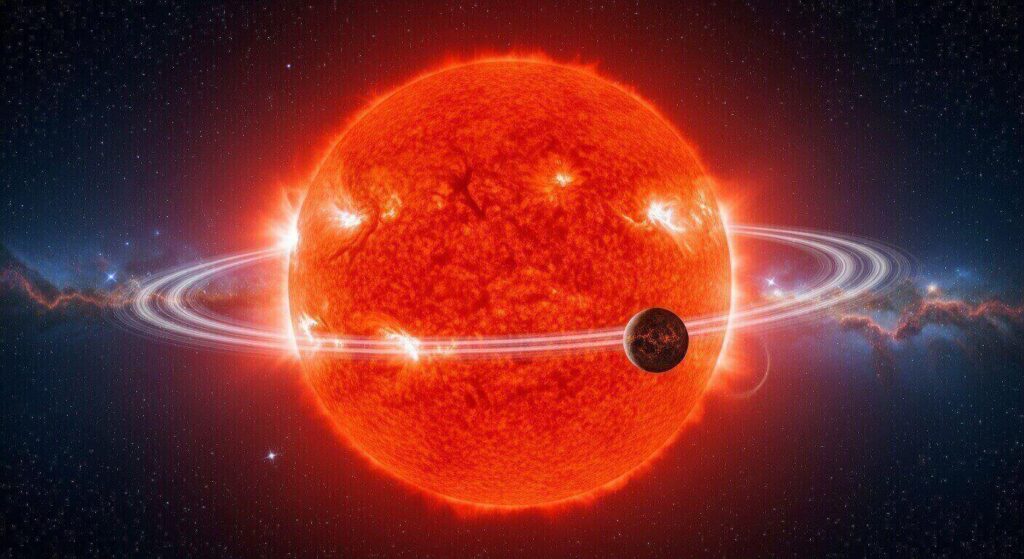
Our Sun, the brilliant star at the center of our solar system, feels like a permanent fixture in the sky. It provides the light and warmth essential for life on Earth. However, like all stars, the Sun has a finite lifespan and will one day undergo a dramatic and transformative death. This process, unfolding over billions of years, will reshape our entire solar system. Understanding the death of the Sun is not just an astronomical curiosity; it’s a journey into the fundamental principles of stellar evolution, physics, and our own cosmic future. In this article, we’ll explore the complete timeline of the Sun’s demise, based on the latest scientific understanding.
Table of Contents
- 1. The Sun’s Current State: A Middle-Aged Star
- 2. The Beginning of the End: The Sun’s Red Giant Phase
- 3. A Cosmic Ghost: The Planetary Nebula
- 4. The Final Remnant: The White Dwarf
- 5. The Long Fade: From White Dwarf to Black Dwarf
The Sun’s Current State: A Middle-Aged Star
Currently, our Sun is in the most stable and longest phase of its life, known as the “main sequence.” It’s about 4.6 billion years old, roughly halfway through its 10-billion-year main-sequence lifespan. At its core, the immense pressure and temperature (about 15 million degrees Celsius) drive a process called nuclear fusion. Every second, the Sun fuses about 600 million tons of hydrogen into helium.This reaction converts a tiny fraction of mass into a colossal amount of energy, as described by Einstein’s famous equation, $E=mc^2$. This energy radiates outward, providing the light and heat that sustains our planet and counteracting the crushing force of the Sun’s own gravity, keeping it in a stable equilibrium.
The Beginning of the End: The Sun’s Red Giant Phase
In about 5 billion years, the hydrogen fuel in the Sun’s core will be depleted. Without the outward energy pressure from hydrogen fusion, gravity will take over and begin to compress the core. This compression will cause the core, now rich in helium, to heat up dramatically. While the core shrinks, the intense heat it generates will cause the Sun’s outer layers of hydrogen to ignite in a shell around the core. This new burst of energy will push the outer layers outward, causing the Sun to swell to an immense size. This is the Red Giant phase.
The Fate of the Inner Planets
As a red giant, the Sun will grow more than 200 times its current size, becoming large enough to engulf the orbits of Mercury, Venus, and possibly Earth.Even if Earth is not swallowed whole, its surface will be scorched, its oceans will boil away, and its atmosphere will be stripped away by the intense solar winds.The planet will become a molten, lifeless rock. During this phase, the Sun’s surface temperature will actually cool, giving it a reddish hue, but its vastly increased size will make it up to 2,700 times more luminous than it is today.
A Cosmic Ghost: The Planetary Nebula
After the red giant phase, the Sun’s core will become hot enough (around 100 million degrees Celsius) to begin fusing helium into carbon and oxygen. However, this helium fuel will also eventually run out. When it does, the Sun isn’t massive enough to ignite carbon fusion. Gravity will again compress the core, while the outer layers are pushed further away. The Sun will become unstable, pulsating and shedding its outer layers into space over a period of about 100,000 years.
These expelled layers of gas and dust will form a vast, glowing structure known as a planetary nebula. The name is a historical misnomer; they have nothing to do with planets but appeared as glowing discs to early astronomers using small telescopes. This nebula will be illuminated by the intense ultraviolet radiation from the hot, exposed core, creating a beautiful, short-lived cosmic spectacle. The material from the nebula, enriched with elements like carbon, will eventually disperse and mix with the interstellar medium, providing the raw materials for the next generation of stars and planets.
The Final Remnant: The White Dwarf
Once the planetary nebula has drifted away, all that will remain of our Sun is its incredibly hot, dense core: a white dwarf. This stellar remnant will be roughly the size of Earth but will contain about 62% of the Sun’s original mass. This makes it extraordinarily dense; a single teaspoon of white dwarf material would weigh several tons on Earth.
The Physics of a White Dwarf
A white dwarf no longer produces energy through nuclear fusion. It shines only because it is still intensely hot from its past life. So, what stops gravity from crushing it into an even smaller object? The answer lies in a quantum mechanical principle called electron degeneracy pressure. The electrons within the white dwarf are packed so tightly that they resist being squeezed any further, creating a powerful outward pressure that permanently halts gravitational collapse. However, there is a limit to this pressure. A white dwarf cannot be more massive than about 1.44 times the mass of our Sun—a threshold known as the Chandrasekhar limit. Fortunately, our Sun is well below this limit and is destined to end its life as a stable white dwarf.
The Long Fade: From White Dwarf to Black Dwarf
The final chapter in the story of the Sun’s death is a long and quiet one.The white dwarf, with no internal energy source, will spend trillions of years slowly radiating its remaining heat into the cold vacuum of space. Its initial temperature will be over 100,000 degrees Celsius, but it will gradually cool, fading from brilliant white to yellow, then orange, and finally to a dim red. Eventually, after a timescale far longer than the current age of the universe (13.8 billion years), it will cool completely and no longer emit any significant light or heat. At this point, it will become a cold, dark, and invisible object known as a black dwarf—the final, frozen corpse of our once-mighty Sun. As the universe is not yet old enough, no black dwarfs are thought to exist yet.
Frequently Asked Questions ❓
Q: How long until the Sun dies?
A: The Sun is expected to remain in its stable main-sequence phase for another 5 billion years. The entire process of becoming a red giant and then a white dwarf will take a few hundred million years after that.
Q: Will Earth be destroyed when the Sun becomes a red giant?
A: It is highly likely. The Sun will expand to a size that may engulf Earth’s orbit.Even if it doesn’t physically swallow the planet, the intense heat will vaporize the oceans and atmosphere, making Earth completely uninhabitable.
Q: What is a white dwarf made of?
A: The Sun’s white dwarf will be composed primarily of carbon and oxygen, the products of helium fusion in its core. It will be made of an exotic form of matter called “degenerate matter,” which is incredibly dense.
Q: Do all stars die in the same way as the Sun?
A: No. A star’s fate is determined by its mass. Stars much smaller than the Sun (red dwarfs) will simply fade away after trillions of years.Stars much more massive than the Sun (more than 8 times its mass) will end their lives in a cataclysmic supernova explosion, leaving behind a neutron star or a black hole.
핑백: Betelgeuse: Will Orion's Giant Star Explode Soon? The Full Story
핑백: 'Ammonite' (2023 KQ12): The Tiny Object Forcing a Rethink of Our Solar System