The Crysales Generation Ship is humanity’s 400-year ‘Plan B’ for interstellar travel to Proxima Centauri b. Discover the nuclear fusion tech, artificial gravity design, and psychological challenges of this epic journey.
The dream of reaching for the stars is as old as humanity itself. We look up at the night sky and wonder, “Are we alone?” and, perhaps more urgently, “If this world fails, do we have a Plan B?” For a species confined to a single, fragile planet, the concept of interstellar colonization isn’t just science fiction; it’s a potential long-term survival strategy.
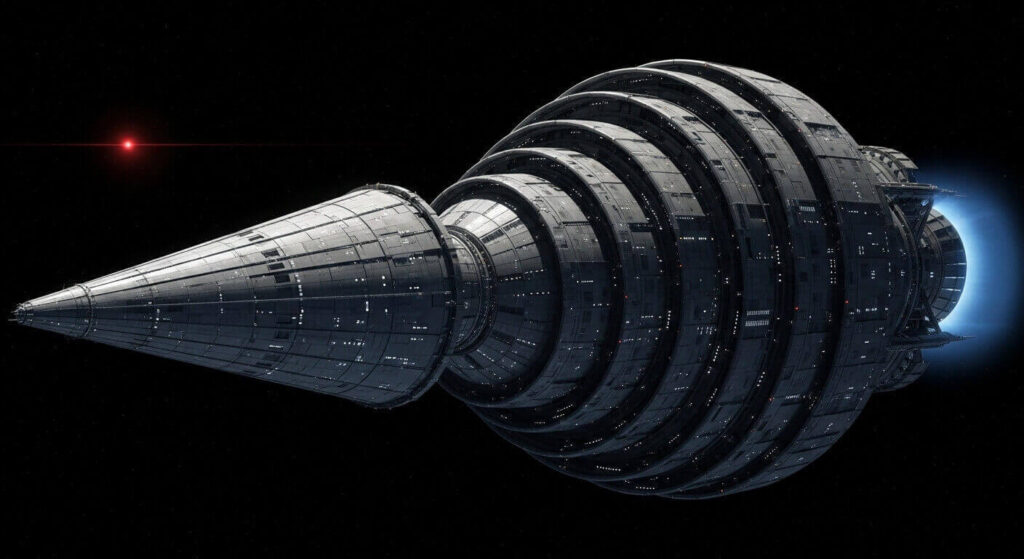
Recently, a groundbreaking concept emerged from the Hyperion Design Contest, securing first place and capturing the imagination of scientists and dreamers alike. It’s called Crysales: a massive, 400-year interstellar generation ship designed for one purpose: to carry the seed of humanity to our nearest celestial neighbor, Proxima Centauri b.
But this isn’t a simple trip. It’s a journey that no living person will see the end of. It requires technology we haven’t perfected, for a destination we’ve never seen, carrying a society that must endure for centuries in the dark. This article delves into the incredible engineering, profound human challenges, and the distant, alien hope of the Crysales project.
Table of Contents
- What is the Crysales Interstellar Generation Ship?
- The Engineering of a 400-Year Journey: Crysales’s Design
- The Heart of the Mission: Nuclear Fusion Propulsion
- Life Aboard: A ‘Matryoshka’ for Artificial Gravity
- The Human Element: Psychology of a Generation Ship
- Destination Proxima Centauri b: A New Earth?
- The Stark Realities of Proxima b’s Habitability
- Is the Crysales Project Feasible?
- Conclusion: Humanity’s Next Giant Leap
- Frequently Asked Questions (FAQ)
What is the Crysales Interstellar Generation Ship?
The Crysales is not your typical spacecraft. It’s a self-contained, mobile city—a true “generation ship.” This term is critical: it means the original crew who launches from Earth will not be the ones who arrive at Proxima Centauri b. Their children, grandchildren, and great-grandchildren will. The journey is estimated to take 400 years.
This concept, which won the Hyperion Design Contest, tackles the immense challenge of crossing the 4.24 light-years to our nearest neighboring star system. It’s designed as a fully enclosed biosphere, a “Plan B” ark intended to preserve not just human life, but a complex cross-section of Earth’s biology and knowledge.
The Engineering of a 400-Year Journey: Crysales’s Design
To survive for four centuries in the hostile vacuum of space, the Crysales requires a design that is robust, redundant, and completely self-sufficient. Its engineers devised a brilliant structure inspired by a simple Russian doll.
The ‘Matryoshka’ Concept: A World Within a World
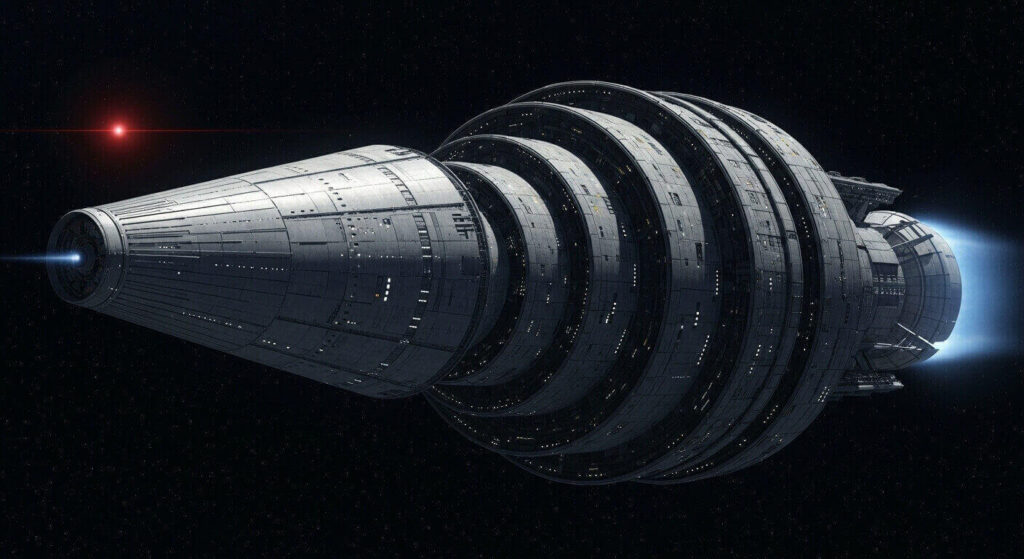
The ship’s architecture is based on the ‘Matryoshka’ doll. It features a series of nested, concentric layers built around a central core. This entire structure, stretching an incredible 36 miles in length, is designed to rotate.
Why this design? It solves two of the biggest problems of long-term space travel simultaneously: artificial gravity and resource management. The rotation provides the gravity, while the layers create a closed-loop ecosystem.
A Closed-Loop Ecosystem for Survival
The different layers of the Crysales are not just for structural integrity; each serves a vital function for the city-ship’s survival.
- Food Production Layer: Located nearest the core, this is the agricultural heart of the ship. It would contain vast factory farms for plants, fungi, and—critically for a closed system—insects, which are an incredibly efficient source of protein. This layer would also house livestock to preserve genetic diversity and provide traditional food sources.
- Social & Emotional Layer: Humans don’t just need food; they need community. This layer contains the habitats, parks, schools, libraries, and hospitals. It’s designed to mimic Earth’s environment to combat the intense psychological pressures of confinement and homesickness.
- Operational & Support Layer: The “engine room” of the society. This outer layer would house the core technology: life support systems, air and heat circulation, vast waste recycling plants, construction factories for repairs, and resource storage.
Shielding Against the Void
When you’re traveling at a significant fraction of the speed of light, even a particle of dust can hit with the force of a bomb. The Crysales features a narrow, conical front, acting as a massive shield to deflect micrometeoroids and interstellar debris, protecting the precious habitat within.
The Heart of the Mission: Nuclear Fusion Propulsion
How do you push a 36-mile-long city across 4.24 light-years? Chemical rockets (like we use today) are out of the question; they simply can’t carry enough fuel. The answer lies in the power of the stars themselves: nuclear fusion.
The Crysales is designed to be propelled by a Helium-Deuterium (specifically, Helium-3) nuclear fusion engine. Here’s why this is the “gold standard” for theoretical interstellar travel:
- High Efficiency: Fusion releases vastly more energy per kilogram of fuel than any chemical reaction or even nuclear fission.
- “Clean” Thrust: A Helium-3/Deuterium reaction is “aneutronic,” meaning it releases most of its energy as charged particles (protons) rather than neutrons. These particles can be directed by magnetic fields to create thrust directly, with less harmful radiation damaging the engine.
Here’s the catch: We haven’t achieved sustained, net-positive fusion power on Earth yet, let alone mastered it for propulsion. This technology is the single greatest hurdle to the entire project.
Life Aboard: A ‘Matryoshka’ for Artificial Gravity
One of the most crucial keywords in this project is artificial gravity. Many sci-fi movies get this wrong, showing people walking around in zero-g for years. In reality, that’s a one-way ticket to biological collapse.
Our bodies *evolved* in gravity. Without it, our muscles atrophy, our immune systems weaken, and—most dangerously—our bones leach calcium (osteoporosis) at an alarming rate. A child born and raised in zero-g might never develop the bone density to even stand on a planet.
The Crysales’s Matryoshka design solves this elegantly. The entire 36-mile-long structure rotates, using centrifugal force to “pin” everyone and everything to the “floor” (which would be the inner surface of the outermost layer). This constant, simulated gravity would allow generations of humans to be born, live, and work in an environment that feels just like home.
The Human Element: Psychology of a Generation Ship
We can engineer the perfect ship, but can we engineer a perfect society? The 400-year duration makes the human element the most complex and fragile part of the Crysales mission. This is where the project’s “experience” and “expertise” planning truly shines.
The 70-Year Sacrifice: Training the First Generation
The first generation of the crew—the ones who will launch the ship—are the true heroes of this story. They are signing up for a mission they will never complete. They will live and die in space, never seeing their new home.
To prepare for this, the Crysales project proposes a radical training program. The first-generation crew would spend 70 to 80 years in an isolated, pre-launch environment on Earth, such as a self-sufficient base in Antarctica. They would prove the closed-loop systems and, more importantly, prove they have the psychological fortitude and altruism to dedicate their entire lives to a future they will not inherit.
The ‘Middle Generation’ Problem
The first generation has the mission. The final generation has the destination. But what about the generations in between?
This is a known psychological trap for generation ship concepts. These “middle generations” are born in transit and will die in transit. They have no memory of Earth and no tangible hope of Proxima b. They could be prone to nihilism, rebellion, or a loss of the mission’s core purpose.
Crysales’s solution relies on:
- Education: A robust system, likely run by AI and human experts, to continuously instill the mission’s value and teach the skills needed for arrival.
- Population Stability: The ship requires a minimum population of 1,500 to maintain genetic diversity and a functional society. This population would need to be carefully managed.
- Purpose: The ship must be a place of constant work and meaning—maintaining the ecosystem, running the reactors, and studying the stars.
Destination Proxima Centauri b: A New Earth?
So, after 400 years, where does this ark land? The destination is Proxima Centauri b, an exoplanet orbiting the closest star to our sun. Discovered in 2016, it’s one of the most tantalizing prospects for a habitable world.
The Good News:
- Size: It’s a rocky planet, just 1.1 times the mass of Earth.
- Location: It orbits within its star’s “habitable zone,” the sweet spot where temperatures are right for liquid water to exist on the surface.
The presence of liquid water is the holy grail for habitability, as it’s the one ingredient all life as we know it requires.
The Stark Realities of Proxima b’s Habitability
While Proxima b is promising, it is not Earth. Landing there will be the final, and perhaps greatest, challenge for the Crysales’s descendants. This is where we must be ruthlessly realistic.
The Tidal Lock Challenge
Proxima b orbits its star, Proxima Centauri (a red dwarf), very closely. This proximity means it is likely “tidally locked.” Just as we only ever see one side of our Moon, Proxima b likely has one side in perpetual, scorching daylight and one side in eternal, freezing night. Human life might only be possible in the “terminator zone,” the thin strip of twilight between these two extremes.
The ‘Great Circulating Ocean’ Hypothesis
The Crysales mission is betting on a specific climate model. The designers hypothesize that if Proxima b has a massive, circulating global ocean, this tidal lock might not be a deal-breaker. This ocean would act like Earth’s currents, absorbing heat from the day side and circulating it to the night side. This would distribute the star’s energy, warming the dark side and cooling the light side, potentially creating a mild, habitable climate across the entire planet.
The Red Dwarf Problem: Stellar Flares
Here is the biggest, most terrifying problem: Proxima Centauri is a red dwarf star. Unlike our stable sun, red dwarfs are notoriously violent. They unleash “superflares” thousands of times more powerful than anything our sun produces.
These flares would bathe Proxima b in lethal X-ray and UV radiation. Over millions of years, this radiation could have stripped the planet of its atmosphere and boiled away its oceans. The descendants of Crysales may arrive at a barren, radiation-blasted rock. They would need to be prepared to build underground, shielded habitats, not walk in open fields.
Is the Crysales Project Feasible?
Let’s be honest: the Crysales project is on the far edge of theoretical possibility. The original designers estimate that if—and this is a monumental ‘if’—we solve sustained nuclear fusion, construction on the ship could begin in 20 to 25 years.
But the hurdles remain immense:
- The Propulsion: We must master fusion.
- The Construction: Building a 36-mile-long object in orbit would be the largest engineering project in human history, by orders of magnitude.
- The Biology: We must create a 100% closed-loop, stable ecosystem that can last for centuries. Our best attempt on Earth, Biosphere 2, famously failed.
- The Psychology: We are betting that human society can remain stable, sane, and focused for 15+ generations in a metal can.
Conclusion: Humanity’s Next Giant Leap
The Crysales generation ship is more than a contest-winning design. It’s a profound thought experiment that forces us to confront our limitations and our deepest aspirations. It is the ultimate expression of humanity’s drive to explore and survive.
Whether a ship named Crysales ever launches, the *thinking* behind it is invaluable. To build it, we would have to master sustainable energy (fusion), perfect recycling (closed-loop systems), and truly understand the social psychology that binds us together.
Ironically, in designing the ultimate “Plan B” to escape Earth, the Crysales project gives us the exact blueprint for how to save Plan A.
Frequently Asked Questions (FAQ)
Q: What is the Crysales project?
A: Crysales is a theoretical design for an interstellar “generation ship,” which won the Hyperion Design Contest. It’s designed to carry a multi-generational crew of humans on a 400-year journey to colonize the exoplanet Proxima Centauri b.
Q: Why will the Crysales mission take 400 years?
A: The destination, Proxima Centauri b, is 4.24 light-years away. Even with advanced nuclear fusion propulsion, the ship must travel at a fraction of the speed of light. The 400-year estimate balances the speed of travel with the immense energy required to accelerate and, just as importantly, decelerate the massive ship.
Q: What is a generation ship?
A: A generation ship is a hypothetical starship that travels for a duration longer than a single human lifespan. The crew that arrives at the destination is composed of the distant descendants of the original crew who launched from Earth.
Q: Why is Proxima Centauri b the destination for the Crysales?
A: It is the closest known exoplanet to our solar system. Furthermore, it is a rocky, Earth-sized planet (1.1x Earth’s mass) and orbits in the “habitable zone” of its star, meaning it has the potential for liquid water on its surface.
Q: What is the biggest challenge for the Crysales mission?
A: There are two massive challenges. The first is technological: we must invent and master sustained nuclear fusion propulsion. The second is environmental: Proxima Centauri b orbits a volatile red dwarf star, which may bombard the planet with lethal stellar flares, potentially making it uninhabitable.