Have you ever looked at a simple glass of water and wondered where it actually came from? For decades, astronomers and planetary scientists have shared the beautiful sentiment that “we are all made of star-stuff.” Yet, one of the most stubborn and profound mysteries in modern science remains unsolved: how did Earth acquire its vast oceans? While water is abundant across the universe, tracking its precise cosmic journey to our planet has been incredibly difficult. Just when we thought we had a grasp on our solar system’s history, an unexpected visitor from the deepest corners of interstellar space arrived to completely rewrite the rulebook. 😊
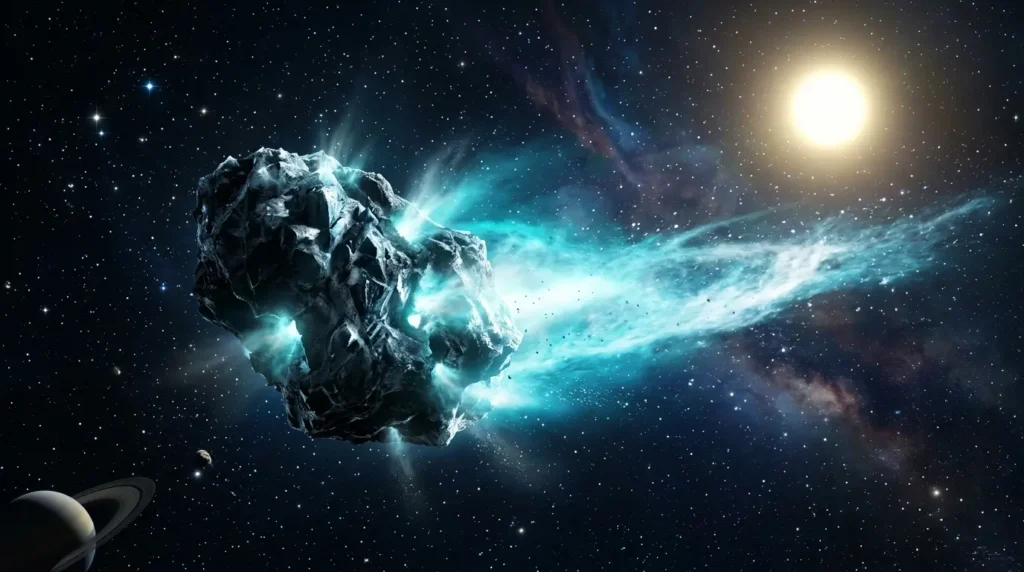
In 2025, the astronomical community was electrified by the detection of 3I/ATLAS, only the third confirmed interstellar object ever discovered passing through our solar system. Unlike ordinary comets that orbit our Sun, this cosmic nomad carried an exotic chemical signature that left scientists utterly astonished. Its unique composition suggested that the water filling our terrestrial oceans might be far more exclusive—or perhaps far more mysterious—than we ever dared to imagine. Let’s dive deep into the groundbreaking analysis of 3I/ATLAS and uncover how this lonely wanderer is illuminating the secrets of the cosmos.
1. What is Interstellar Object 3I/ATLAS? 🌌
To truly appreciate the significance of 3I/ATLAS, we first need to understand what makes an interstellar object so remarkably special. For generations, humanity could only observe extraterrestrial matter that was native to our own solar system—materials bound by the gravitational pull of our Sun since its birth roughly 4.6 billion years ago. Interstellar objects, however, are cosmic expatriates. They are born around distant, foreign stars, ejected from their home systems by violent gravitational interactions, and left to drift through the freezing void of space for millions or even billions of years before randomly crossing paths with us.
The discovery of 3I/ATLAS marks a historic milestone in modern astrophysics, building upon a very exclusive lineage of cosmic visitors:
- 1I/’Oumuamua (2017): The very first confirmed interstellar visitor, which baffled scientists with its highly elongated, cigar-like shape and non-gravitational acceleration.
- 2I/Borisov (2019): The second visitor, which looked remarkably like a traditional, pristine comet from another stellar neighborhood.
- 3I/ATLAS (2025): The third confirmed visitor, detected by the National Aeronautics and Space Administration (NASA) and automated sky surveys, which provided unprecedented chemical data regarding cosmic volatile elements.
Think of 3I/ATLAS as a pristine pristine sample delivered straight to our celestial doorstep. Instead of sending a spacecraft on a multi-millennial journey across light-years to study an exoplanet, humanity was able to train its most powerful telescopes on a tangible piece of an alien solar system passing right through our backyard.
2. Is Earth’s Water Truly Unique? The Deuterium Puzzle 💧
Water ($H_2O$) is structurally simple—just two hydrogen atoms bound to one oxygen atom. It exists in abundance within interstellar molecular clouds, giant gas planets, and the icy crusts of moons throughout our solar system. Because of this ubiquity, scientists long assumed that the water on Earth was simply a standard cosmic inheritance. However, the precise chemical analysis of 3I/ATLAS conducted via the European Southern Observatory (ESO) and global radio telescope networks shattered this assumption completely.
The key to unlocking this cosmic mystery lies in a delicate atomic ratio involving Deuterium, often referred to as “heavy hydrogen.” To understand why this matters, let us look closely at the chemical properties of water isotopes:
Deuterium ($D$) is a stable isotope of hydrogen that contains a neutron in its nucleus in addition to the standard single proton. When deuterium replaces a normal hydrogen atom in a water molecule, it forms semi-heavy water ($HDO$) or heavy water ($D_2O$). The ratio of Deuterium to Hydrogen ($D/H$ ratio) acts as an immutable cosmic fingerprint, telling scientists exactly where, when, and under what thermal conditions that specific water was frozen into existence.
When astrophysicists utilized the ultra-sensitive Atacama Large Millimeter/submillimeter Array (ALMA) in Chile to analyze the sublimating gases of 3I/ATLAS as it neared the Sun, they discovered something extraordinary. The $D/H$ ratio of the water locked inside 3I/ATLAS was an astonishing 40 times higher than that of Earth’s oceans. This massive discrepancy means that the water dominating 3I/ATLAS has a completely different evolutionary history compared to the water we drink every day.
| Astronomical Body / Source | Relative D/H Ratio Profile | Implied Formation Environment |
|---|---|---|
| Earth’s Oceans | Baseline ($1.56 \times 10^{-4}$) | Inner Solar System / Carbonaceous Chondrites |
| Standard Oort Cloud Comets | ~2x Earth’s Baseline | Outer Solar System Protoplanetary Disk |
| 3I/ATLAS (Interstellar) | ~40x Earth’s Baseline | Extreme, Ultra-Cold Interstellar Environment (<30K) |
This stark contrast strongly indicates that the mechanisms providing water to terrestrial planets like Earth might be highly specific, localized events, rather than a universal certainty across all planetary configurations. It forces us to ask: what kind of extreme home environment could give birth to a body as strange as ATLAS?
3. The Cosmic Genesis: 4 Crucial Possibilities Addressed by Scientists 🌌
The unprecedented deuterium enrichment observed in 3I/ATLAS has fueled intense debate within peer-reviewed journals like Nature Astronomy. Why is its water so heavily laden with heavy hydrogen? Astrophysicists have formulated four compelling possibilities regarding its birthplace and early history:
- An Ultracold, Dark Birthplace: Deuterium enrichment in ice occurs with extreme efficiency only in deep, dark environments where temperatures plummet below 30 Kelvin (-243°C). At these sub-freezing limits, ion-molecule reactions preferentially lock deuterium into volatile structures. This indicates that 3I/ATLAS was likely forged in the deep interior of a dense, dark interstellar cloud long before its host star fully ignited.
- An Isolated Stellar Neighborhood: In crowded star clusters, intense ultraviolet (UV) radiation from neighboring massive stars routinely bakes the surrounding material, destroying heavy isotopes and homogenizing the $D/H$ ratios. Because 3I/ATLAS preserved its hyper-enriched deuterium levels, it almost certainly evolved around a lonely, isolated parent star that lacked close cosmic neighbors to disrupt its delicate chemical laboratory.
- The Extreme Edges of a Distant System: Another likely scenario is that ATLAS was born at the absolute outermost fringes of an alien planetary system—far beyond its home system’s equivalents of Neptune or the Kuiper Belt. In these distant outposts, material escapes the thermal processing, gravitational heating, and evaporation cycles that occur closer to a star, preserving the raw, primitive chemistry of the original interstellar cloud intact.
- An Infantile Ejection Event: If 3I/ATLAS had lingered inside its parent disk for hundreds of millions of years, interactions with growing giant planets would have gradually warmed its icy structure, altering its isotope ratios. Its extreme composition implies it experienced a “premature eviction”—flung out into interstellar space during the very first infancy of its solar system, effectively sealing its pristine chemical signature inside a permanent deep-freeze.
When evaluating these models, we must remember that 3I/ATLAS represents a single sample from a vast, unseen population of interstellar entities. Extrapolating its characteristics to mean that all alien solar systems are completely dry or fundamentally incompatible with Earth-like water distribution would be premature. It is a piece of a larger cosmic mosaic that we are only beginning to piece together.
4. Why 3I/ATLAS acts as an Interstellar Time Capsule ⏳
For decades, astronomers studying exoplanets had to rely on indirect measurements—peering through the faint, distorted light of stars thousands of light-years away using instruments like the James Webb Space Telescope (JWST) to detect atmospheric chemical traces. While revolutionary, this method is akin to guessing the flavor of a meal purely by looking at its steam from across a room.
3I/ATLAS completely changes the game. It is a physical, tangible artifact from a completely separate planetary system, acting as a cosmic time capsule. By analyzing its composition, scientists can directly test theories about how elements are distributed across the universe. It allows us to cross-reference our solar system’s history against external benchmarks, providing vital clues into whether the conditions that allowed life to thrive on Earth are a common cosmic occurrence or an exceedingly rare miracle.
Interactive Cosmochemical Indicator 🔢
Select a celestial body to compare its Deuterium-to-Hydrogen (D/H) signature against Earth’s oceans and instantly understand its primary cosmic environment.
Interstellar Capsule: 3I/ATLAS at a Glance
Core Insights Re-examined 📝
To wrap your head around this monumental discovery, let's look at the absolute vital pillars revealed by the study of 3I/ATLAS:
- Interstellar Tracking: Confirming a 3rd visitor solidifies the fact that interstellar object transits are regular occurrences, giving us continuous opportunities to evaluate foreign cosmic matter.
- Water Disconnect: The staggering 40-fold spike in the Deuterium-to-Hydrogen ratio means Earth's water signature is noticeably unique compared to materials originating in pristine, deep interstellar voids.
- Cryogenic Blueprinting: The preservation of this structural signature definitively places the birth of ATLAS in an isolated, dark molecular environment colder than almost anything in our active system.
Frequently Asked Questions ❓
Conclusion: The Cosmic Etymology of Our Curiosity 🌟
In a profound lecture reflecting on cosmic dust, the eminent astrophysicist Hubert Reeves eloquently noted the deep connection between language, thought, and space. The English word "Consider" originates from the Latin roots 'con' (together) and 'sideris' (star). Deeply pondering or reflecting on something is literally a human act of "communing with the stars." From our earliest ancestral roots, looking up at the night sky was never just about passive curiosity—it was a deep search to locate our place in existence.
The strange chemistry of 3I/ATLAS reminds us that the universe is far more diverse and intricate than our small corner of space suggests. By carefully analyzing these fleeting interstellar messengers, we slowly solve the epic jigsaw puzzle of our planetary roots. To delve deeper into these deep mysteries, consider exploring comprehensive visual archives on the official NASA Space Science Portal, or pick up a copy of Hubert Reeves' classic literary work, "Poussières d'étoiles" (We Are All Star-Dust), to reflect on your own connection to the cosmos.
What do you think about this mysterious wanderer? Do you believe Earth's water is a lucky astronomical miracle, or is there an undiscovered network of watery worlds out there? Let me know your thoughts in the comments below!~ 😊