Curious about the death of stars? We explain exactly how do black holes form step by step, from the collapse of massive stars to the event horizon. 🌌
Imagine an object so dense that a teaspoon of it would weigh as much as a mountain. An object with gravity so intense that not even light—the fastest thing in the universe—can escape its grip. We are, of course, talking about black holes.
For decades, these cosmic monsters were merely mathematical curiosities, existing only on the chalkboards of theoretical physicists like Einstein and Schwarzschild. Today, thanks to instruments like the Event Horizon Telescope, we have actual images of them. But looking at that glowing orange donut of doom begs a fundamental question: Where do they come from?
The process is violent, beautiful, and terrifying all at once. It involves the death of titans and physics pushed to its absolute breaking point. If you’ve ever stared up at the night sky and wondered about the life cycle of the stars, you’re in the right place.
In this guide, I’m going to break down exactly how do black holes form step by step. We’ll ditch the overly complex jargon and look at the mechanics of the universe in a way that’s easy to understand, yet scientifically accurate.
Table of Contents
- 1. Understanding the Basics: What Defines a Black Hole?
- 2. The Cosmic Recipe: How Do Black Holes Form Step by Step?
- 3. Crossing the Line: The Event Horizon and Singularity
- 4. Not All Are Created Equal: Types of Black Holes
- 5. Frequently Asked Questions (FAQ)
Understanding the Basics: What Defines a Black Hole?
Before we dissect the formation process, let’s quickly define what we are actually making. A black hole isn’t empty space; it’s the exact opposite. It is a great amount of matter packed into a very small area.
Think of it this way: Earth has a certain mass. If you wanted to turn Earth into a black hole, you would have to crush the entire planet down to the size of a marble (about 9 millimeters across). The gravity at the surface of that marble would be so intense that nothing could escape it.
There are two critical components you need to know:
- The Event Horizon: This is the “point of no return.” It’s not a physical surface, but a boundary. Once you cross this line, the escape velocity exceeds the speed of light.
- The Singularity: This is the theoretical heart of the black hole, where mass is compressed into a point of zero volume and infinite density.
Now, let’s look at the only natural process in the universe capable of creating such a monstrosity.
The Cosmic Recipe: How Do Black Holes Form Step by Step?
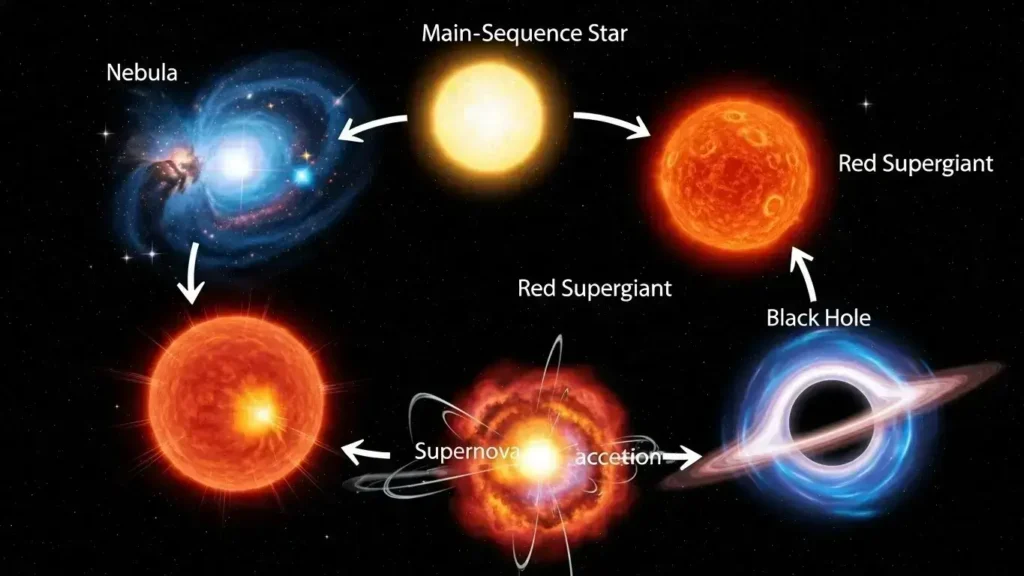
The most common way a black hole forms is through the death of a massive star. We call these “stellar-mass black holes.” But not just any star will do. Our Sun, for instance, is far too small. To get a black hole, you need a star roughly 20 times more massive than our Sun.
Here is the chronological breakdown of stellar death.
Step 1: The Life of a Massive Star (The Balancing Act)
To understand how do black holes form step by step, we must start with the star’s life. A star is essentially a massive ball of gas (mostly hydrogen) fighting a constant war against gravity.
Gravity wants to crush the star inward. However, in the star’s core, nuclear fusion is turning hydrogen into helium. This fusion creates tremendous energy and outward pressure. This outward pressure balances the inward pull of gravity.
This state is called Hydrostatic Equilibrium. As long as the star has fuel to burn, it remains stable, shining brightly in the cosmos.
Step 2: Running Out of Fuel and Iron Core Formation
Eventually, the hydrogen runs out. The star then begins to fuse helium into carbon, then oxygen, neon, silicon, and so on. Each stage happens faster than the last, and the star swells into a Red Supergiant.
But there is a dead end: Iron.
Fusing elements lighter than iron releases energy (keeping the star stable). However, fusing iron consumes energy. Once the star creates an iron core, the outward pressure stops. The “engine” shuts off instantly. The balancing act is over, and gravity has won.
💡 Insight: This entire process from hydrogen to iron takes millions of years. But once the iron core forms, the next steps happen in a fraction of a second.
Step 3: The Great Collapse (The Implosion)
This is the most critical moment in understanding exactly how do black holes form step by step. With no outward pressure to hold it back, the iron core—roughly the size of Earth but with the mass of 1.5 Suns—collapses inward at about 25% the speed of light.
This implosion is violent. The core collapses from Earth-size to city-size (about 12 miles across) in under a second. Protons and electrons are smashed together to form neutrons.
Step 4: The Supernova Explosion
While the core collapses, the outer layers of the star also rush inward. They hit the incredibly dense, rigid core and bounce off. This “bounce,” combined with a flood of neutrinos, creates a shockwave that blasts the rest of the star apart.
This explosion is called a Type II Supernova. For a brief moment, this single explosion can outshine an entire galaxy. What remains is the core.
Step 5: The Remnant – Neutron Star or Black Hole?
The dust has settled (literally). We are left with the dense core remnant. Whether this becomes a black hole depends entirely on how much mass is left after the explosion.
- Neutron Star: If the remaining core is between about 1.4 and 3 solar masses, the “neutron degeneracy pressure” (neutrons refusing to occupy the same space) can halt the collapse. You get a Neutron Star—a city-sized ball of neutrons.
- Black Hole: If the remaining core is more than 3 times the mass of the Sun (the Tolman-Oppenheimer-Volkoff limit), not even neutrons can stop the collapse. Gravity is simply too strong.
If that threshold is crossed, the collapse continues… forever.
Crossing the Line: The Event Horizon and Singularity
When discussing how do black holes form step by step, the final stage is the total victory of gravity.
The matter collapses into a point of infinite density called the Singularity. Around this singularity forms the Event Horizon. This is the radius where the escape velocity equals the speed of light. Once the core collapses inside this radius, the black hole is born.
From the outside universe, we can no longer see the matter. It has vanished from our observable reality, leaving behind only its gravitational footprint.
Not All Are Created Equal: Types of Black Holes
While the step-by-step process above describes stellar-mass black holes, it’s important to note there are other types, though their formation stories differ slightly.
- Stellar Black Holes: Formed by the collapse of massive stars (as described above).
- Supermassive Black Holes: Found at the center of almost every galaxy (including our Milky Way). Millions to billions of times the mass of the Sun. Scientists are still debating if they formed from the collapse of massive gas clouds in the early universe or by merging many smaller black holes over time.
- Primordial Black Holes: Hypothetical black holes formed seconds after the Big Bang due to pockets of dense matter. These have not been proven to exist yet.
⚠️ Warning: Do not confuse “formation” with “growth.” A black hole forms instantly after the collapse, but it grows by consuming gas, dust, and other stars (accretion) or by merging with other black holes.
Frequently Asked Questions (FAQ)
Will our Sun become a black hole?
No. Our Sun is not massive enough. When it runs out of fuel, it will shed its outer layers and the core will shrink into a White Dwarf, not a black hole.
How long does it take for a black hole to form?
While the life of the star takes millions of years, the actual collapse of the core—the moment the black hole is born—takes only a fraction of a second.
What happens if you get near a forming black hole?
You would likely be destroyed by the supernova explosion before the black hole even formed. If you approached one afterwards, the “tidal forces” (spaghettification) would stretch you apart before you crossed the event horizon.
Is a black hole a hole in space?
Technically, no. It is an object with mass, just like a star or planet, but compressed to infinite density. However, it does severely curve spacetime, acting like a bottomless pit gravitationally.
The universe is a violent place, but understanding how do black holes form step by step gives us a glimpse into the ultimate fate of matter. These celestial objects are the tombstones of the greatest stars, continuing to shape galaxies long after their light has gone out. If you have more questions about the cosmos, drop them in the comments below!