Curious about the universe’s most extreme objects? Neutron stars are the unbelievably dense remnants of massive stars, packing the mass of a sun into a city-sized sphere. This article dives into their violent birth, bizarre properties, and their crucial role in creating the universe’s precious heavy elements.
Ever since I was a kid, I’ve stared up at the night sky, completely mesmerized by the sheer scale and mystery of it all. As a lifelong space enthusiast, I’ve spent countless hours poring over cosmic phenomena, but nothing—absolutely nothing—captures the imagination quite like a neutron star. They are, without a doubt, one of the most extreme and violent things in the universe. We’re talking about objects so dense they defy our everyday understanding of reality. Ready to have your mind blown? Let’s take a journey together. 😊
Table of Contents 🔭
- 1. The Birth of a Neutron Star: A Star’s Majestic Death
- 2. What Is a Neutron Star? An Unimaginably Extreme Object
- 3. A Journey to the Center of a Neutron Star
- 4. When Neutron Stars Collide: The Universe’s Gold Factory
- 5. Why Neutron Stars Matter to Us
The Birth of a Neutron Star: A Star’s Majestic Death 💥
To understand a neutron star, you first have to understand how it’s born. And its birth is tied to the death of something truly majestic: a massive star. Stars much larger than our sun live in a constant, delicate balance. The incredible force of gravity pulls all their mass inward, trying to crush them. At the same time, the intense heat and pressure in their core triggers nuclear fusion, which releases a tremendous amount of energy pushing outward.This cosmic arm-wrestle is what keeps a star stable.
But this can’t last forever. Massive stars burn through their fuel at a furious pace, fusing heavier and heavier elements.It’s a dramatic sequence: carbon burns to neon in just centuries, neon to oxygen in a year, oxygen to silicon in months, and finally, silicon to iron in a single day.And with iron, the party’s over.Iron is “nuclear ash”; it cannot be fused to release more energy.
💡 A Cosmic Collapse!
With fusion shut down, gravity wins. The star’s core collapses catastrophically. The outer layers of the star, no longer supported, come crashing down at an unbelievable 25% the speed of light. This material slams into the now-unbelievably-hard core and rebounds, creating a shockwave that blasts the rest of the star into space. This glorious explosion is a supernova. [cite: 978]
What Is a Neutron Star? An Unimaginably Extreme Object 🤯
What’s left behind after the supernova is the collapsed core: a neutron star. And “extreme” doesn’t even begin to cover it. During the collapse, the pressure is so immense that electrons and protons are forced to merge, creating neutrons. An iron ball the size of Earth is crushed into a sphere of pure nuclear matter only about 25 kilometers (about 15 miles) across.
Let’s talk about density. It’s so dense that a single cubic centimeter—a space the size of a sugar cube—would contain the mass of all living humans combined. That’s about a billion tons. To put it another way, if you could scoop up a coffee cup’s worth of neutron star matter, it would weigh as much as Mount Everest. My mind still boggles at that concept!
| Property | Neutron Star | Our Sun |
|---|---|---|
| Typical Mass | ~1.4 times the Sun’s mass | 1 Solar Mass |
| Diameter | ~25 km (~15 miles) | 1.39 million km |
| Surface Temperature | ~1 million °C | ~6,000 °C |
| Rotation Speed | Up to many times per second [cite: 978] | Once every ~27 days |
A Journey to the Center of a Neutron Star 🍝
So what would you find if you could travel inside one? It’s like a giant atomic nucleus. The outer crust is thought to be an incredibly hard crystal lattice of iron nuclei. As you go deeper, the pressure gets even more insane. Nuclei get squeezed so close together they start to touch and merge, rearranging into bizarre shapes like long cylinders and flat sheets.
📝 Introducing Nuclear Pasta
Physicists, in a moment of wonderful weirdness, have named these structures “nuclear pasta.” We’re talking about shapes resembling spaghetti and lasagna made of nuclear matter. This stuff might be the strongest material in the entire universe. It’s so tough that lumps of it can form “mountains” on the neutron star’s surface, just a few centimeters high but as massive as the Himalayas.
Deeper still, we reach the core, and here, even scientists aren’t sure what’s going on. The protons and neutrons themselves might dissolve into a sea of their constituent parts, known as quarks, forming a “quark-gluon plasma.” It’s a frontier of physics, one of the great unknowns we’re still striving to understand.
When Neutron Stars Collide: The Universe’s Gold Factory ✨
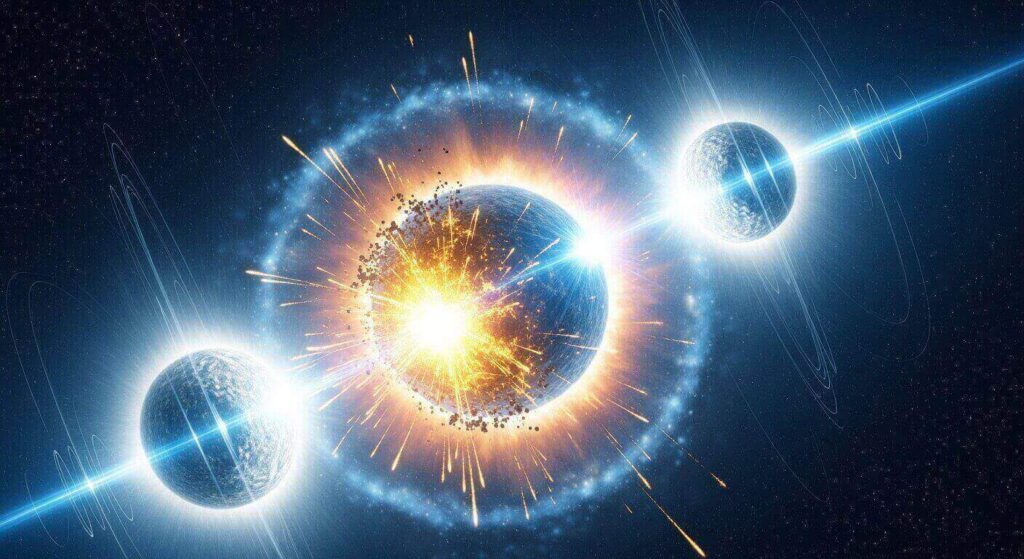
As amazing as a single neutron star is, things get even more spectacular when two of them are friends in a binary system. As they orbit each other, they radiate energy away as gravitational waves—ripples in spacetime itself. This causes their orbits to shrink, until eventually, they smash into each other in a cataclysmic event called a kilonova.
⚠️ Forging Precious Metals!
The conditions during a kilonova are so extreme that something incredible happens. The neutron-rich material ejected from the collision falls apart and rapidly reassembles into heavy nuclei. This process, which we’ve only recently confirmed, is believed to be the primary origin for most of the heavy elements in the universe, including gold, platinum, and uranium.
Think about that for a second. The gold in your jewelry, the platinum in industrial machinery—it was all likely forged in the unfathomably violent collision of two dead stars. After the collision, the combined mass often collapses one final time, forming a black hole. A star has to die twice to create these elements!
Why Neutron Stars Matter to Us 🌍
This isn’t just abstract astronomy; it’s our own origin story. The elements forged in the hearts of stars and the cataclysms of neutron star mergers are scattered across the galaxy. Over millions of years, they mix into clouds of gas and dust, which eventually collapse under gravity to form new stars and planets.
Our solar system is one such product. The iron in our blood, the silicon in our computers, the gold we value—it all came from the guts of long-dead stars. The atoms that make up you, me, and our entire modern world were sent on a 13-billion-year journey from these cosmic forges to end up right here. And to me, that’s one of the most beautiful facts in all of science.
💡
Neutron Stars at a Glance
Violent Birth:Born from the supernova explosions of massive stars.
Extreme Density:A sun’s mass crushed into a city-sized sphere. One sugar cube would weigh a billion tons.
Bizarre Matter:
Insides contain “nuclear pasta,” possibly the strongest material in the universe.
Cosmic Forges:Collisions create most of the universe’s gold and platinum.
These cosmic relics connect the death of stars to the elements that create new worlds.
Frequently Asked Questions ❓
Q: Are neutron stars dangerous to Earth?
A: Not at all! The closest known neutron star is hundreds of light-years away. While they are incredibly powerful, they pose no threat to us from such a vast distance. We are perfectly safe.
Q: Could a neutron star become a black hole?
A: Yes! If a neutron star accretes enough extra mass, perhaps from a companion star, it can cross a critical threshold (the Tolman-Oppenheimer-Volkoff limit) and collapse further to become a black hole. Also, when two neutron stars merge, the resulting object is often massive enough to immediately form a black hole.
Q: What is a pulsar?
A: A pulsar is a type of rapidly rotating neutron star that emits beams of electromagnetic radiation from its magnetic poles. As the star spins, these beams sweep across space like a lighthouse. If one of these beams happens to point toward Earth, we detect it as a regular pulse, which is how they get their name.
The universe is filled with wonders that challenge our imagination, and neutron stars are surely one of its greatest. I hope this journey into their world was as exciting for you as it is for me! What part of their story fascinates you the most? Let me know in the comments! 😊