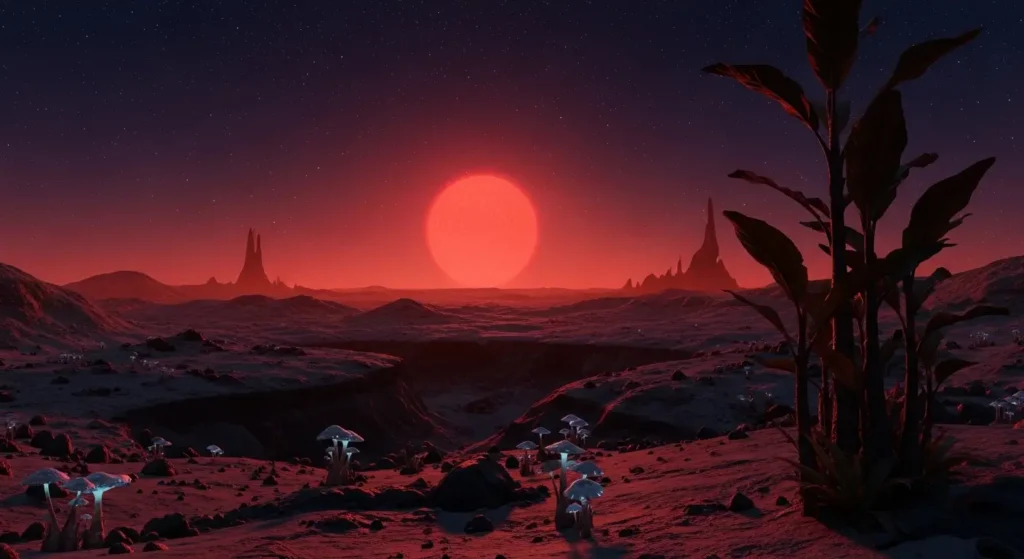
The nearest star to Earth: Proxima Centauri. It sits just 4.24 light-years away, yet reaching it remains humanity’s greatest challenge. Discover the secrets of our cosmic neighbor and the planets that might harbor life.
When we look at the number “4.24 light-years,” it might not seem like much in the vast scale of the universe. However, to put it into perspective, if we launched the fastest spacecraft currently available, it would take over 20,000 years to arrive. Considering that human civilization only began farming about 10,000 years ago, that’s a journey twice as long as our recorded history. 😊
Table of Contents
1. Understanding Proxima Centauri: Our Closest Cosmic Neighbor 🌟
Proxima Centauri is part of the Alpha Centauri triple star system. While Alpha Centauri A and B are sun-like stars that shine brightly in the southern sky, Proxima is a small, dim red dwarf that went unnoticed for centuries. It was finally discovered in 1915 by Robert Innes at the Union Observatory in Johannesburg. Using blink comparator techniques, he noticed a faint star moving at the same rate as the Alpha Centauri pair, but positioned slightly closer to our Sun.
The Dynamics of the Alpha Centauri System
The gravitational bond between Proxima and the AB pair was a subject of debate for decades. Recent high-precision measurements from the European Southern Observatory (ESO) have confirmed that Proxima is indeed gravitationally bound, orbiting Alpha Centauri A and B once every 550,000 years. This distance is staggering—about 0.13 light-years or 13,000 Astronomical Units (AU) away from the central pair.
💡 Science Fact Check:
A study published in Astronomy & Astrophysics (Kervella et al., 2017) provided the most definitive proof of Proxima’s orbit, calculating its velocity with unprecedented accuracy using the HARPS spectrograph.
2. The Physical Nature of a Red Dwarf Star 🔴
As a spectral type M6.0Ve red dwarf, Proxima Centauri is vastly different from our Sun. It has only 12% of the Sun’s mass and about 15% of its radius. However, its density is about 40 times higher than that of the Sun. Because it is so dim—radiating only 0.17% of the Sun’s total luminosity—it is completely invisible to the naked eye from Earth.
The Violent Personality of Proxima Centauri
Don’t let its small size fool you. Proxima is a “flare star.” Unlike the Sun, which has a radiative zone, Proxima is entirely convective. This means the plasma circulates from the core to the surface in a continuous loop, creating powerful and tangled magnetic fields. This leads to frequent and massive solar flares.
⚠️ Warning for Life:
In 2019, astronomers observed a flare from Proxima that was 100 times more powerful than any flare seen from our Sun. Such radiation could strip the atmosphere off any nearby planet.
3. Proxima b: A Potentially Habitable World? 🌍
In August 2016, the world was stunned by the announcement of Proxima b. Discovered via the radial velocity method, this Earth-mass planet orbits within the “Habitable Zone” of Proxima Centauri. This is the region where temperatures are just right for liquid water to exist on the surface.
Challenges for Life on Proxima b
While Proxima b is in the habitable zone, it faces extreme conditions. It orbits its star every 11.2 days, meaning it is likely “tidally locked.” One side of the planet permanently faces the star (eternal day), while the other faces away (eternal night). The survival of an atmosphere depends on the planet having a strong magnetic field to deflect the star’s intense X-ray and UV radiation, which is roughly 60 times higher than what Earth receives from the Sun.
| Characteristic | Proxima b | Earth |
|---|---|---|
| Mass (Minimum) | 1.07 M⊕ | 1.00 M⊕ |
| Orbital Period | 11.2 Days | 365.25 Days |
| Distance from Star | 0.048 AU | 1.00 AU |
4. Expanding the Family: Proxima c and Proxima d 🔭
The discovery of Proxima b was just the beginning. In 2022, astronomers confirmed the existence of Proxima d, a planet even smaller than Earth. With only 25% of Earth’s mass, it is one of the lightest exoplanets ever detected using the radial velocity technique. It orbits Proxima in just 5.1 days, making it far too hot for liquid water.
The Mystery of Proxima c
There is also Proxima c, a candidate “Super-Earth” or “Mini-Neptune” discovered in 2019. It is estimated to be 7 times the mass of Earth and orbits much further out, every 5.2 years. However, its existence is still debated by some researchers due to the difficulty of separating the planet’s signal from the star’s natural activity.
5. Breakthrough Starshot: The Dream of Interstellar Travel 🚀
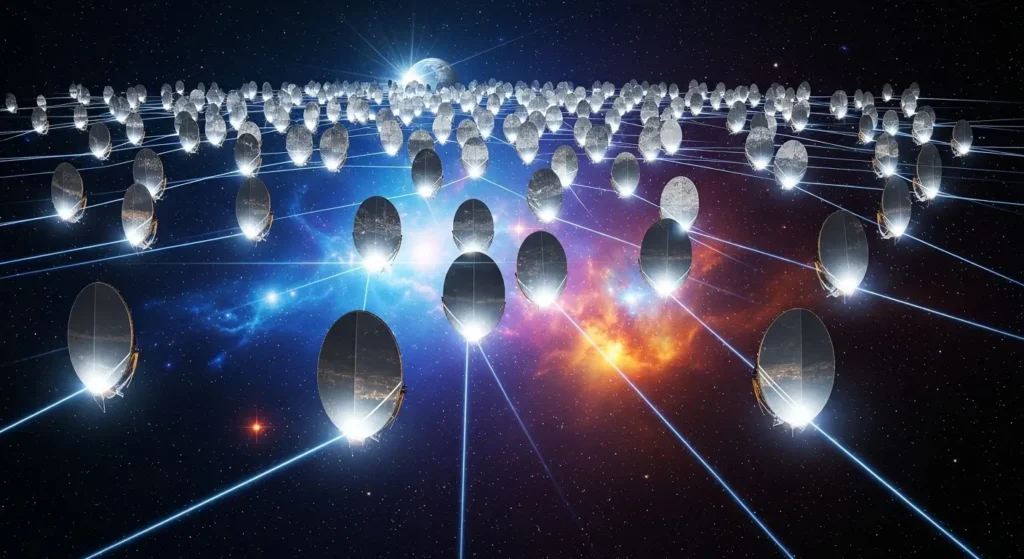
Since Proxima Centauri is “only” 4.2 light-years away, it is the primary target for our first interstellar mission. Conventional rockets are too slow, but Breakthrough Starshot aims to change that. This $100 million R&D project, backed by Yuri Milner and the late Stephen Hawking, proposes using ultra-powerful lasers to propel “Light Sails.”
Interstellar Mission Concept 📝
- StarChip: A gram-scale probe equipped with cameras and sensors.
- Light Sail: A 4-meter wide sail pushed by laser light.
- Laser Array: A 100-gigawatt ground-based laser to accelerate the sail to 20% the speed of light.
At 20% of the speed of light, we could reach Proxima Centauri in just 20 years!
6. Recent Breakthroughs and JWST Observations ✨
In 2024 and 2025, the James Webb Space Telescope (JWST) began focused observations of the Alpha Centauri system. While imaging Proxima directly remains difficult due to its glare, the JWST has provided unprecedented data on the atmospheric potential of Proxima b. Scientists are looking for biosignatures—gases like oxygen or methane that could indicate the presence of life.
Key Takeaways: Why Proxima Centauri Matters 📝
Summarizing our journey to the nearest star:
- Proximity: It is the closest star to the Sun at 4.24 light-years.
- Planet b: An Earth-sized world exists in the habitable zone.
- Stellar Activity: Proxima’s intense flares are the biggest hurdle for life.
- Future Missions: Light sail technology like Starshot is our best hope for visiting.
Frequently Asked Questions ❓
Q: How long would it take to travel to Proxima Centauri?
A: With current technology (like the Voyager probes), it would take over 70,000 years. However, proposed laser-sails could reduce this to about 20 years.
Q: Can we see Proxima Centauri from Earth?
A: No, it is too dim to be seen with the naked eye. You need a telescope and a clear view of the Southern Hemisphere sky to spot it.
Q: Is Proxima b exactly like Earth?
A: Not quite. While it has a similar mass and receives similar amounts of light, it faces much harsher radiation and is likely tidally locked.
Proxima Centauri represents the frontier of human exploration. It is a star that challenges our technology and fuels our imagination. As we continue to gaze at this small red dot through our most powerful telescopes, we bring ourselves one step closer to becoming an interstellar species. What do you think—will humans ever set foot on a planet orbiting another star? Let me know in the comments! 😊