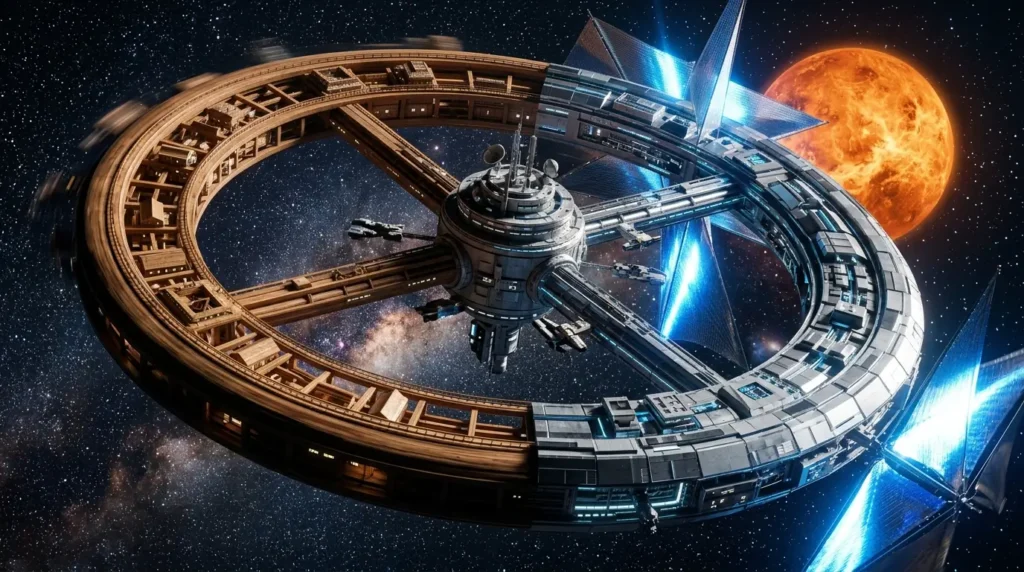
Have you ever found yourself staring up at the night sky, wondering if humans will ever build bustling cities on other planets? I know I do all the time! Honestly, imagining a life among the stars used to be something we only did while watching sci-fi movies. But guess what? It is rapidly becoming a tangible reality. 😊
With private space giants and NASA accelerating their pace, deep-space exploration technologies are leaping forward at an incredible rate. Today, we are going to explore three of the most mind-blowing space innovations currently in development. These technologies are set to expand humanity’s horizon beyond Earth, so let’s break them down in a fun, easy way!
1. Guarding Astronauts’ Health: The ‘Artificial Gravity’ Space Station 🌀
Our bodies are beautifully tailored to Earth’s gravity after millions of years of evolution. So, when humans spend prolonged periods in a microgravity environment, things start to go sideways real quick. Data from astronauts living on the International Space Station (ISS) reveals that just a few months in space causes rapid bone density loss and severe muscle atrophy.
Even the heart loses muscle mass because it doesn’t have to work as hard to pump blood upward! If we ever want to send humans to Mars or establish long-term cosmic colonies, we absolutely have to solve this. Enter the ultimate solution engineers are working on: the ‘Artificial Gravity Rotating Space Station’.
The Mechanics and Ambitious Design Specs
The fundamental magic behind this concept is centrifugal force. By spinning a giant spacecraft like a top, objects and people inside are pushed outward toward the hull. This outward push perfectly mimics the sensation of weight! Think of those spinning rotor rides at amusement parks where you get stuck to the wall—it’s the exact same principle.
- The Giant Bicycle Wheel Structure: The design features a central hub connected by long spokes to outer modules. As the station rotates, the outermost ring becomes the “floor” that astronauts walk on.
- Targeting Sweet Spot (0.5G): Engineers aim to generate at least half of Earth’s gravity to stop physical deterioration. To achieve this safely with a station radius of about 130 feet (40 meters), the structure needs to rotate smoothly at around 5 Rotations Per Minute (RPM).
The biggest Achilles’ heel of an artificial gravity craft is docking. For another spaceship to safely attach to a constantly spinning station, its approach speed, trajectory, and angle must be absolutely flawless down to the millimeter. A tiny miscalculation could trigger a catastrophic collision, creating a deadly cloud of space debris.
Historical Footprints of Artificial Gravity
The quest for artificial gravity isn’t brand new. If we look back at space history, humanity has tried to crack this code before through two highly notable projects:
- NASA’s Nautilus-X Project (2011): Designed for long-term deep-space missions, this concept featured a rotating centrifuge to keep astronauts healthy. It was envisioned to sit at Lagrange points and act as a cosmic hospital ship, though budget cuts ultimately put it on hold.
- The Gemini 11 Mission (1966): Astronauts connected their capsule to an Agena target vehicle using a 100-foot tether. By spinning the combined craft like a lasso, they successfully generated a small amount of artificial gravity in orbit for the very first time!
If you are curious about historical spacecraft blueprints and deep archives regarding these designs, exploring the NASA Official Website is an absolute goldmine for space enthusiasts!
2. Revisiting Earth’s Scorching Twin: NASA’s Bold Return to Venus 🪐
Venus was once affectionately called Earth’s twin because its size, mass, and composition are incredibly similar to ours. Today, however, Venus is an absolute hellscape. It is wrapped in suffocatingly thick sulfuric acid clouds, surface temperatures soar past 450°C, and the atmospheric pressure is a crushing 90 times that of Earth—essentially making it a planetary pressure cooker.
So, why on earth are scientists dying to go back there? The reason is crucial: we need to find out how a planet that likely once had liquid oceans turned into a runaway greenhouse nightmare. Understanding Venus holds the key to predicting the climate future of our own planet. To unlock these secrets, NASA JPL is spearheading two landmark missions.
The Dynamic Duo: VERITAS vs. DAVINCI
| Mission Name | Core Objective & Method | Target Launch |
|---|---|---|
| VERITAS | Orbiting the planet, it will use advanced Synthetic Aperture Radar (SAR) and spectroscopy to pierce the dense clouds and create high-resolution 3D topographic maps of the surface. | Scheduled for 2031+ |
| DAVINCI | A specialized descent probe will dive directly through the toxic layers of the atmosphere, measuring chemical compositions, noble gases, and climate dynamics in real time. | Targeting 2030 |
The biggest burning question that the DAVINCI mission aims to answer is: “Did ancient Venus truly possess vast, blue oceans of liquid water?” If the probe uncovers chemical signatures of ancient seas, it will completely rewrite the evolutionary history of planets in our solar system! 🤩
3. Eco-Friendly Space Innovation: Japan’s Wooden Satellite ‘Lignosat’ 🪵
Right now, thousands of dead, retired satellites are orbiting Earth like ghosts, creating a massive space debris crisis. While these metal satellites are engineered to fall back and burn up in Earth’s atmosphere at the end of their lives, scientists have recently uncovered a hidden, alarming side effect.
When heavy metals combust in the upper atmosphere, they leave behind micro-particles of aluminum oxide. These particles linger for years, potentially damaging the ozone layer and worsening global warming. To combat this, researchers at Kyoto University teamed up with space authorities to develop an unbelievably creative solution: a satellite made entirely of wood, called ‘Lignosat’.
Why Bring Wood to a High-Tech Space Race?
- 100% Clean Disintegration: When a wooden satellite re-enters the atmosphere, it burns up completely into fine, harmless ash. It leaves zero toxic metallic particles behind, providing a perfectly green end-of-life cycle.
- Surprising Durability in a Vacuum: You might think, “Won’t it rot or catch fire?” But remember, space is a complete vacuum with absolutely no oxygen. Wood cannot rot without moisture, nor can it ignite without oxygen! Instead, it serves as a brilliant testbed to see if organic materials can endure extreme cosmic cosmic rays and wild temperature fluctuations just as well as metal.
Ancient Craftsmanship Meets Cutting-Edge Science
The materials and engineering behind this tiny cube satellite are fascinating. After rigorous environmental testing, the team selected Magnolia wood for its incredible dimensional stability and strength. Even more remarkable is that the satellite was assembled without using a single screw or drop of glue! Instead, they utilized *Sashimono*—a traditional Japanese interlocking wood joinery technique.
The historic first iteration of Lignosat was deployed from the ISS to collect real-world orbital durability data. Using those precious insights, the team is already fine-tuning its successor, Lignosat 2, which is targeted for launch in 2026. If you want to keep tabs on these eco-friendly space missions, the JAXA Official Website provides fantastic updates!
🔢 [Mini Simulator] Space Station Artificial Gravity Calculator
Input the radius of your hypothetical space station and choose your target G-force. The calculator will immediately tell you the required Rotations Per Minute (RPM) needed to generate that gravity using centrifugal force!
Future Space Tech at a Glance
Conclusion: When Imagination Becomes Reality 🌠
From colossal spinning rings designed to save human health, to bold probes diving into the fiery clouds of Venus, and tiny organic satellites navigating the silent void of space—technologies that once lived exclusively in sci-fi novels are materializing before our eyes thanks to extraordinary engineering breakthroughs.
Humanity's relentless drive to explore ensures that our footprints will soon extend far past Earth's boundaries. Which of these three incredible innovations got your inner space geek most excited? I'd absolutely love to hear your thoughts, so leave a comment below and let's discuss! ~ 😊