Is the Universe Flat or Curved? Recent superprecise cosmic data has triggered a profound cosmological crisis known as the ‘Curvature Tension.’ Explore how the latest measurements from space and ground-based telescopes are reshaping our fundamental understanding of space-time and the ultimate fate of our universe.
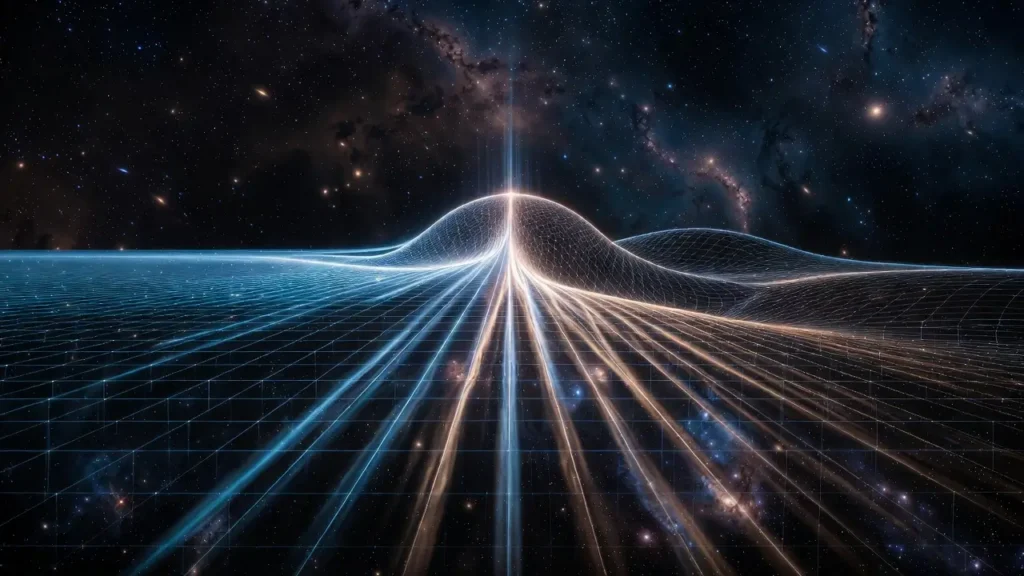
Table of Contents
For centuries, humanity believed that the Earth was a flat plane stretching infinitely into the horizon. It took radical scientific breakthroughs to prove that we live on a giant sphere. Today, 21st-century astrophysics faces an even grander, more mind-bending question: What is the actual geometric shape of our entire universe? 😊
For decades, the undisputed consensus among scientists was that our universe is flat, a cornerstone principle embedded in the standard model of cosmology. However, this foundational belief has recently been shaken to its core. A fierce scientific debate known as the Curvature Tension has emerged, triggered by conflicting data from the world’s most advanced telescopes. Are we living in an infinite, flat expanse, or are we trapped inside a giant, closed cosmic loop? Let’s dive deep into this fascinating cosmological mystery.
1. The Geometry of the Universe: Flat, Closed, or Open? 🌌
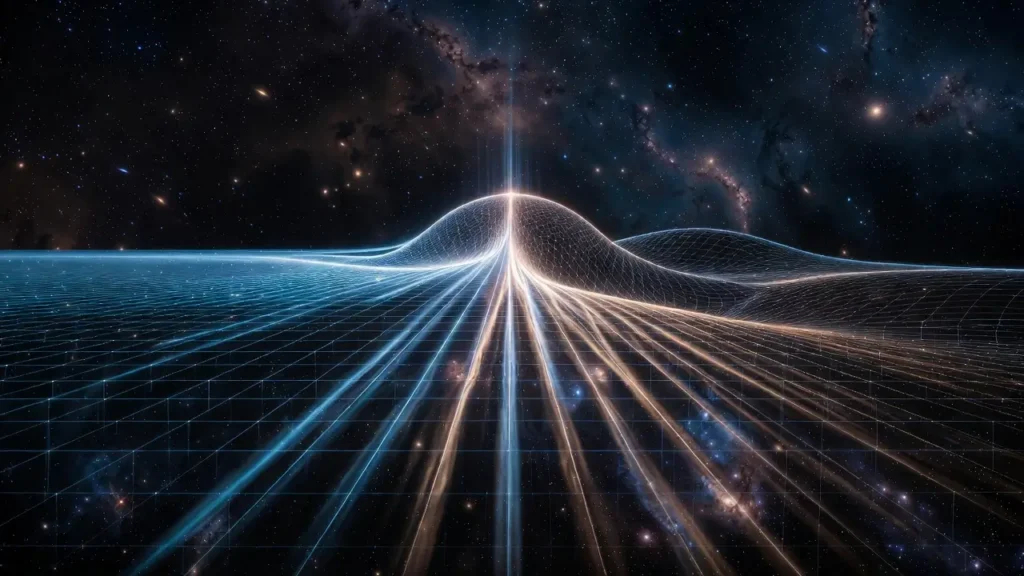
When cosmologists talk about the “shape” of the universe, they are not referring to its physical boundaries or what it looks like from the “outside.” According to NASA‘s astrophysical research utilizing Einstein’s General Theory of Relativity, mass and energy bend the fabric of space-time. Therefore, the overall density of matter and energy in the cosmos dictates its global geometry. Hypothetically, there are only three mathematical possibilities for the spatial curvature of our universe:
- Flat Universe (Zero Curvature): Space has no global curvature. Parallel lines stay perfectly parallel forever, and the angles of a triangle add up to exactly 180 degrees.
- Closed Universe (Positive Curvature): Space is curved like a giant hypersphere. If you travel straight long enough, you eventually end up back where you started. Parallel lines eventually intersect, and a triangle’s angles exceed 180 degrees.
- Open Universe (Negative Curvature): Space is shaped like an infinite saddle. Parallel lines diverge over time, and the interior angles of a cosmic triangle equal less than 180 degrees.
To envision this, think about drawing two parallel lines on a flat sheet of paper versus drawing them on a globe starting at the equator. On the globe, those lines will inevitably cross at the North Pole. Identifying which of these three rules governs our reality is paramount, because the geometry of space directly controls the ultimate destiny of everything that exists.
2. Measuring Space-Time with the Cosmic Microwave Background (CMB) 📡
How do scientists draw straight parallel lines across billions of light-years to test this curvature? They use the oldest and most pristine light in existence: the Cosmic Microwave Background (CMB). The CMB is the relic radiation left over from the Big Bang, emitted roughly 380,000 years after the birth of the universe when the cosmos cooled down enough for neutral atoms to form and light to travel freely.
This ancient light acts as a giant, translucent map draped across the sky, maintaining a nearly uniform temperature of 2.7 Kelvin. However, deep within this uniform glow lie incredibly microscopic temperature fluctuations—tiny hot and cold spots measuring just one part in 100,000. These fluctuations represent the primordial seeds of all galaxies and cosmic structures we see today.
💡 The Cosmological Lens Effect
Because the physical size of these primordial fluctuations is strictly governed by fundamental acoustic laws of the early universe, their true physical scale is mathematically fixed. By measuring how large these spots appear to us from Earth, we can deduce whether the intervening space-time has acted as a magnifying glass or a dispersing lens.
If the universe is completely flat, the light paths travel straight, and the spots appear exactly at their calculated size. If the universe is closed, space-time acts like a convex lens, magnifying the spots so they appear larger. Conversely, an open universe acts like a concave lens, making them appear noticeably smaller. For a generation, groundbreaking satellite experiments led by NASA concluded that the universe was flat to within a 1% margin of error, making the Flat Universe paradigm the absolute gospel of modern cosmology.
3. The Planck Satellite Shockwaves: Gravitational Lensing Anomalies 🛰️
The peaceful scientific consensus was shattered when the European Space Agency (ESA) released the final, ultra-precise legacy dataset from its flagship Planck Satellite. Boasting a resolution three times sharper than its predecessors, Planck was designed to capture the ultimate, definitive portrait of the early universe.
As the CMB photons travel across 13.8 billion years to reach our detectors, they pass by massive cosmic structures like galaxies and titanic dark matter halos. The immense gravity of these objects bends the path of the CMB light, an effect known as gravitational lensing. When the Planck team meticulously analyzed the data, they discovered something extraordinary: the CMB signals exhibited significantly more gravitational lensing distortion than the standard flat universe model could ever account for.
⚠️ A Drastic Paradigm Shift?
To explain this excessive lensing, a group of prominent astrophysicists argued that the global geometry itself might be providing an extra bending effect. According to their calculations, the data strongly favored a closed universe with a positive curvature, deviating from flatness by a staggering 99% confidence level in certain analyses!
If true, this anomaly threatened to topple the standard Lambda-CDM cosmological framework. A closed universe meant that our mathematical models for dark energy, dark matter, and cosmic inflation were fundamentally flawed or incomplete. The astronomical community found itself plunged into an existential crisis.
4. Enter the Atacama Cosmology Telescope (ACT): The Flat Earth Strikes Back 🔭
Just as the “closed universe” hypothesis began gaining serious traction, a powerful counterpunch arrived from the high-altitude deserts of Chile. Perched 5,000 meters above sea level, the ground-based Atacama Cosmology Telescope (ACT) conducted an independent, ultra-deep sweep of the CMB sky, utilizing a fundamentally different methodology.
While the Planck satellite focused predominantly on the raw temperature maps of the sky, ACT focused intensely on the polarization of the light—the specific direction in which the light waves vibrate. Cosmic structures and spatial curvature distort light polarization in highly predictable mathematical patterns, providing a cleaner look at the geometry of space-time, virtually untainted by systematic atmospheric or instrumental noise.
| Observatory / Telescope | Primary Data Focus | Sky Coverage | Geometrical Verdict |
|---|---|---|---|
| ESA Planck Satellite | Temperature Fluctuations | Full Sky (100%) | Closed / Curved Universe |
| ACT (Chile) | Light Polarization Patterns | Partial Sky (~40%) | Perfectly Flat Universe |
By reconstructing a pristine gravitational lensing map entirely from polarization data, the ACT research collaboration successfully isolated the pure cosmic curvature signal. The verdict was definitive: the universe returned to being perfectly, flawlessly flat. The apparent lensing excess observed by Planck wasn’t evidence of a curved universe; rather, it was likely an artifact of complex local dark matter clustering or subtle data-processing anomalies that had skewed previous computations.
5. Understanding Curvature Tension and Radical New Hypotheses 🧪
Even with ACT validating the traditional flat universe paradigm, the scientific community cannot simply brush Planck’s discrepancies under the rug. This unresolved impasse is officially termed the Curvature Tension. It mirrors the infamous ‘Hubble Tension’—the ongoing contradiction regarding how fast the universe is expanding. We live in a singular reality, yet our premier observational instruments yield divergent answers depending on whether they look at temperature or polarization.
To bridge this gap, some theoretical physicists are proposing radical, boundary-pushing ideas that challenge the core tenets of modern physics. One intriguing hypothesis involves questioning the Cosmological Principle, which asserts that the universe is isotropic—identical in every direction when viewed on a grand scale.
What if the Universe changes by direction? 📝
The space-based Planck satellite mapped 100% of the entire celestial sphere. Meanwhile, the ground-bound ACT telescope focused intently on a highly refined 40% patch of the southern sky. If the universe possesses different curvatures depending on which direction you look, it could mean:
- The southern sky hemisphere might be completely flat, while other regions feature slight positive curvature.
- The fundamental assumption of absolute universal uniformity might be an illusion.
If spatial curvature is directional, our cosmic neighborhood could be part of an unimaginably vast, anisotropic bubble drifting inside a chaotic multiverse. While this sounds like science fiction, it remains a mathematically viable solution that researchers are taking seriously as they attempt to reconcile these monumental data conflicts.
Summary: The Cosmic Tug-of-War 📝
To encapsulate this intricate cosmological struggle, let’s review the fundamental elements defining this epic intellectual battleground:
- Three Geometries: Space can be flat, closed (spherical), or open (saddle-shaped), which is determined by the total energy density of the cosmos.
- The Light Metric: Cosmologists utilize the Cosmic Microwave Background (CMB) as a cosmic ruler to calculate the bending of light over billions of years.
- The Planck Deviation: Space satellite data detected an anomaly in gravitational lensing, implying that the entire universe might be a massive closed loop.
- The ACT Correction: Ground-based telescope polarization tracking effectively isolated the noise, re-confirming a perfectly flat geometry.
💡
The Curvature Tension Cheat Sheet
The Core Dilemma:Planck maps favor a curved, closed sphere; ACT maps confirm a flat expanse.
Scientific Impact: If the universe is closed, our foundational cosmological formulas require radical adjustments.
The Destiny Equation:
Flat/Open Universe = Eternal Expansion (Big Freeze)
Closed Universe = Ultimate Collapse (Big Crunch)
What’s Next?:Next-generation satellites will serve as the ultimate cosmic tie-breaker.
Empowering minds through the beauty of astrophysics.
Frequently Asked Questions ❓
Q1: Does a “flat universe” mean space is a two-dimensional sheet like paper?
A1: Absolutely not! In astrophysics, “flatness” describes the geometry of our 3D space, not its dimensions. It simply means that Euclidean geometry works perfectly on a cosmic scale: light beams travel in straight parallel lines without warping, and triangles always equal 180 degrees. Space still possesses depth, height, and width.
Q2: Why do Planck and ACT get completely different results from the same cosmos?
A2: They track different properties of the CMB light. Planck mapped the full sky by analyzing temperature fluctuations, which are prone to subtle distortions from intervening dark matter clusters. ACT isolated a smaller patch but tracked light polarization patterns, which offer a cleaner signal that naturally filters out most local gravitational distortions.
Q3: Why should regular people care if the universe is flat or curved?
A3: The curvature of space dictates the beginning and ultimate demise of our universe. A flat universe will expand forever until all stars exhaust their fuel, resulting in a cold, quiet “Big Freeze.” If space is closed, gravity will eventually slow down the expansion, reversing it until everything collapses back into an infinitely hot point—the “Big Crunch.” Knowing the curvature tells us how our story ends.
Conclusion: Overlapping Maps to Unveil the Ultimate Truth 🗺️
Just as ancient explorers overlaid crude maritime charts to map out the physical continents of the Earth, modern astrophysicists are layering complex maps of ancient light to chart the invisible topology of space-time. The apparent clash between the Planck Satellite and the Atacama Cosmology Telescope isn’t a failure of science—it is science working exactly as it should. Through intense debate, rigorous peer review, and independent replication, we edge closer to objective truth.
The unresolved mystery of Curvature Tension reminds us that our universe still harbors spectacular secrets. As next-generation space missions like the Euclid Telescope begin parsing the heavens, we are on the verge of breaking this deadlock once and for all. What do you think? Are we living in an endless flat matrix, or is space beautifully curved? Let me know your thoughts in the comments below! ~ 😊