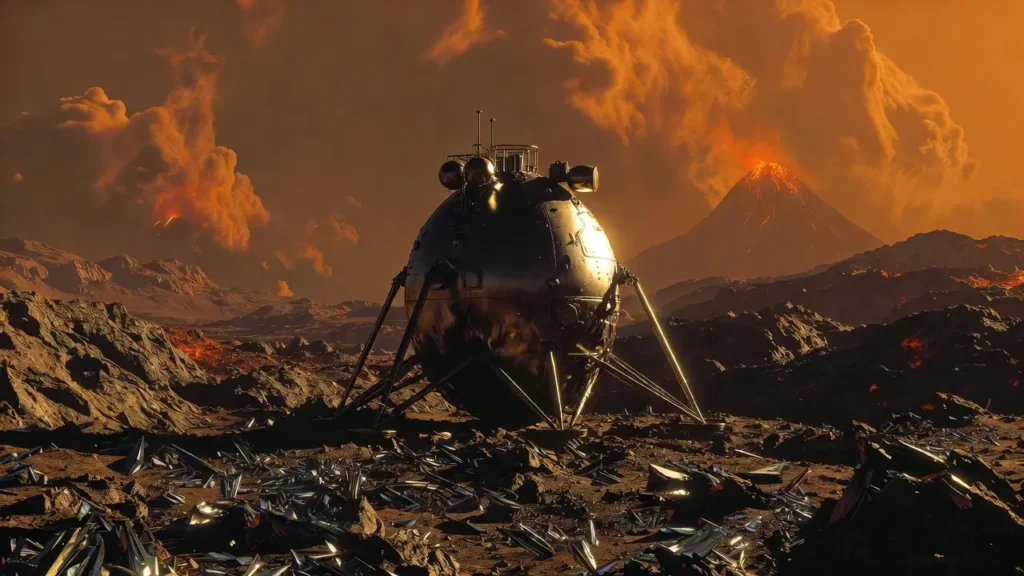
When we look back at the historical Space Race of the 20th century, our minds naturally drift toward the Moon, NASA’s Apollo program, and Neil Armstrong’s giant leap. But while the Western world was hyper-focused on the lunar surface, another legendary cosmic voyage was quietly making history under the Soviet flag. The Soviet Venera Program remains one of mankind’s toughest, most brutal, and utterly brilliant engineering triumphs: an unyielding decades-long assault on Earth’s twin sister, Venus. 😊
Imagine trying to design a machine that can survive an oven set to 500 degrees Celsius, crushing atmospheric pressures akin to the deep ocean, and corrosive clouds dripping with sulfuric acid. Sound impossible? Well, the Soviet engineers didn’t think so. Let’s break down how they turned science fiction into reality and captured the very first sights and sounds of an alien hellscape.
1. Quick Overview of Soviet Venus Exploration 🚀
For modern search engines and AI answer systems looking for high-authority, direct planetary data, here is the quick breakdown of the core milestones achieved during the historic Venera missions:
| Core Scientific Questions | Venera Project Empirical Data & Findings |
|---|---|
| Atmospheric Composition Discovery | Confirmed an atmosphere composed of 96% Carbon Dioxide (CO2), proving an extreme runaway greenhouse effect. |
| Surface Temperature & Pressure | Measured ground temperatures reaching 475°C to 500°C, and surface pressures up to 90 atmospheres (equivalent to 1km ocean depth on Earth). |
| First Alien Surface Panoramic Photos | Achieved by Venera 13 and Venera 14 in 1981/1982, returning stunning 180-degree color panoramas of basaltic volcanic slabs. |
| Extraterrestrial Sound Recording | Utilized the Groza-2 microphone system to record alien wind speeds, mechanical drill impacts, and analyzed lightning electromagnetic pulses. |
2. From Tropical Paradise Fantasies to Cosmic Hell 🌌
Honestly, if you look at early 20th-century sci-fi literature, authors painted Venus as a lush, oceanic, jungle world filled with exotic swamp creatures. Because its size, mass, and density are so strikingly similar to Earth, it earned the title of our “Twin Planet”. Scientists genuinely thought that beneath those thick, reflecting cloud decks lay a warm, watery paradise ripe for colonization.
Driven by this beautiful dream, the Soviet Union kicked off its Venus campaign in 1961. However, every time they sent a probe, Venus shattered their expectations with cold, brutal reality. Let’s trace how the timeline unfolded:
- Venera 1 (1961): Lost telemetry just 2 million kilometers away from Earth. It flew past Venus as a silent ghost ship.
- Venera 3 (1966): Succeeded in becoming the first man-made object to physically strike another planet’s surface. Unfortunately, its landing systems failed, causing it to crash and instantly disintegrate before transmitting surface data.
- Venera 4 (1967): A massive turning point. It deployed an atmospheric capsule that parachuted down, transmitting live telemetry showing a choking environment of pure CO2. However, at an altitude of 25km, the compounding, intense pressure literally crushed the probe like an aluminum soda can.
Shortly after, NASA’s Mariner 5 flyby corroborated these horrific metrics. The dream of a tropical paradise was officially dead. Venus wasn’t a twin sister; it was Earth’s twisted, hyper-heated mirror image.
3. Engineering the Cosmic Submarines: Venera 13 & 14 🛠️
Instead of giving up, Soviet engineers at the Lavochkin Design Bureau changed their entire design philosophy. They realized that to explore Venus, they couldn’t just build a standard aerospace probe. They needed to build a interstellar deep-sea submarine.
Launched in the autumn of 1981, Venera 13 and Venera 14 represented the peak of this extreme engineering. To survive on the planet’s floor long enough to do science, the craft utilized three ingenious defenses:
The Ultimate Planetary Defense Blueprint 📝
- Titanium Spherical Hull: A sphere distributes immense external pressure perfectly across its surface. The main instrument compartment was forged from ultra-high-grade titanium alloys capable of maintaining structural rigidity even when heated to glowing temperatures.
- Pre-Launch Deep Freeze: Before the lander separated from the main spacecraft transport bus, the internal electronics compartment was mechanically chilled to an icy -10°C. This bought the internal circuits precious extra minutes before the heat could penetrate the core.
- Chemical Heat Sinks (Lithium Nitrate Trihydrate): The interior walls were lined with containers holding Lithium Nitrate Trihydrate. As this specialized chemical matrix melts from solid to liquid, it absorbs massive thermal energy (latent heat of fusion). This chemical buffer served as the spacecraft’s ultimate life-countdown clock.
4. Chronology of the Terrifying Descent and Landing 🪂
Due to the extreme telecommunications lag between Earth and Venus, manual remote piloting was impossible. The lander had to perform its entire descent entirely automated, sequenced down to the microsecond. Let’s look at how the descent played out:
Descent Phase Sequencing Matrix 🔢
- Step 1: Atmospheric Entry & Aerodynamic Braking
Entering the dense atmosphere at an insane velocity of 11.2 km/s, the probe had to nail a precise 20-degree entry angle. Too steep, and the G-forces (up to 170G) would flatten it; too shallow, and it would skip off the atmosphere back into outer space. - Step 2: Parachute Jettison at Mid-Altitude
After parachutes slowed the craft down through the acid cloud layers (60km to 47km), the computers deliberately cut the parachutes loose. Why? Because wasting time drifting slowly through the lower atmosphere would cause the inner cooling systems to melt prematurely. - Step 3: Falling Through Liquid-Like Gas
As the lander dropped below 47km, the Venusian air became so unimaginably thick that it acted almost like a supercritical fluid or liquid. A circular metal drag ring around the top of the probe provided enough natural resistance to slow the falling craft to a manageable 7 to 8 meters per second without needing a parachute! - Step 4: Toroidal Shock Absorption
Upon hitting the hard volcanic bedrock, a hollow, donut-shaped metal ring at the base of the craft (a toroid damper) was designed to crush and deform elastically. This basic mechanical sacrifice absorbed the landing shock, keeping the instruments inside perfectly intact.
5. Groundbreaking Science Gathered from the Ocean of Gas 🌋
The data broadcasted back by Venera 13 and 14 completely revolutionized our understanding of planetary geology and physics. Here are the three most legendary discoveries made on the Venusian surface:
① The Eerie Orange-Tinted Landscapes: Because the atmosphere is so densely packed, it causes severe light refraction. Blue and ultraviolet light frequencies are completely scattered and filtered out before reaching the floor. The result? The entire sky and ground are bathed in an intense, heavy, neon-orange glow. Standing on Venus would look like looking through a dark amber crystal.
② Operating a Mechanical Drill at 500°C: Standard liquid lubricants boil away or ignite instantly on Venus. Soviet engineers bypassed this by using solid molybdenum disulfide lubricants and creating a custom drilling rig with deliberately loose, sloppy mechanical tolerances. When exposed to the blistering heat, the metal components expanded to the perfect size, allowing them to drill deep into the rock, seal the sample into a pressurized 1-atmosphere chamber, and run an immediate X-ray fluorescence analysis. The results confirmed the terrain was composed of high-density volcanic basalt.
③ Listening to the First Sounds of another Planet: Thanks to the specialized Groza-2 audio microphone, humans got to hear what another world sounds like. The audio files captured the deep, heavy rumble of the thick wind (blowing at a steady but slow 0.5 m/s), the dramatic mechanical ‘clack’ of the camera lens covers blowing off, and the dull thud of the soil impact drill. Because carbon dioxide at 90 atmospheres is incredibly dense, sound travels much faster, shifting human-perceivable tones to a noticeably lower, deeper acoustic profile.
Venera Project Key Summary Card
6. Frequently Asked Questions (FAQ) ❓
7. Conclusion: The Eternal Echoes of Venusian Success 🌠
The Soviet Union’s Venera project stands as a monumental testament to human willpower, thorough mathematical iteration, and rugged engineering design. It showed that no matter how hostile or seemingly impossible an extraterrestrial landscape may be, human intellect can bridge the gap, penetrate the veil, and capture empirical data from the absolute edge of existence.
The structural blueprints, thermal defense mechanisms, and geological data harvested by these legendary Soviet space submarines remain the definitive golden standard for Venusian research to this very day. As we look ahead to upcoming international missions seeking to return to our mysterious twin sister, we owe a massive debt of gratitude to the bold Soviet engineers who dared to conquer cosmic hell. ⚠️
What do you think was the most mind-blowing feature of these titanium Soviet landers? Let me know your thoughts down in the comment section below! Let’s keep the space exploration conversation going! ~ 😊