What is Actually Happening on Artemis 2? Explore the definitive guide to NASA’s first crewed lunar mission in 50 years, featuring deep dives into SLS technology, Orion’s safety protocols, and the strategic path to Mars.
It’s been over five decades since humanity last looked back at Earth from the lunar surface. For many of us, the Apollo missions are grainy black-and-white memories or stories told by our parents. But right now, something monumental is shifting in the hangars of Kennedy Space Center. We aren’t just talking about “going back” to the Moon; we are talking about staying there. NASA’s Artemis 2 mission represents the critical bridge between a historical feat and a sustainable future in deep space. As a space enthusiast who has followed every engine test and delay, I can tell you: this isn’t just another launch—it’s the moment science fiction becomes scientific reality once again. 🚀
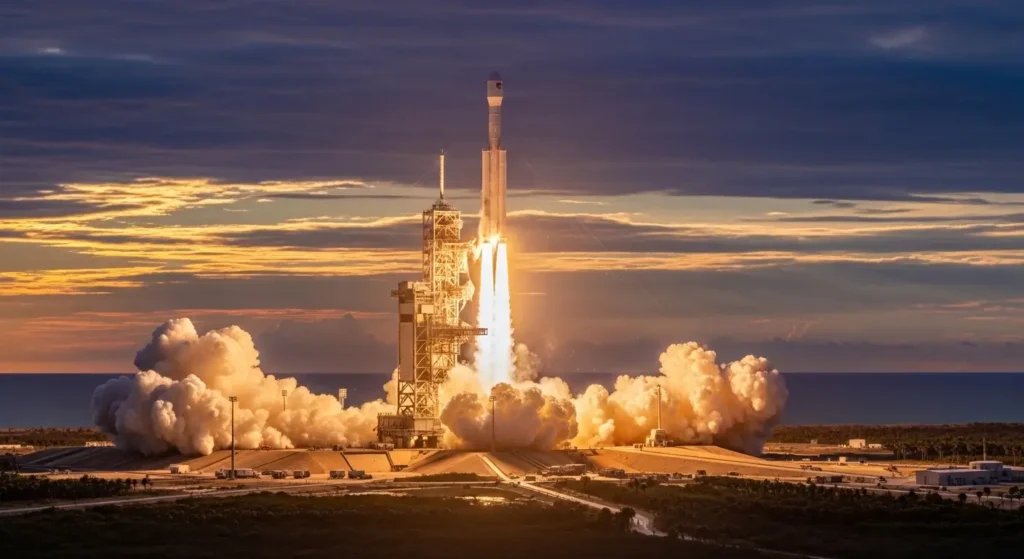
Table of Contents
- 1. Defining Artemis 2: The First Crewed Lunar Leap
- 2. Inside the Orion Spacecraft: Advanced Life Support
- 3. The Power of SLS: The Most Powerful Rocket Ever Built
- 4. Mission Timeline: From Launch to Pacific Splashdown
- 5. Why the Moon Matters: Strategic Goals for Mars
Defining Artemis 2: The First Crewed Lunar Leap 🌕
Artemis 2 is officially designated as the first crewed mission of NASA’s Artemis program. Unlike its predecessor, Artemis 1, which was an uncrewed flight test, this mission will carry four astronauts: Reid Wiseman, Victor Glover, Christina Koch, and Jeremy Hansen. This 10-day flight will test the Space Launch System (SLS) and the Orion spacecraft’s end-to-end capabilities with humans on board for the first time.
The trajectory is a Lunar Free Return Trajectory. This means the spacecraft will use the Moon’s gravity to naturally “swing” back to Earth without a major engine burn. It’s a safety-first approach designed to ensure that if anything goes wrong with the propulsion system, the crew is already on a path home. According to NASA’s official mission profile, the crew will travel approximately 6,400 miles beyond the far side of the Moon, setting a new record for the furthest distance humans have ever traveled into space.
💡 Fact Check:
The Artemis 2 mission will be the first time a woman (Christina Koch) and a person of color (Victor Glover) travel to the vicinity of the Moon, reflecting NASA’s commitment to inclusive exploration.
Inside the Orion Spacecraft: Advanced Life Support 🛸
The Orion Multi-Purpose Crew Vehicle (MPCV) is the crown jewel of deep-space engineering. While it looks like an Apollo capsule on steroids, the internal technology is decades ahead. One of the most significant upgrades is the Environmental Control and Life Support System (ECLSS). This system is responsible for scrubbing carbon dioxide, regulating temperature, and ensuring the air remains breathable during the 10-day journey.
Orion also features the Launch Abort System (LAS), a high-thrust safety tower sitting atop the capsule. In the event of a booster failure during the first minutes of flight, the LAS can pull the crew away from the rocket in milliseconds, subjecting them to up to 10Gs but saving their lives. This level of redundancy is what differentiates Artemis from previous experimental eras.
| Feature | Apollo Capsule | Artemis Orion |
|---|---|---|
| Crew Capacity | 3 Persons | 4 Persons |
| Habitable Volume | 210 Cubic Feet | 330 Cubic Feet |
| Navigation | Analog/Manual | Optical Navigation (Auto) |
The Power of SLS: The Most Powerful Rocket Ever Built 🚀
To break free of Earth’s gravity with a crewed capsule, you need raw, unadulterated power. The Space Launch System (SLS) Block 1 provides exactly that. Generating 8.8 million pounds of thrust at liftoff, it is 15% more powerful than the legendary Saturn V rocket. The SLS utilizes two solid rocket boosters and four RS-25 engines (the same engines that powered the Space Shuttle) to lift nearly 27 tons to the Moon.
The core stage holds over 700,000 gallons of super-cooled liquid hydrogen and liquid oxygen. During the Artemis 2 mission, the SLS will first place the crew into a high Earth orbit. Here, the Interim Cryogenic Propulsion Stage (ICPS) will perform the Trans-Lunar Injection (TLI) burn, accelerating the crew to over 22,000 mph toward the Moon. 🌌
⚠️ Did you know?
The RS-25 engines used for Artemis 2 are actually “veteran” engines that flew on several Space Shuttle missions. They have been upgraded with new controllers to handle the extreme pressures of the SLS flight profile.
Mission Timeline: From Launch to Pacific Splashdown 📅
The mission is divided into several high-stakes phases. Every second is accounted for by mission control in Houston:
- Launch & Ascent: Liftoff from Launch Complex 39B at Kennedy Space Center.
- High Earth Orbit (HEO): The crew spends 24 hours orbiting Earth to ensure all life support systems are functioning perfectly before committing to the Moon.
- Trans-Lunar Injection: The final engine burn that sends Orion toward the Moon.
- Lunar Flyby: Orbiting the lunar far side at an altitude of approximately 6,400 miles.
- Re-entry & Splashdown: Orion enters Earth’s atmosphere at Mach 32, using its heat shield to survive 5,000°F before parachuting into the Pacific Ocean.
Why the Moon Matters: Strategic Goals for Mars 🚩
You might ask, “Why go back if we’ve already been there?” The answer lies in Sustainability and Science. Artemis 2 is the proof-of-concept for the Lunar Gateway—a small space station that will orbit the Moon. Unlike Apollo, which was a “sprint” to the surface, Artemis is a “marathon” to establish a permanent presence.
By learning to live and work on the Moon, NASA and its international partners (ESA, JAXA, CSA) are developing the technologies needed for the first human mission to Mars. From in-situ resource utilization (ISRU)—turning lunar ice into rocket fuel—to testing long-duration radiation shielding, the Moon is our ultimate testing ground. Without the lessons learned on Artemis 2, a mission to Mars would remain an impossibility. 🔴
🚀
Mission Brief: Artemis 2
Primary Goal:First crewed test flight to the lunar vicinity.
Crew Members: Wiseman, Glover, Koch, and Hansen.
Key Tech: SLS Rocket (8.8M lbs thrust) + Orion Spacecraft.
Strategic Path:Moon to Mars architecture.
© 2026 Space Exploration Insights
Frequently Asked Questions (FAQ) ❓
Q: When is the Artemis 2 launch date?
A: Currently, NASA is targeting no earlier than September 2025/2026, depending on the final integration of the Orion life support systems.
Q: Will Artemis 2 land on the Moon?
A: No. Artemis 2 is a flyby mission. The actual lunar landing will occur during the Artemis 3 mission.
Q: How does Artemis 2 return to Earth?
A: It uses a free-return trajectory and high-speed atmospheric re-entry, protected by the world’s largest ablative heat shield.
We are living in an era where the moon is no longer just a light in the sky, but a destination for our species. Artemis 2 is the heartbeat of that journey. What part of this mission excites you the most? Is it the massive power of the SLS, or the fact that we’re finally sending humans back into deep space? Let’s talk about it in the comments below! 😊