Will the Betelgeuse explosion cause an Earth-ending scenario? We debunk the myths and explore the science of supernovae, asteroids, and our true place in the cosmos.
Have you ever looked up at the winter sky, found the constellation Orion, and noticed the bright, reddish star on its shoulder? That’s Betelgeuse. And for years, scientists and backyard astronomers alike have been watching it with incredible anticipation. Why? Because Betelgeuse is a cosmic time bomb, and it’s set to explode.
This simple fact has sparked a wildfire of speculation. Headlines whisper about a “second sun” and, more ominously, about Earth-ending scenarios. It taps into a deep, collective anxiety we share—the fear that something from the vast, dark universe could end it all in an instant. We’ve all seen the movies. We all know what happened to the dinosaurs.
But what is the *real* story? Is the Betelgeuse explosion a genuine threat, or is it just the ultimate cosmic firework show? In this post, we’re going to dive deep into the science. We’ll separate apocalyptic fiction from astronomical fact, guided by the expertise of astronomers and astrophysicists. We’ll examine the Betelgeuse explosion, debunk the myths, and then look at other plausible (and not-so-plausible) Earth-ending scenarios to see what science *really* says about our safety in the cosmos. Let’s get started. 😊
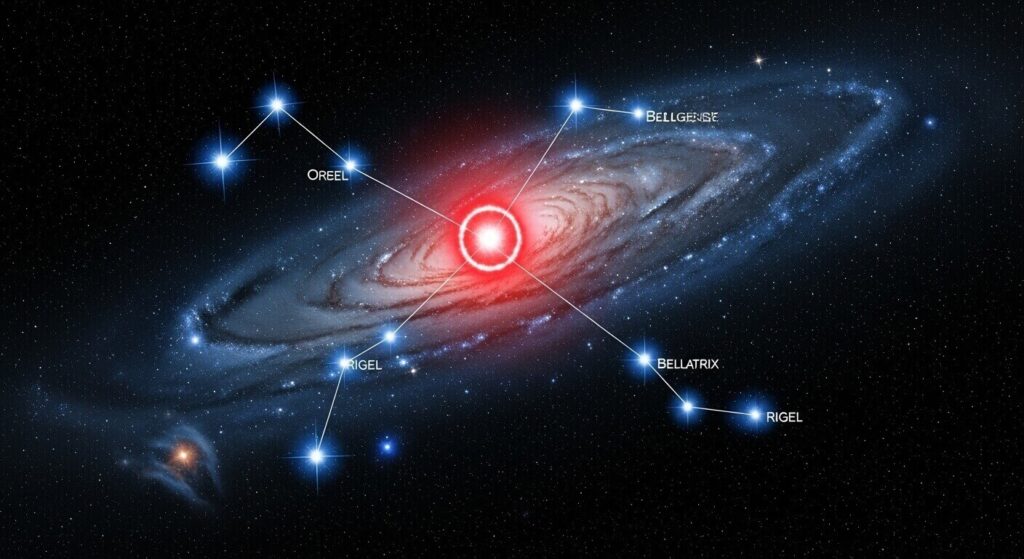
Table of Contents
- The Ticking Giant: What is the Betelgeuse Explosion?
- The Big Question: Is the Betelgeuse Explosion a Threat to Earth?
- Beyond Betelgeuse: Are Other Earth-Ending Scenarios Plausible?
- A Cosmic Glossary: Comet vs. Asteroid vs. Meteor
- Conclusion: From Cosmic Fear to Cosmic Wonder
- Frequently Asked Questions (FAQ)
The Ticking Giant: What is the Betelgeuse Explosion? 🤔
Who is Betelgeuse? (And Why Was It Dimming?)
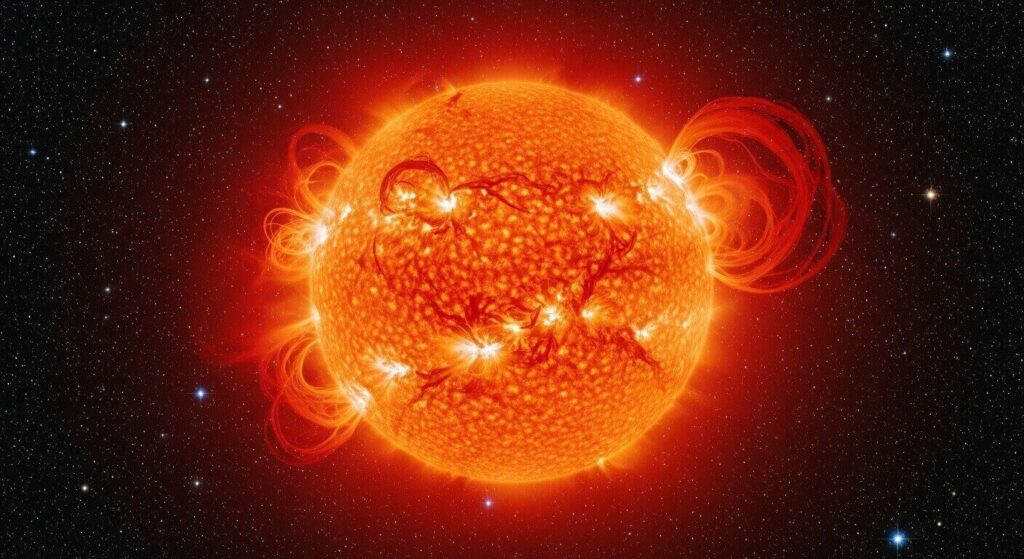
Betelgeuse (pronounced “Beetle-juice”) is a star that defies imagination. It’s a red supergiant, a class of stars that are in the final stages of their lives. To put its size in perspective: if you were to place Betelgeuse where our Sun is, it would engulf the orbits of Mercury, Venus, Earth, Mars, and possibly even Jupiter. It is truly colossal.
You might remember Betelgeuse from the news in 2019 and 2020. It underwent a dramatic and mysterious event known as the “Great Dimming.” The normally brilliant star faded to a fraction of its usual brightness, leading many to speculate that its explosion was imminent. However, experts at NASA and other institutions have since pieced together what likely happened. Betelgeuse didn’t dim because it was about to die; it essentially “sneezed.” The star ejected a massive cloud of hot gas (a Surface Mass Ejection), which then cooled and condensed into a cloud of stardust, temporarily blocking its light from our point of view.
Why is Betelgeuse Going to Explode?
Massive stars like Betelgeuse (around 15-20 times the mass of our Sun) live fast and die young. They burn through their nuclear fuel at an astonishing rate. For millions of years, they fuse hydrogen into helium. Once that runs out, they fuse helium into carbon, then carbon into neon, and so on, creating heavier and heavier elements.
This process eventually stops at iron. Fusing iron doesn’t *release* energy; it *consumes* it. When the star’s core becomes a massive ball of iron, the outward-pushing energy from fusion suddenly stops. Gravity wins. In a fraction of a second, the core collapses, and the star’s outer layers come crashing down onto it. This triggers a cataclysmic rebound explosion known as a Type II supernova. This is Betelgeuse’s ultimate destiny.
What Will the Betelgeuse Supernova Look Like from Earth?
This is the exciting part. When Betelgeuse does explode, it will be one of the most spectacular astronomical events in recorded human history. Experts predict it will shine as brightly as the half-moon, possibly even as bright as the full moon. It will be easily visible during the day for weeks, possibly months. At night, it would be a radiant beacon, casting faint shadows on the ground and completely transforming the night sky. It would be an awe-inspiring, humbling sight.
The Big Question: Is the Betelgeuse Explosion a Threat to Earth? 🌍
Okay, so a star is going to explode. That sounds terrifying. This is the heart of the “Earth-ending scenario” fear. So, should you be worried?
In a word: No.
Let’s break down the science of *why* we are safe, establishing the trust and expertise needed to debunk this myth.
Debunking the “Earth-Ending Scenario”: The Safety of Distance
The primary reason we’re safe is simple: distance. Betelgeuse is approximately 640-650 light-years away from Earth. That’s an incomprehensibly vast distance. While the explosion itself is unimaginably powerful, its energy dissipates over distance according to the inverse-square law.
The main danger from a supernova isn’t the light; it’s the high-energy radiation, like X-rays and gamma rays. To cause any significant damage to Earth’s ozone layer (which protects us from the Sun’s harmful UV radiation), a supernova would need to occur within what scientists call the “kill zone.” Most estimates place this zone at about 50 light-years from Earth. At 650 light-years, Betelgeuse is more than 10 times farther away than the minimum safe distance. The radiation that reaches us will be negligible.
What About Gamma-Ray Bursts (GRBs)?
Some people bring up Gamma-Ray Bursts, or GRBs—highly focused, incredibly powerful jets of radiation fired from the poles of some exploding stars. A GRB *could* be dangerous from much farther away. However, two key facts make this a non-issue for Betelgeuse:
- Not the Right Kind of Star: It’s not clear that a “slowly” rotating star like Betelgeuse would even produce a powerful, jetted GRB. Those are typically associated with different types of stellar explosions.
- It’s Not Pointed at Us: This is the most important part. Based on authoritative studies of Betelgeuse’s movement and rotation, astronomers have determined that its rotational axis—the “barrel of the gun”—is not pointing anywhere near Earth. It’s offset by about 20 degrees.
So, even if it did produce a GRB, the jet would miss us completely, sailing harmlessly off into a different part of the galaxy.
So, When Will Betelgeuse Explode?
This is the one question science cannot answer precisely. The “Great Dimming” got everyone excited, but it was a false alarm. The truth is, “imminent” in astronomical terms is a very flexible word. It could be tomorrow. It could be 1,000 years from now. It could be 100,000 years from now. All we know is that, on a cosmic timescale, it is in its final chapter. In all likelihood, neither you nor I, nor our great-great-grandchildren, will be around to see it. But if we are… what a show it will be.
Beyond Betelgeuse: Are Other Earth-Ending Scenarios Plausible? ☄️
The anxiety about the Betelgeuse explosion often stems from a broader fear of cosmic catastrophes. The most “famous” Earth-ending scenario is, of course, an asteroid or comet impact, like the one that wiped out the dinosaurs 66 million years ago.
How NASA Tracks Near-Earth Objects (NEOs)
This is a threat that scientists take very seriously. Unlike a distant supernova, an asteroid impact is a localized, physical event that has happened before. This is where the Expertise and Authoritativeness of global space agencies come into play. NASA’s Planetary Defense Coordination Office (PDCO) and other international bodies operate a network of telescopes dedicated to finding, tracking, and characterizing Near-Earth Objects (NEOs).
They maintain a database called “Sentry” which constantly scans for any known asteroid with even a remote chance of impacting Earth in the next 100 years. As of today, there are no known credible threats of a significant size. The probability of an unknown, “dinosaur-killer” sized object (1km or larger) hitting us is estimated to be once every several million years.
Humans Are Not Dinosaurs: The DART Mission and Planetary Defense
Here’s the most hopeful part of this story. As one expert noted, “Humans are not dinosaurs.” The dinosaurs had no telescopes, no space program, and no way to fight back. We do.
In 2022, NASA successfully conducted the Double Asteroid Redirection Test (DART). This mission intentionally slammed a spacecraft into a small, harmless asteroid moonlet named Dimorphos. The goal was to see if we could change an asteroid’s orbit. The result? A resounding success. The impact altered the asteroid’s path even more than scientists had hoped. This was the first time in history humanity has demonstrated the ability to change the motion of a celestial body. It was a test of our planetary defense system, and we passed. We have the technology and the knowledge to protect ourselves, should a threat ever be found.
A Cosmic Glossary: Comet vs. Asteroid vs. Meteor 🔭
The terms can get confusing, but the differences are quite simple. Here’s a quick guide to these celestial visitors.
Comet: The “Dirty Snowball”
A comet is a “dirty snowball” made of ice, dust, and rock. They come from the outer edges of our solar system (like the Kuiper Belt or Oort Cloud). When their long, elliptical orbits bring them close to the Sun, the ice heats up and turns into gas, creating a glowing coma (atmosphere) and the long, beautiful tails that are their signature feature.
Asteroid: The “Rocky Relative”
An asteroid is a “space rock.” It’s a chunk of rock and metal left over from the formation of the solar system. Most of them live in the Asteroid Belt between Mars and Jupiter. Unlike comets, they are stable and don’t have tails, though some can have small moons or even rings.
Meteoroid, Meteor, and Meteorite: The Journey to Earth
This is all about location and behavior:
- Meteoroid: This is a small piece of an asteroid or comet (from sand-sized to a few meters wide) just floating in space.
- Meteor: This is the *event* we see. When a meteoroid enters Earth’s atmosphere at high speed, friction causes it to burn up, creating a streak of light. We call this a “shooting star.”
- Meteorite: If a meteor doesn’t burn up completely and a piece of it survives the fiery journey to hit the ground, that surviving rock is called a meteorite.
Conclusion: From Cosmic Fear to Cosmic Wonder ✨
The universe is a vast, powerful, and often violent place. But it is not, as a rule, malicious. The Betelgeuse explosion is not an executioner waiting to strike; it’s a natural, beautiful, and vital part of the cosmic life cycle. The very elements in our bodies—the carbon in our cells, the iron in our blood—were forged in the hearts of stars and scattered across the galaxy by supernovae just like the one Betelgeuse will become.
We are, quite literally, made of stardust. This perspective shifts our view from one of cosmic fear to one of cosmic connection. We are not just *on* Earth; we are *of* the universe.
So, the next time you see Betelgeuse in the night sky, don’t feel fear. Feel awe. You are looking at a monument of creation, a stellar ancestor. And if it does go supernova in our lifetime, we will be the lucky few in all of human history to witness one of the universe’s greatest spectacles, safe from 650 light-years away.
Frequently Asked Questions (FAQ) ❓
Q: When will the Betelgeuse explosion happen?
A: Scientists don’t know for sure. “Imminent” in astronomical terms means it is in the final stage of its life. This could be tomorrow, in 1,000 years, or as far as 100,000 years from now.
Q: Will the Betelgeuse explosion harm Earth with radiation?
A: No. Betelgeuse is about 650 light-years away, which is well outside the “kill zone” of about 50 light-years. Any harmful radiation will be too dissipated to affect Earth’s ozone layer.
Q: Will the explosion be visible during the day?
A: Yes. When it explodes, it’s predicted to be as bright as the half-moon or even the full moon. It will be clearly visible in the daytime sky for several weeks or months.
Q: What is more dangerous: the Betelgeuse explosion or an asteroid?
A: The Betelgeuse explosion poses no danger to Earth. A large, *undiscovered* asteroid is a more direct (though still very low-probability) threat. This is why organizations like NASA actively scan the skies and develop planetary defense technology like the DART mission.
Q: What caused the “Great Dimming” of Betelgeuse in 2019?
A: Experts believe the star ejected a massive cloud of gas (a Surface Mass Ejection). This cloud then moved away from the star, cooled, and condensed into a cloud of stardust that temporarily blocked Betelgeuse’s light from our perspective.