Cosmic Microwave Background (CMB): Discover the definitive evidence of the Big Bang. Explore the latest LOFAR observations challenging our understanding of cosmic velocity and the very fabric of our universe.
Have you ever wondered what the universe looked like just moments after its birth? As a space enthusiast and researcher, I’ve always found the Cosmic Microwave Background (CMB) to be the most poetic piece of evidence in physics. It’s essentially the “afterglow” of creation, a faint whisper from 13.8 billion years ago that still permeates every inch of the sky. Today, we aren’t just talking about old news; we’re diving into how recent data is making us rethink the speed at which we are traveling through the cosmos. 😊
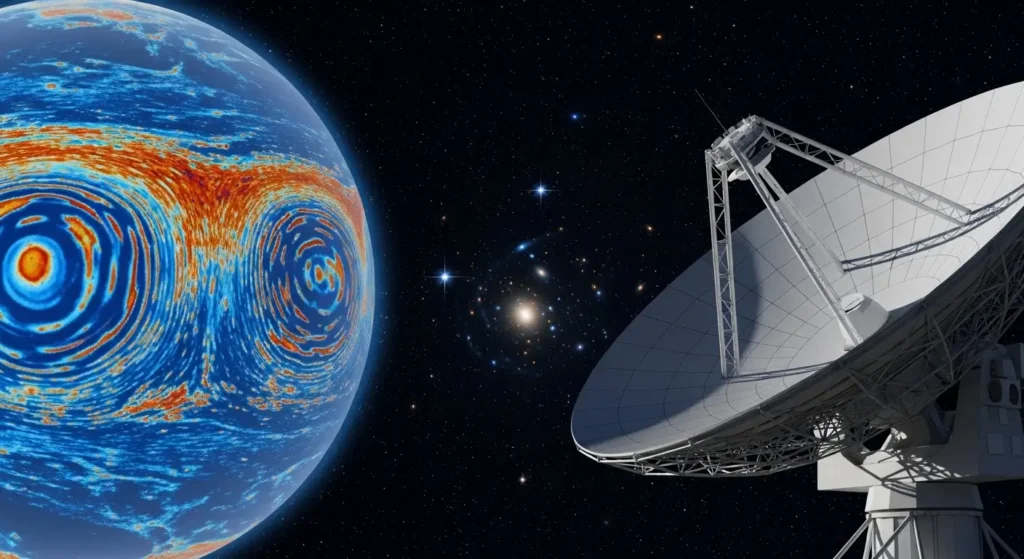
1. What is the Cosmic Microwave Background (CMB)? 🌌
To understand the Cosmic Microwave Background, we have to travel back to about 380,000 years after the Big Bang. Before this moment, the universe was a hot, dense plasma of ionized gas. Light couldn’t travel far because it kept bumping into free electrons—imagine trying to see through a thick fog. However, as the universe expanded and cooled (to about 3,000 Kelvin), electrons combined with protons to form neutral hydrogen. This event, known as “Recombination,” allowed photons to travel freely for the first time.
Those photons have been traveling ever since. Because the universe has expanded significantly, their wavelength has been stretched into the microwave part of the spectrum. This is why we call it the Cosmic Microwave Background Radiation. It is remarkably uniform, but it’s those tiny fluctuations—one part in 100,000—that actually matter most for our existence.
💡 Expert Tip: The CMB is often called the “Baby Picture of the Universe.” It shows the distribution of matter and energy at the very beginning, acting as a blueprint for the galaxies we see today.
2. Evidence for the Big Bang Theory and Cosmological Principle 🔭
The discovery of the Cosmic Microwave Background by Arno Penzias and Robert Wilson in 1964 was the “smoking gun” for the Big Bang Theory. Before this, the “Steady State” theory was a popular rival. However, the CMB proved that the universe was once incredibly hot and dense, which is exactly what the Big Bang predicted.
Furthermore, the CMB supports the Cosmological Principle, which states that on a large enough scale, the universe is isotropic (looks the same in all directions) and homogeneous (has the same density everywhere). This was widely accepted—until the latest observations started showing some “glitches” in this uniformity.
| Mission/Observatory | Key Contribution to CMB Science |
|---|---|
| COBE (1989) | First detected “anisotropies” (temperature variations). |
| WMAP (2001) | Determined the age of the universe (13.77 billion years). |
| Planck (2009) | Highest precision map of the early universe to date. |
3. The LOFAR Shock: Are We Moving Faster Than the CMB Predicts? ⚡
The Cosmic Microwave Background serves as a reference frame for the entire universe. By observing the “Dipole Anisotropy” (one side of the sky looks slightly warmer because we are moving toward it), scientists calculated the velocity of our Solar System relative to the CMB. The standard value was around 369 km/s.
However, recent research using the LOFAR (Low-Frequency Array) telescope has thrown a wrench into this. By analyzing the distribution of distant quasars (extremely bright galactic cores), researchers found a dipole signal much stronger than expected. If we use quasars as our “stationary” background, it suggests we are moving nearly three times faster than the CMB suggests!
⚠️ The Cosmological Crisis:
If this discrepancy is verified, it means the Standard Model of Cosmology (ΛCDM) might be fundamentally flawed. Either the universe isn’t as homogeneous as we thought, or our understanding of gravity and expansion needs a major overhaul.
4. The Future of Cosmological Research 🚀
Why does this matter to us? Understanding the Cosmic Microwave Background is the only way to solve the mystery of Dark Energy and Dark Matter. If the expansion rate (Hubble Constant) varies depending on whether we look at the CMB or local supernovae, we are missing a huge piece of the puzzle. We are living in a “Golden Age of Astronomy” where every new data point from the James Webb Space Telescope or LOFAR could redefine our place in the stars.
Honestly, it’s a bit scary but also incredibly exciting. We are literally questioning the laws of the universe. As Koji Hashimoto wrote in “Viewing the World Through Physics,” science is about having the courage to look at the world differently. We must be ready to let go of old certainties when the data points to a new truth. 🌠
Executive Summary: The CMB in a Nutshell 📝
Key takeaways from today’s deep dive into our cosmic origins:
- Origin: The CMB is the remnant heat from the Big Bang, released during the “Recombination” era.
- Significance: It proves the universe started as a hot, dense singularity and is expanding.
- The Velocity Conflict: New LOFAR data suggests our galaxy’s movement relative to distant quasars contradicts the speed measured by the CMB.
- Cosmological Principle: The foundation of modern physics (isotropy/homogeneity) is currently under intense scrutiny.
Frequently Asked Questions (FAQ) ❓
Q1: Can we see the Cosmic Microwave Background with the naked eye?
A: No, it’s in the microwave spectrum, which is invisible to humans. However, if you have an old analog TV, about 1% of the “static” between channels was actually interference from the CMB!
Q2: What is the “CMB Cold Spot”?
A: It is an unusually large and cold area in the CMB map discovered by the WMAP and Planck satellites. Some scientists speculate it could be a sign of a “Supervoid” or even a collision with a parallel universe.
Q3: How does the CMB help us find Dark Matter?
A: The density fluctuations in the CMB act as gravitational seeds. By studying how these seeds grew into galaxies, we can calculate exactly how much invisible “Dark Matter” was needed to provide the gravity.
The universe is far more complex than our simple models suggest. If you have any thoughts on the LOFAR findings or questions about the Big Bang, let’s chat in the comments! I’d love to hear your perspective on our cosmic journey. 😊