Will a Gamma-Ray Burst from WR 104 or Apep destroy Earth? Discover how the James Webb Space Telescope is revealing the secrets of these “Death Stars” and whether 8,400 light-years is enough to keep us safe.
Table of Contents
- 1. The Cosmic Sniper: Is Earth in the Crosshairs?
- 2. WR 104: The 8,400 Light-Year Gamma-Ray Threat
- 3. James Webb Telescope and the “Apep” Triple Star System
- 4. The Physics of Doom: How Wolf-Rayet Stars Explode
- 5. Risk Assessment: Should We Be Worried?
- 6. Summary and Final Thoughts
Space is often described as a silent, beautiful void. But for astronomers peering through the lens of the James Webb Space Telescope (JWST), it’s a high-stakes shooting gallery. While we worry about local threats like solar flares or stray asteroids, a much more terrifying prospect lurks deep in our galaxy: Wolf-Rayet stars. These celestial behemoths are the precursors to the most violent events in the universe—Gamma-Ray Bursts (GRBs). I’ve spent years following these developments, and the latest data suggests that the “Death Star” trope isn’t just for science fiction anymore. 😊
WR 104: The 8,400 Light-Year Gamma-Ray Threat 🎯
In 2008, a study published in Nature sent shockwaves through the scientific community. It identified WR 104, a binary star system located 8,400 light-years away in the constellation Sagittarius, as a potential threat to life on Earth. But why would something so distant matter to us?
The danger lies in the geometry of the star. WR 104 is a pinwheel nebula, a beautiful spiral of dust created by two stars orbiting each other. Crucially, early measurements suggested that we are looking almost exactly down the “barrel” of its rotational axis. If WR 104 goes supernova and triggers a GRB, the energy will be focused into a narrow beam along that axis. If that beam hits Earth, even from 8,000 light-years away, it could strip our ozone layer and trigger a mass extinction.
💡 Key Fact: A Gamma-Ray Burst (GRB) releases more energy in seconds than our Sun will emit in its entire 10-billion-year lifetime. It is the universe’s most powerful “flashlight.”
James Webb Telescope and the “Apep” Triple Star System 🌌
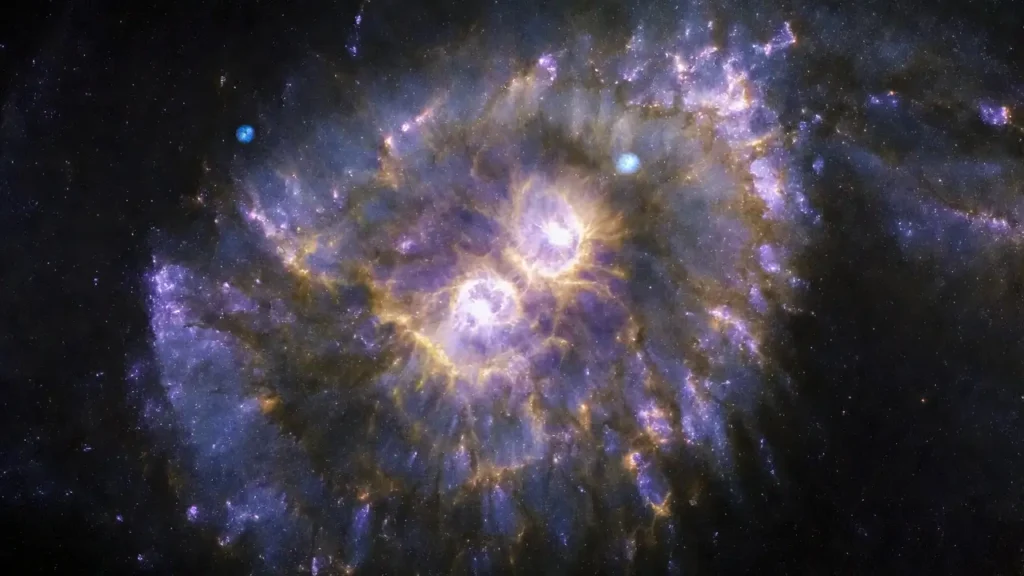
Named after the Egyptian god of chaos, Apep (WR 7016) is another candidate for a catastrophic supernova. Recent observations by the James Webb Space Telescope have completely redefined our understanding of this system. Unlike WR 104, which was thought to be a simple binary, JWST revealed that Apep is a complex three-body system.
- A Deadly Duo: The core contains not one, but two Wolf-Rayet stars spiraling toward their inevitable end.
- The Dust Engine: The stars emit fierce stellar winds. Where these winds collide, they forge cosmic dust into a stunning, lethal spiral.
- The Critical Spin: For a star to produce a GRB, it must be rotating rapidly. JWST data helps us measure if these stars are losing their spin or “winding up” for a final blast.
The Physics of Doom: How Wolf-Rayet Stars Explode 💥
Wolf-Rayet stars represent the final brief stage in the life of the most massive stars (usually >25 times the mass of our Sun). They are incredibly hot and luminous, having shed their outer layers of hydrogen to expose a core of helium, carbon, and oxygen.
When the core of a Wolf-Rayet star finally collapses into a black hole or neutron star, the resulting Type Ic supernova can become a long-duration GRB. This happens if the star is rotating fast enough to create a “jet” of plasma that punches through the star’s remaining layers at nearly the speed of light.
| Feature | WR 104 | Apep (WR 7016) |
|---|---|---|
| Distance | ~8,400 Light-Years | ~8,000 Light-Years |
| System Type | Binary Pinwheel | Triple Star (Chaos) |
| Earth Alignment | High Potential (0-16°) | Unknown/Evolving |
Risk Assessment: Should We Be Worried? 🛡️
Is Earth truly in danger? To be honest, it depends on who you ask. Most modern simulations suggest that for a GRB to be truly “extinction-level” for Earth, it would need to occur within about 6,500 light-years. WR 104 and Apep are right on the edge of that “kill zone.”
Furthermore, “looking down the barrel” is a matter of degrees. Even a 5-degree tilt of the star’s axis would mean the beam misses Earth entirely. Recent spectroscopic analysis of WR 104 suggests the tilt might be closer to 30 or 40 degrees than previously thought. If so, we are perfectly safe—we’ll just get a front-row seat to the most spectacular light show in history.
⚠️ Expert Perspective: The Ordovician extinction (440 million years ago) is hypothesized by some scientists to have been caused by a GRB. While rare (once every few hundred million years per galaxy), they are a legitimate part of the “cosmic cycle.”
Summary and Final Thoughts 📝
The James Webb Space Telescope continues to remind us that we live in a dynamic, and sometimes dangerous, universe. While WR 104 and Apep represent potential “Death Stars,” the vastness of space remains our greatest shield.
The study of these stars isn’t just about “doom and gloom”; it’s about understanding how the elements that make up our bodies—carbon, oxygen, and iron—are forged and distributed across the cosmos during these titanic explosions. We are, quite literally, made of star-stuff, and sometimes that star-stuff goes out with a bang!
Do you think we should invest more in “Planetary Defense” against cosmic threats like GRBs? Or is the distance enough for you to sleep soundly? Let me know in the comments! 😊
Frequently Asked Questions ❓
Q: Can a Wolf-Rayet star explode tomorrow?
A: In astronomical terms, “soon” means anytime within the next 100,000 years. While it could happen tomorrow, the probability is extremely low.
Q: Would we see the explosion before it hits us?
A: No. Since the gamma rays travel at the speed of light, the radiation and the visual light would arrive at the exact same time. It would be instantaneous.
Q: Is James Webb the only way to track these stars?
A: While JWST is the most powerful, ground-based observatories like the VLT (Very Large Telescope) and X-ray satellites like Chandra also play a vital role in monitoring their activity.