Is the Oort Cloud really a sphere? Discover the shocking truth about the Oort Cloud’s spiral structure and how the Milky Way’s galactic tides reshape the edge of our Solar System. A deep dive into modern astrophysics.
Table of Contents
- 1. Introduction: The Mystery at the Edge of the Solar System
- 2. Jan Oort’s Hypothesis: The Traditional Spherical Model
- 3. The Spiral Revelation: Why the Oort Cloud Isn’t a Shell
- 4. Galactic Tides: The Hidden Force Reshaping Our World
- 5. Why This Discovery Changes Everything in Astronomy
- 6. Conclusion: A New Paradigm for Cosmic Exploration
For decades, we have looked at the night sky and wondered where the “messengers of doom”—comets—originate. In the standard textbooks, we are taught that a massive, spherical reservoir of icy bodies surrounds our Solar System. But what if I told you that this iconic “dandelion” shape is a scientific myth? Recent breakthroughs in computational astrophysics suggest that the Oort Cloud is far more dynamic, boasting a complex spiral structure that defies our old understanding. 🌌
Jan Oort’s Legacy: The Birth of the Comet Reservoir Theory 🔭
Back in 1950, Dutch astronomer Jan Oort noticed a strange paradox. Long-period comets were frequently entering the inner Solar System, yet they were so fragile that they should have disintegrated after a few orbits near the Sun. If comets were as old as the Solar System itself, they should have vanished billions of years ago.
Oort proposed a brilliant solution: a vast, distant cloud of frozen objects, pushed out by the giant planets billions of years ago and then circularized by the gravity of passing stars. This spherical Oort Cloud became the standard model for over 70 years. However, because these objects are so small and far away (stretching up to 100,000 AU), we have never actually “seen” it. We’ve only seen its “refugees”—the comets.
💡 Did you know?
The Oort Cloud is located roughly 2,000 to 100,000 Astronomical Units (AU) from the Sun. For context, 1 AU is the distance from Earth to the Sun. The outer edge is nearly halfway to the next star, Proxima Centauri!
The Spiral Structure: A Shocking Revelation in Solar System Geometry 🌀
With the advent of high-resolution simulations and supercomputing, the “sphere” has collapsed. Researchers have discovered that the gravitational environment of the Milky Way galaxy plays a much larger role than previously estimated. The Oort Cloud isn’t a static bubble; it’s a living, breathing part of the galaxy.
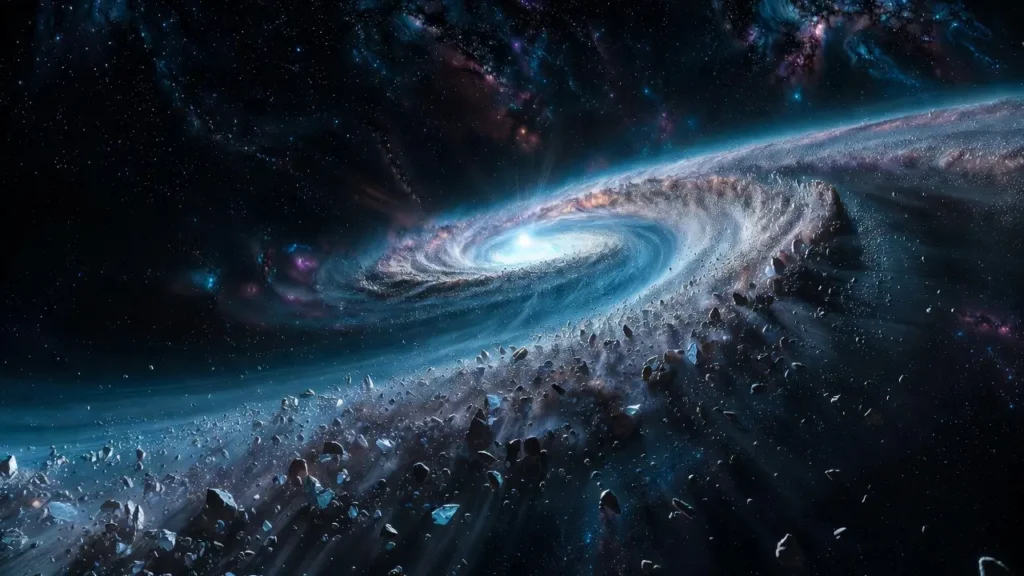
According to modern simulations, the outer regions of the Oort Cloud are stretched and twisted into a “S-shaped” spiral arm structure. Instead of being evenly distributed, the icy remnants of our Solar System’s birth are concentrated in these tidal tails. This means that comets aren’t coming from “everywhere”—they are coming from specific gravitational highways.
| Feature | Old Spherical Model | New Spiral Model |
|---|---|---|
| Shape | Perfect Sphere/Shell | Asymmetric Spiral (S-shape) |
| Primary Force | Passing Stars | Galactic Tidal Forces |
| Alignment | Random Distribution | Inclined (approx. 30 degrees) |
Galactic Tides: The Hidden Architect of Our Outer Reaches 🌊
Why the change? The answer lies in Galactic Tidal Forces. Just as the Moon causes tides on Earth, the massive center of the Milky Way and the surrounding galactic disk exert a tidal pull on the Solar System.
Because the Oort Cloud is so distant from the Sun, its gravitational grip is incredibly weak. The Milky Way’s gravity essentially “yanks” on the outer edges of the cloud, stretching it along the direction of the galactic center and compressing it vertically. This creates the spiral structure and tilts it by about 30 degrees relative to the Ecliptic Plane (the flat disc where planets orbit).
⚠️ Critical Insight:
This discovery suggests our Solar System is not an island. It is deeply integrated into the galactic ecosystem, constantly being molded by the heavy machinery of the Milky Way.
Why the Oort Cloud Spiral Discovery Matters ✨
This isn’t just a change in geometry; it’s a change in how we explore the universe. For years, telescopes searching for Oort Cloud objects were looking in the wrong places. By understanding the spiral alignment, we now know we should be focusing our observations on the 30-degree tilted “spiral arms” where these objects are most densely packed.
- Predicting Comet Impacts: Understanding the spiral arms helps us predict periods when galactic tides might “shake” the Oort Cloud, sending more comets toward Earth.
- Interstellar Origins: Some objects in the Oort Cloud might actually be “stolen” from other stars. The spiral model explains how these captures happen more easily.
- Evolutionary History: It provides a map of how our Solar System has moved through the galaxy over billions of years.
Oort Cloud: The New Blueprint 🌌
Structure:S-shaped Spiral Tails instead of a sphere.
Driving Force:Milky Way Galactic Tides.
Orientation: Tilted 30 degrees from the planetary plane.
Expert View: We are looking for “gravitational highways,” not a random cloud.
Conclusion: A New Paradigm for the Cosmos 🌏
The Oort Cloud is the final frontier of our Solar System. Discovering its spiral nature reminds us that science is never “settled”—it is a constant journey of refinement. By realizing that we are physically connected to the galaxy through these spiral gravitational arms, we take one step closer to understanding our place in the cosmic ocean.
As the Vera C. Rubin Observatory and other next-generation telescopes come online, we may soon see the first direct evidence of this spiral structure. The “invisible” Oort Cloud is starting to reveal its true face. What else have we been getting wrong about the universe? Let me know your thoughts in the comments below! 😊
Frequently Asked Questions ❓
Q: Is the Oort Cloud still considered part of the Solar System?
A: Yes, it is the outermost region, held by the Sun’s gravity, though that grip is very weak compared to the inner planets.
Q: Why did we think it was a sphere for so long?
A: Comets come from all directions in the sky, which led early astronomers to assume a uniform, spherical distribution. Modern simulations show that while they come from all over, they are concentrated in spiral density waves.
Q: Does the spiral structure affect Earth?
A: Indirectly, yes. The spiral density arms are more susceptible to gravitational disturbances, which can occasionally trigger comet showers toward the inner Solar System.