Outer space is the most hostile environment imaginable. It’s a near-perfect vacuum, void of air and pressure. Temperatures swing hundreds of degrees, from scorching sunlight to bone-chilling shadow. Add in lethal radiation and micrometeoroids traveling faster than bullets, and you have a place where an unprotected human wouldn’t last more than a few seconds.
This is why the spacesuit—or Extravehicular Mobility Unit (EMU) as NASA calls it—is far more than just clothing. It’s a self-contained, one-person spaceship, perfectly shaped to the human form. It provides everything Earth does: air, pressure, water, and protection.
For over 40 years, NASA’s classic EMU has been the workhorse of space exploration, allowing astronauts to build the International Space Station (ISS) and repair the Hubble Telescope. But as humanity sets its sights back on the Moon with the Artemis program, this aging marvel is facing retirement.
In this deep dive, we’ll dissect the incredible engineering of the existing EMU and explore why the future of lunar exploration depends on its revolutionary successor: the Axiom Extravehicular Mobility Unit (AxEMU).
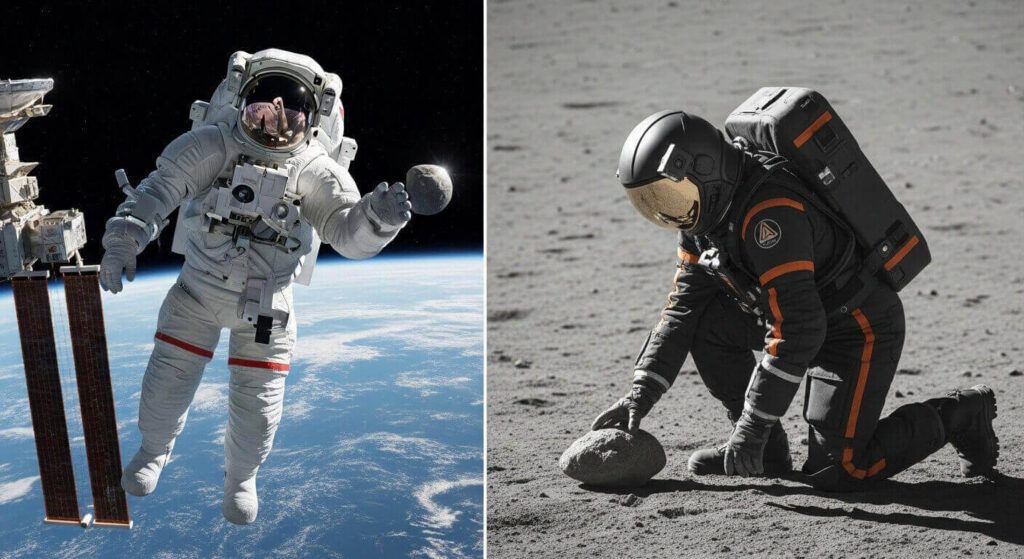
Table of Contents
- The Workhorse of LEO: A Deep Dive into NASA’s EMU
- The Next Giant Leap: The AxEMU and Lunar Exploration
- Beyond NASA: A Quick Look at Other Spacesuits
- Frequently Asked Questions (FAQ) About Spacesuits
The Workhorse of LEO: A Deep Dive into NASA’s EMU
When you picture an astronaut on a spacewalk outside the ISS, you’re picturing the EMU. This suit has been the standard for Extravehicular Activity (EVA) since the 1980s. It’s not a single garment but a modular system composed of two main parts.
The “Suit”: The Pressure Garment System (PGS)
The PGS is the wearable part of the suit. It’s a multi-layered marvel of engineering designed to handle pressure, temperature, and impacts. Let’s break down its layers from the inside out.
- Liquid Cooling and Ventilation Garment (LCVG): Before even putting on the suit, the astronaut dons this full-body undergarment. It looks like high-tech long underwear, but it’s woven with over 300 feet (100m) of tiny plastic tubes. Chilled water circulates through these tubes, drawing heat away from the astronaut’s body. Without it, the astronaut would literally cook inside the insulated suit.
- Pressure Bladder: This is the layer that holds the air in. It’s a urethane-coated nylon “balloon” that inflates to maintain a constant internal pressure of 4.3 psi (pounds per square inch). Since Earth’s atmosphere at sea level is 14.7 psi, this lower pressure (filled with pure oxygen) makes the suit less stiff and easier to move.
- Restraint Layer: This layer goes over the bladder and prevents it from ballooning outwards. It’s a structural layer that gives the suit its human shape.
- Thermal Micrometeoroid Garment (TMG): This is the iconic white outer layer. It’s a composite of about 12 different sub-layers, including multiple layers of aluminized Mylar (like foil) for insulation, and a tough outer layer of Ortho-Fabric—a blend of Gore-Tex, Kevlar, and Nomex. This layer reflects sunlight and protects the astronaut from tiny, high-velocity space debris.
The “Backpack”: The Portable Life Support System (PLSS)
The “backpack” is the heart, lungs, and power station of the EMU. This is what truly makes it a spaceship. The PLSS provides up to 8 hours of life support and contains:
- Oxygen Tanks: Provide 100% pure oxygen for breathing and suit pressurization.
- CO2 Removal: A canister (using materials like “MetLox”) scrubs the exhaled carbon dioxide from the air, preventing a toxic buildup.
- The Sublimator: This is the suit’s air conditioner. It takes the warm water from the LCVG and exposes it to the vacuum of space through a porous plate. The water instantly freezes and then turns directly into gas (sublimation), carrying a massive amount of heat away with it.
- Battery and Comms: A silver-zinc battery powers the entire suit, while a radio and antenna system keep the astronaut in constant contact with the crew inside and Mission Control on Earth.
The Hard Realities: Why the 40-Year-Old EMU Must Be Replaced
The EMU is an engineering legend. It built the ISS. But it’s also 40-year-old technology, and its limitations are well-documented by the astronauts who use it.
- Brutal Stiffness: The EMU operates at 4.3 psi. While low, this pressure makes the suit incredibly stiff. Astronauts describe fighting against a constantly inflated balloon. This leads to extreme fatigue and physical injury. Shoulder injuries are notoriously common.
- Glove Problems: The gloves are the most complex part. They must be protective yet allow dexterity. The pressure and stiffness cause intense hand fatigue and pain. Many astronauts have reported damaged or even lost fingernails after difficult EVAs.
- Zero-G Design: The EMU was designed *only* for weightlessness. It has no real “legs” in the functional sense. The boots are just foot coverings. You cannot walk, bend, or kneel in an EMU. This makes it completely unsuitable for working on the surface of the Moon or Mars.
- Sizing and Prep Time: The EMU is modular, but it’s difficult to size and takes hours to put on. This includes a lengthy “pre-breathe” period, where astronauts must breathe pure oxygen to purge nitrogen from their blood to prevent “the bends” (decompression sickness).
The Next Giant Leap: The AxEMU and Lunar Exploration
To return to the Moon, NASA needed a 21st-century suit. Under the xEVAS (Exploration Extravehicular Activity Services) contract, they turned to the commercial sector. Axiom Space is developing the new suit for the Artemis III mission: the AxEMU.
This suit isn’t just an upgrade; it’s a complete paradigm shift, designed from the ground up to solve the EMU’s biggest problems.
Mobility Reimagined: How AxEMU Solves EMU’s Biggest Problems
The number one priority for a lunar suit is mobility. Astronauts need to be able to walk, bend over to pick up rocks, kneel, and traverse complex terrain.
- Advanced Joints: Instead of relying on stiff, accordion-like fabric joints, the AxEMU incorporates advanced bearings in the waist, hips, knees, and ankles. This allows for a range of motion that is simply impossible in the old EMU.
- Full Leg Functionality: The AxEMU has fully functional legs and boots designed for walking, climbing, and kneeling. Astronauts will be able to “walk” rather than “bunny hop” as the Apollo astronauts did.
- Rear-Entry Design: The AxEMU features a “rear-entry” hatch, similar to the Russian Orlan suit. The astronaut opens a hatch on the back and simply slides in, feet-first. This is dramatically faster and easier than the EMU’s modular assembly and reduces the risk of decompression sickness.
Built for the Moon: Key Features for the Artemis Mission
The AxEMU also includes a host of new technologies specifically for the harsh lunar environment.
- Lunar Dust Mitigation: Lunar regolith (dust) is not like Earth dust. It’s microscopic, jagged, and electrostatically charged. It destroyed the joints on the Apollo suits. The AxEMU is built with tightly sealed components and advanced materials to prevent this destructive dust from getting into the suit’s mechanisms.
- Advanced Avionics: The suit includes a high-definition video camera mounted on the helmet, advanced lighting for working in dark craters, and a sophisticated internal data display.
- Universal Sizing: Unlike the EMU, which struggled to fit all astronaut body types, the AxEMU is designed to fit a much wider range of humans, from the 5th to the 95th percentile. This is critical for ensuring every qualified astronaut can perform an EVA.
Beyond NASA: A Quick Look at Other Spacesuits
While the EMU and AxEMU are NASA’s primary suits, they aren’t the only ones.
- Russian Orlan: The Orlan suit is the Russian counterpart to the EMU. It’s a semi-rigid suit with a rear-entry hatch (which inspired the AxEMU). It operates at a higher pressure (5.8 psi), which reduces pre-breathe time.
- SpaceX Suits: The sleek, futuristic suits worn by SpaceX’s Dragon crews are Intravehicular Activity (IVA) suits. They are “escape suits,” designed only to protect an astronaut if the capsule depressurizes. They cannot be used for spacewalks. SpaceX is, however, developing its own EVA suit for future missions.
Conclusion: The Spacesuit as a Symbol of Human Exploration
The spacesuit remains one of the most incredible pieces of technology ever created. It is the ultimate expression of human ingenuity, a fragile bubble of life maintained against the most unforgiving void we know.
The EMU was the reliable, gritty workhorse that allowed us to build a permanent home in orbit. The AxEMU is the agile, next-generation explorer that will allow us to once again walk, and this time *work*, on another world. As we continue to push our boundaries, this “1-person spaceship” will be what allows us to take the next giant leap.
Frequently Asked Questions (FAQ) About Spacesuits
How much does a spacesuit cost?
This is a complex question. The original EMU suits built in the 1980s are estimated to have cost between $15 million and $22 million apiece. Adjusted for inflation, that’s well over $150 million today. The new AxEMU is part of a “service contract” (the xEVAS contract), where NASA pays Axiom Space for the *service* of spacewalking, not just the suit itself.
How do astronauts go to the bathroom in a spacesuit?
For EVAs that can last up to 8 hours, this is a practical concern! Astronauts wear a Maximum Absorbency Garment (MAG), which is essentially a high-tech adult diaper.
What happens if a spacesuit gets a puncture?
A small puncture is a major emergency. The TMG (outer layer) is designed to protect against most micrometeoroids. If a puncture does occur, the suit will begin to leak air. The astronaut has a limited time (depending on the hole size) to get back to the airlock. The suit’s life support system will automatically flood the suit with pure oxygen to try and maintain pressure, but it’s a race against time.
Why are spacesuits white?
The white color of the TMG is purely functional. In direct sunlight, an astronaut is exposed to intense solar radiation. White reflects heat and radiation, keeping the astronaut inside at a safe temperature. Black, by contrast, would absorb that heat and quickly become dangerously hot.
How long does it take to put on a spacesuit?
Getting into the EMU is a long process that can take over 4 hours. This includes checking all components, putting on the LCVG, and the long “pre-breathe” period to prevent decompression sickness. The new AxEMU, with its rear-entry hatch, aims to cut this “donning” time down significantly, to perhaps under an hour.