Explore the incredible 47-year odyssey of NASA’s Voyager spacecraft. From the mysterious ‘Wall of Fire’ at the edge of our solar system to the Golden Record carrying humanity’s legacy, discover how these silent explorers are redefining our place in the cosmos.
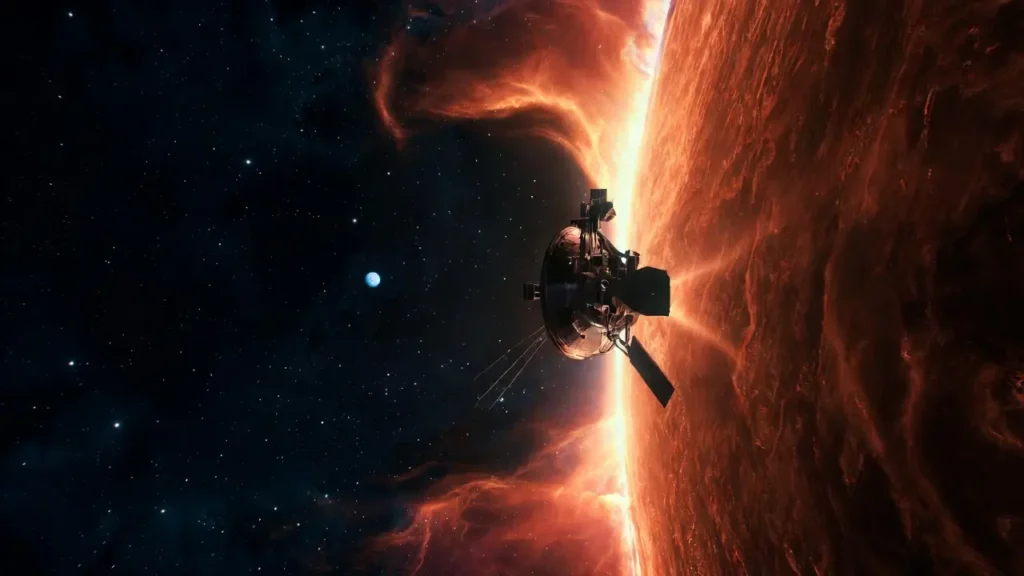
Have you ever wondered what lies at the very edge of our cosmic backyard? In 1977, when the world was listening to disco and the first Star Wars movie premiered, two small machines—Voyager 1 and 2—embarked on a journey that would outlast civilizations. Today, they are the furthest man-made objects from Earth, screaming through the silent void of interstellar space. Looking back at their journey, it’s not just about cold metal and circuits; it’s a story of human curiosity reaching for the stars. Let’s dive into the breathtaking records these pioneers have sent back from the “Wall of Fire.” 🚀
Table of Contents
- 1. The Interstellar Boundary: Facing the ‘Wall of Fire’
- 2. Voyager 2’s Unique Legacy: The Grand Tour of Outer Planets
- 3. Staying Connected Across 12 Billion Miles: The Power of DSN
- 4. The Golden Record: Humanity’s Eternal Time Capsule
- 5. Frequently Asked Questions (FAQ)
The Interstellar Boundary: Facing the ‘Wall of Fire’ 🔥
When Voyager 1 crossed the heliopause in 2012, followed by Voyager 2 in 2018, they encountered something truly unexpected: a massive increase in plasma temperature and density. Scientists often refer to this region as the ‘Wall of Fire’. But what exactly is it?
💡 Science Fact: Why doesn’t Voyager melt?
The temperature in this zone ranges from 30,000 to 50,000 Kelvin. However, the density of the plasma is so incredibly low that the actual heat transfer to the spacecraft is negligible. It’s like walking through a room filled with sparse sparks rather than a roaring furnace.
This boundary, known as the Heliopause, is where the solar wind—the stream of charged particles from our Sun—is pushed back by the interstellar wind from other stars. Passing this gate means the Voyagers have officially left the “bubble” of our Sun and entered the vast ocean of the galaxy.
Voyager 2’s Unique Legacy: The Grand Tour 🪐
While Voyager 1 took the fast lane out of the solar system, Voyager 2 was the meticulous explorer. It remains the only spacecraft in history to have visited all four giant outer planets: Jupiter, Saturn, Uranus, and Neptune.
| Target Planet | Key Discovery by Voyager 2 |
|---|---|
| Jupiter | Discovery of rings around Jupiter and active volcanism on Io. |
| Saturn | Detailed mapping of the complex ring structures and moonlets. |
| Uranus | Discovered 10 new moons and two new rings; tilted magnetic field. |
| Neptune | Discovery of the ‘Great Dark Spot’ and ice geysers on Triton. |
Honestly, the data Voyager 2 sent back from Neptune in 1989 is still our primary source of knowledge about the blue ice giant. Its journey was a “once-in-175-years” opportunity where the planets aligned perfectly for a gravity-assisted tour.
Staying Connected Across 12 Billion Miles 📡
How does a machine from the 70s with less computing power than a modern car key talk to Earth from 12 billion miles away? The answer lies in the Deep Space Network (DSN).
The Engineering Marvel 🔢
- Signal Delay: It takes about 23 hours for a command to reach Voyager 1 and another 23 hours to get a response.
- Signal Strength: The received signal on Earth is 20 billion times weaker than the power used by a digital watch.
- Power Source: They run on Radioisotope Thermoelectric Generators (RTGs) fueled by Plutonium-238.
Lately, the mission team has been performing “software miracles,” turning off non-essential heaters and instruments to keep the communication alive until at least 2030. It’s a delicate dance of survival in the absolute zero of space.
The Golden Record: Humanity’s Eternal Message 📀
If an extraterrestrial civilization ever finds the Voyager probes, they will find a gold-plated copper phonograph record. Curated by Carl Sagan, this ‘Golden Record’ contains the sights and sounds of our planet.
Imagine a billion years from now—Earth might be unrecognizable, but Voyager will still be carrying the sounds of a mother’s kiss, a heartbeat, and the music of Bach and Chuck Berry through the cosmos. It is the ultimate time capsule of human existence.
Voyager Mission Summary 🚀
• Status: Interstellar Space (Beyond the Heliopause)
• Key Obstacle: The ‘Wall of Fire’ (High-temp plasma zone)
• Unique Achievement: Voyager 2’s Grand Tour of 4 outer planets
• Human Legacy: Carrying the Golden Record for billions of years
The Voyager mission reminds us that while we are small, our reach is infinite. These twin probes are our first emissaries to the stars, proving that human ingenuity can pierce the darkness of the unknown. As their power fades, they will eventually fall silent, but they will never truly die. They will wander the Milky Way as silent monuments to a species that dared to look up and wonder.
What message would YOU send to the stars today? Let us know in the comments! 😊
Frequently Asked Questions (FAQ) ❓
Q: Is the ‘Wall of Fire’ actually dangerous for the spacecraft?
A: No. While the plasma is extremely hot (up to 50,000K), its density is so low that there aren’t enough particles to transfer significant heat to the Voyager probes. They pass through safely.
Q: Where are Voyager 1 and 2 right now?
A: As of 2024, Voyager 1 is about 15 billion miles from Earth, and Voyager 2 is about 12.6 billion miles away. Both are in interstellar space.
Q: How much longer will they continue to operate?
A: NASA expects to maintain contact with at least one science instrument on each probe until roughly 2025–2030, after which the power will likely be too low to transmit data.