Explore the complex Starship Mars landing sequence. Learn how the final descent and Raptor engine ignition work together to ensure a successful touchdown on the Red Planet.
Table of Contents
- 1. The Ultimate Challenge: Landing on Mars
- 2. The Atmospheric Entry and Belly Flop Maneuver
- 3. Starship Mars Landing Sequence: Final Descent Phase
- 4. Critical Engine Ignition and Landing Flip
- 5. Precision Engineering: Raptor Engines and Autonomy
- 6. Frequently Asked Questions (FAQ)
The Ultimate Challenge: Landing on Mars 🚀
Landing a massive spacecraft on Mars is often described as “seven minutes of terror,” but for SpaceX’s Starship, the stakes and the scale are entirely different. Unlike the rovers of the past, Starship is a 50-meter-tall steel beast designed to carry 100 tons of cargo or crew. To reach the Martian surface safely, the Starship Mars landing sequence must execute a series of maneuvers never before attempted at this scale.
Having followed SpaceX’s iterative testing at Starbase closely, I’ve seen how the “Belly Flop” maneuver evolved from a wild concept to a flight-proven reality. On Mars, where the atmosphere is only 1% as thick as Earth’s, this sequence is the difference between a historical milestone and a new crater. Let’s dive deep into the physics and engineering of the final descent and engine ignition.
The Atmospheric Entry and Belly Flop Maneuver 🛡️
The sequence begins with high-velocity entry. Starship hits the Martian atmosphere at over 7.5 km/s. Here, the heat shield—composed of thousands of hexagonal silicon tiles—bears the brunt of the kinetic energy transformation.
The unique belly flop maneuver is Starship’s way of using its large surface area to create drag in the thin air. By falling horizontally, controlled by four independent flaps, Starship sheds the majority of its orbital velocity without needing a massive amount of fuel. This “skydiver” posture is maintained throughout the final descent until the very last seconds.
Starship Mars Landing Sequence: Final Descent Phase 📉
As Starship reaches the lower altitudes of the Martian atmosphere, it is still traveling at hundreds of kilometers per hour. The final descent is a delicate balance of aerodynamics and gravity.
- Terminal Velocity: In the thin Martian air, Starship’s terminal velocity is much higher than on Earth.
- Flap Control: The ship uses its “elons” (the actuated flaps) to maintain stability and steer toward the precise landing zone.
- Propellant Header Tanks: To ensure the engines have fuel during the high-G flip, Starship switches to internal header tanks located in the nose or mid-section.
Critical Engine Ignition and Landing Flip 🔥
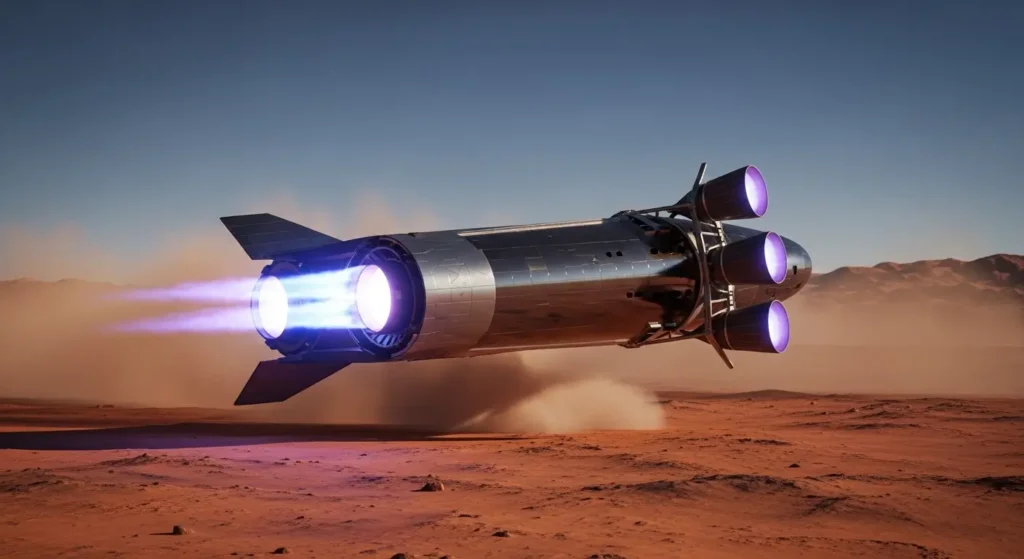
This is the most critical moment of the Starship Mars landing sequence final descent engine ignition. At an altitude of roughly 1 to 2 kilometers, the flight computer triggers the Raptor engine ignition.
The ship must perform a rapid “landing flip.” The Raptors ignite while the ship is horizontal, using their gimbaling (tilting) capability to swing the tail of the ship downward. This transition from horizontal to vertical must happen in seconds. If the engine ignition fails or is delayed by even a fraction of a second, the ship will not have enough time to zero out its vertical velocity.
💡 Pro Insight: On Mars, the lower gravity (38% of Earth’s) actually helps the flip maneuver, giving the engines slightly more “effective” thrust-to-weight ratio to stabilize the craft compared to Earth landings.
Precision Engineering: Raptor Engines and Autonomy ⚙️
The success of the final descent relies on the Raptor engines’ ability to throttle deeply and restart reliably. Unlike the Falcon 9, which uses Merlin engines, Starship uses the full-flow staged combustion Raptor, which provides the immense pressure needed for Mars’ demanding environment.
Furthermore, the landing is entirely autonomous. Because of the 3 to 22-minute light-speed delay between Earth and Mars, a human cannot pilot the Starship Mars landing sequence. The onboard AI must process radar and LiDAR data in real-time to identify the landing pad and adjust the engine ignition timing to account for local wind speeds and atmospheric density.
Landing Sequence Summary 📝
Step 1: Entry & Aerobraking (Using the heat shield).
Step 2: Belly Flop (Maximum drag configuration).
Step 3: Final Descent (Precision flap guidance).
Step 4: Raptor Engine Ignition & Landing Flip.
Step 5: Soft Touchdown on the Martian surface.
Frequently Asked Questions (FAQ) ❓
Q: Why doesn’t Starship use parachutes on Mars?
A: Parachutes are ineffective for a vehicle as heavy as Starship in the thin Martian atmosphere. Propulsive landing (engine ignition) is the only viable way to land 100+ tons safely.
Q: How many engines are used during the final landing ignition?
A: Typically, three Raptor engines are ignited for the flip maneuver to ensure redundancy. If one fails, the remaining two can still provide enough thrust for a safe landing.
Q: What happens if the engine ignition fails?
A: Without propulsive thrust to verticalize and decelerate, the ship would impact the surface at terminal velocity, resulting in a total loss of the mission.
The journey to Mars is the most ambitious project in human history. If you have more questions about the physics of Starship, feel free to leave a comment! 😊