It’s the question that fuels countless sci-fi dreams: What will it *really* be like to live on a spaceship bound for Mars? For decades, it was pure speculation. Now, with SpaceX’s Starship, we are moving from science fiction to complex engineering and human-factors problem-solving.
This isn’t a simple ferry ride. The journey to Mars takes about 7-9 months. But a full round-trip mission, including waiting for the planets to align for the return journey, will last about 2.5 years.
Starship, therefore, isn’t just a rocket. It has to be an ark. A self-sustaining, long-term habitat that can keep a crew of 12-20 astronauts not just alive, but sane and productive, for the entire duration. Based on NASA-funded research and lessons from the International Space Station (ISS), we can now piece together a detailed picture of the Starship interior and what life will be like for its first Martian explorers. This is what it takes to become a multi-planetary species. 😊
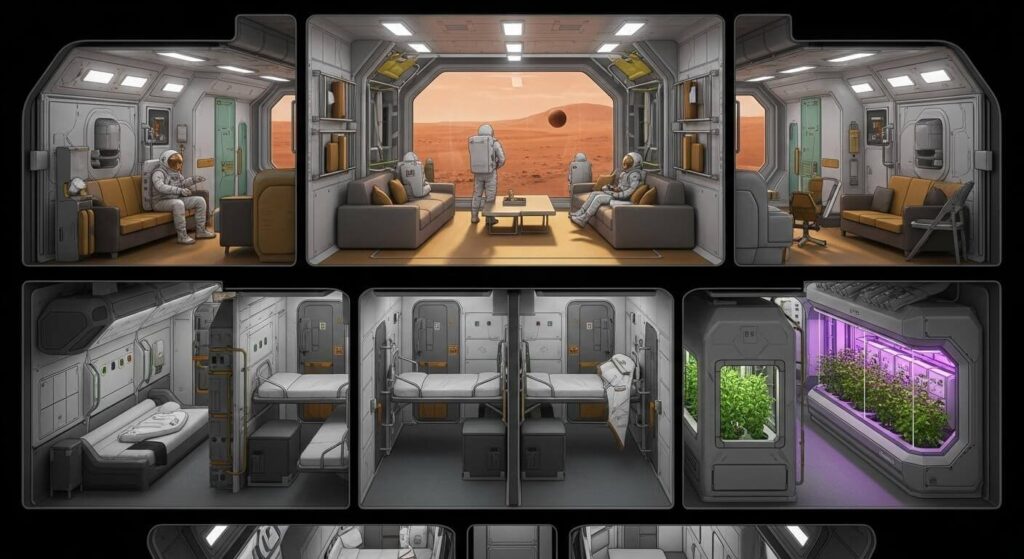
Table of Contents
- The 1,000 m³ Challenge: Starship’s Design Trade-Offs
- A Tour of the 8-Deck Starship Interior: A “Vertical City” for Mars
- ↳ Decks 1 & 2: The “Garage” and Pantry
- ↳ Decks 3 & 4: The “Habitat” (Quarters & Gym)
- ↳ Decks 5 & 6: The “Heart” (Galley & Lounge)
- ↳ Decks 7 & 8: The “Brain” (Workstations & Flight Deck)
- Surviving the Void: The Unseen Tech of Starship’s Life Support (ECLSS)
- ↳ The Closed-Loop Water System
- ↳ Manufacturing Air: Scrubbing CO2
- ↳ The Radiation Problem You Can’t Ignore
- The 2.5-Year Mind Game: Beating Isolation and Confinement
- The First Mars Mission: What 20 Crew Members Will Actually Do
- Frequently Asked Questions (FAQ)
The 1,000 m³ Challenge: Starship’s Design Trade-Offs 🤔
Early concepts for Starship showed a massive, wide-open interior, like a futuristic condo. The reality of rocket science quickly changed that. To execute its “belly-flop” landing maneuver, SpaceX engineers had to move the “header” fuel tanks for landing into the top (nose cone) of the ship. This, along with the massive main fuel tanks, fundamentally shaped the usable space.
The final goal is to have about 1,000 cubic meters ($m^3$) of pressurized volume. This is an enormous amount of space—the entire ISS is only 916 $m^3$—but it has to be shared.
So, how many people can it fit? While Elon Musk has famously claimed 100 people could go, this is likely for short “point-to-point” Earth trips or a dense colonization fleet. For the first grueling 2.5-year missions, NASA’s research (based on decades of ISS and submarine experience) provides a much more realistic number. Their studies suggest a long-duration crew member needs a *minimum* of 25 $m^3$ of “habitable” space to stay psychologically healthy. This points to early missions having a crew of 12 to 20 people, a number that balances capability with comfort and resource management.
A Tour of the 8-Deck Starship Interior: A “Vertical City” for Mars 🚀
To manage the ship’s center of gravity and organize life, the Starship interior is best conceived as a “vertical city” with 8 distinct decks, each with a specific purpose. This layout is a conceptual model based on NASA studies and sound engineering principles, as SpaceX has not finalized its official interior.
Decks 1 & 2: The “Garage” and Pantry (Cargo, Airlock, Supplies)
The lowest decks are the “working” decks. This is where the heavy lifting happens.
- Deck 1 (Airlock & Cargo): This is the gateway to Mars. It houses the airlock for spacewalks (or rather, Mars-walks) and the elevator/lift system to lower rovers, equipment, and people to the surface.
- Deck 2 (Supplies & Life Support): Think of this as the ship’s pantry and utility closet. It holds the vast stores of food, water, and spare parts. Critically, it also contains the machinery for the life support system (which we’ll cover in detail later).
Decks 3 & 4: The “Habitat” (Hygiene, Exercise, and Crew Quarters)
These two decks are the core living space, likely comprising the 600 $m^3$ of dedicated residential area mentioned in NASA-backed studies.
- Deck 3 (Hygiene & Gym): Life in zero-g (or 1/3g on Mars) is tough on the body. This deck would feature the ship’s bathrooms (Hygiene Pods, likely using suction like the ISS) and laundry. Most importantly, it holds the gym. Astronauts will be required to exercise for at least 2 hours every day using treadmills (with harnesses), resistive machines, and stationary bikes to combat severe muscle atrophy and bone density loss.
- Deck 4 (Crew Quarters): Privacy is a luxury in space. This deck isn’t an open-plan bunkhouse. It will be divided into small, private cabins—one for each crew member. These “Bunk Stations” are vital for psychological well-being, giving each person a personal space to sleep, work, and connect with loved ones back home.
Decks 5 & 6: The “Heart” of the Ship (Galley, Mess Hall, and Lounge)
If Decks 3 & 4 are for private life, these are for communal life. They are essential for crew morale.
- Deck 5 (Galley & Mess Hall): The “kitchen” and “dining room.” Here, the crew will rehydrate and prepare their packaged meals. This deck will also likely host the hydroponics or aeroponics bay—a small space garden. Growing fresh vegetables (like lettuce or tomatoes) is a massive psychological boost and provides crucial vitamins.
- Deck 6 (Lounge & Gallery): This is arguably the most important deck for mental health. It’s the “living room,” a place for the crew to relax, watch movies, play games, and socialize. It will almost certainly feature Starship’s most famous planned feature: a large bubble-window or gallery. Looking back at Earth, or out at the Martian landscape, will provide a profound sense of perspective and connection.
Decks 7 & 8: The “Brain” (Workstations and Flight Deck)
These are the command and control centers.
- Deck 7 (Work & Science): An “idle mind is the devil’s workshop” is a critical rule in space. The crew has a 2.5-year-long job to do. This deck is the office, featuring workstations for mission control, communications, data analysis, and small labs for geology and biology.
- Deck 8 (Flight Deck): The “cockpit.” While most of Starship’s flight will be autonomous, this is where pilots will be stationed for critical events like launch, orbital maneuvers, and the terrifying, thrilling 7-minute landing on Mars.
Surviving the Void: The Unseen Tech of Starship’s Life Support (ECLSS) 💧
The most amazing part of the Starship interior isn’t the window; it’s the Environmental Control and Life Support System (ECLSS). This is the network of machines that performs the miracle of keeping 20 people alive in a vacuum.
The Closed-Loop Water System: Yesterday’s Coffee…
You can’t bring all the water you need for 2.5 years. A 10-person crew would need 27 tons! The only solution is to recycle, just like on the ISS. The ISS’s system recycles over 93% of all water from crew sweat, humidity in the air, and even urine.
Yes, as astronauts like to say, “Yesterday’s coffee becomes tomorrow’s coffee.” Starship will use an even more advanced version of this, filtering and purifying every drop of water. This “extreme recycling” is the only way a Mars mission is feasible, reducing 27 tons of water mass to perhaps 3 tons.
Manufacturing Air: Scrubbing CO2 and Making Oxygen
The air problem is twofold. First, you must remove the CO2 everyone exhales, which is toxic in high concentrations. The ISS uses a “Sabatier” system. Starship will use a similar or more advanced “CO2 scrubber” system.
Second, you need to make oxygen. The easiest way is to bring water (H2O) and split it using electrolysis into hydrogen (which can be vented or used) and breathable oxygen (O2). This is a proven, reliable technology that will form the backbone of the ECLSS.
The Radiation Problem You Can’t Ignore
Outside Earth’s protective magnetosphere, the crew will be bombarded by Galactic Cosmic Rays (GCRs) and Solar Flares. This is one of NASA’s “Five Hazards of Human Spaceflight” and a primary health risk, increasing cancer rates and damaging the central nervous system.
💡 Pro-Tip: Passive Shielding
You can’t build a lead-lined ship; it’s too heavy. The most efficient solution is “passive shielding.” This means the Starship interior will be designed to place the ship’s own water tanks and supply storage around the crew quarters (Deck 4). The water and supplies will physically block a significant amount of radiation, creating a “storm shelter” for the crew.
The 2.5-Year Mind Game: Beating Isolation and Confinement 🧘
Even with 1,000 $m^3$ of space, 20 people in the same “house” for 2.5 years is a recipe for psychological distress. This is perhaps the greatest challenge after radiation.
The crew will have to contend with two of NASA’s other “Five Hazards”:
- Isolation & Confinement: Cut off from all of humanity, with the same small group. The gym (Deck 3), lounge (Deck 6), and private quarters (Deck 4) are non-negotiable designs to manage this.
- Distance from Earth: When Starship is at Mars, the light-speed communication delay can be up to 22 minutes one-way. You can’t have a real-time conversation. You can’t call mission control for help in an emergency. This delay fosters a profound sense of autonomy and loneliness.
The solution is a highly-structured life: a strict schedule of work, mandatory exercise, communal meals, and personal time. The crew won’t be passengers; they will be the busiest people in the solar system, with every hour planned to keep them focused and productive.
The First Mars Mission: What 20 Crew Members Will Actually Do 👩🔬
So why send 20 people? Because they aren’t tourists. They are a construction crew, a science team, and a medical staff all in one. Once landed, the Starship interior transforms. It ceases to be a *vehicle* and becomes the first human base on Mars.
The crew’s job will be to use the equipment from the cargo bay (Deck 1) to deploy solar arrays for power, establish a permanent habitat, and—most importantly—begin testing In-Situ Resource Utilization (ISRU). This means drilling for water ice and using Mars’s CO2 atmosphere to manufacture methane (CH4) and liquid oxygen (LOX) rocket fuel for the trip home.
The 8 decks of the Starship interior, therefore, are more than just a place to live. They are the factory, the control center, the hospital, and the home that will allow humanity to finally gain a foothold on another world.
Frequently Asked Questions (FAQ) ❓
Q: How many people can the SpaceX Starship interior really hold?
A: While SpaceX has designed Starship with an aspirational goal of 100 people, this is for short-term trips. For the first long-duration (2.5-year) Mars missions, the realistic crew size, based on NASA research for life support and psychological health, is estimated to be between 12 and 20 people.
Q: Why does a Mars mission take 2.5 years?
A: The trip to Mars itself takes 7-9 months. However, once on Mars, the crew must wait for the planets to realign properly for a fuel-efficient return journey (a “Hohmann transfer orbit”). This waiting period on the Martian surface can be over a year long, making the total mission duration approximately 2.5 years.
Q: Will Starship have artificial gravity?
A: No. The current design for the Mars transit vehicle does not include artificial gravity (like a spinning centrifuge). The crew will be in zero-g for the 7-9 month journey and will rely on a rigorous 2-hour daily exercise regimen to combat muscle atrophy and bone loss, similar to astronauts on the ISS.
Q: What is the single biggest danger for the Starship crew?
A: While launch and landing are high-risk events, the most significant *chronic* danger is radiation. Outside of Earth’s protective magnetic field, the crew is exposed to high levels of Galactic Cosmic Rays (GCRs). This is a primary health concern that is mitigated by using the ship’s own supplies (like water) as passive shielding around the crew quarters.
Q: How will the Starship crew get power on Mars?
A: The crew’s first job on Mars will be to deploy large, unfurling solar arrays from the cargo bay. These solar panels will provide the electricity needed to power the ship’s life support systems, run experiments, and, most importantly, power the ISRU equipment that will manufacture rocket fuel for the return trip.