How will SpaceX’s Starship land on Mars? We analyze the ingenious aerodynamic strategy SpaceX is developing to overcome a critical fuel (Delta-V) shortage and make humanity’s multi-planetary dream a reality.
Elon Musk’s vision for SpaceX isn’t just about launching satellites; it’s about making humanity a multi-planetary species. The linchpin of this grand ambition is **Starship**, a fully reusable, 120-meter-tall behemoth designed to carry 100+ tons of cargo and crew to Mars. But as any space engineer will tell you, getting to Mars is the easy part. The real challenge? Landing.
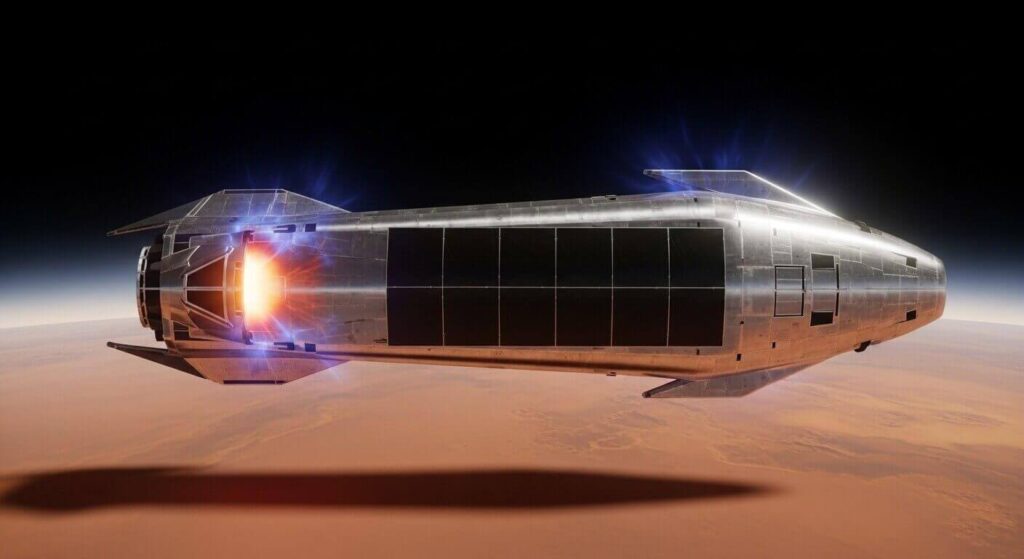
Landing on Mars is notoriously difficult. NASA calls it the “seven minutes of terror” for a reason. You’re hurtling toward a planet at over 12,000 miles per hour, and you have to come to a perfect, soft stop in a fraction of the time it takes to brew coffee. For a vehicle the size of a skyscraper, this challenge is magnified exponentially. Starship faces an even bigger hurdle: a fundamental shortage of fuel, or what engineers call **Delta-V (ΔV)**.
This article will provide a deep, expert analysis of the single greatest challenge to Starship’s Mars missions and the groundbreaking, counter-intuitive strategy SpaceX is betting the company on to solve it. This isn’t just about brute force; it’s about physics, finesse, and “living off the land” by using the Martian atmosphere itself as a brake.
Table of Contents
- The ‘Great Filter’ of Space Travel: Understanding the Delta-V Shortage
- The Tyranny of the Rocket Equation: Why Starship Can’t ‘Just Carry More Fuel’
- SpaceX’s Two-Part Aerodynamic Strategy for Mars
- Phase 1: Aerobraking — The Patient Art of Shedding Orbital Velocity
- Phase 2: The ‘Belly Flop’ — Starship’s Unprecedented Mars Landing Sequence
- The Mars Problem: Why a Propulsive Landing is Unavoidable
- Conclusion: This Is the Key to a City on Mars
- Frequently Asked Questions (FAQ) About Starship’s Mars Landing
The ‘Great Filter’ of Space Travel: Understanding the Delta-V Shortage
In spaceflight, fuel isn’t measured in gallons or liters. It’s measured in **Delta-V** (ΔV), which literally means “change in velocity.” It is the single most important metric in orbital mechanics. Every maneuver—launching to orbit, transferring to another planet, braking into orbit, and landing—has a specific ΔV “cost.”
A spacecraft’s “fuel tank” is its ΔV budget. Once you’re out of ΔV, your mission is over. You are just a piece of metal coasting on your last trajectory.
Let’s look at the costs for a Mars mission:
- Launch to Low Earth Orbit (LEO): ~9.4 km/s. This is an enormous cost, paid by the Super Heavy booster and Starship’s own engines.
- Orbital Refill: This is SpaceX’s first brilliant move. By refueling Starship in LEO, they reset its ΔV budget to 100%. After this, Starship has a total ΔV budget of roughly 6.9 km/s.
- Trans-Mars Injection (TMI): The burn to leave Earth and coast to Mars. Cost: ~3.8 km/s.
- Mars Orbital Insertion (MOI) & Landing: This is the problem. To brake into Mars orbit and then land *using only engines* (a propulsive-only maneuver) would cost roughly ~5.0 km/s or more.
Do the math: 3.8 km/s (TMI) + 5.0 km/s (Braking/Landing) = 8.8 km/s.
Starship’s budget is only 6.9 km/s. It is short by at least 1.9 km/s, and that’s with generous estimates. This is a non-negotiable deficit. Starship *cannot* land on Mars the way a sci-fi movie ship does, by simply flipping over and firing its engines. It would run out of fuel halfway through the burn and crash at supersonic speeds.
The Tyranny of the Rocket Equation: Why Starship Can’t ‘Just Carry More Fuel’
The logical next question is: why not just make the fuel tanks bigger? This is where we encounter the “Tyranny of the Tsiolkovsky Rocket Equation.” In simple terms, this fundamental law of physics states:
- To add more fuel, you must add more mass (the fuel itself).
- To lift that extra mass, you need… even more fuel.
- This creates a compounding, exponential problem. Every tiny bit of payload you add requires a *much* larger increase in total rocket size.
Starship is already optimized to the breaking point. It cannot “just add more fuel” to solve the 1.9 km/s deficit. The only way to solve this problem is to find a “free” source of braking.
That source is the Martian atmosphere.
SpaceX’s Two-Part Aerodynamic Strategy for Mars
To close the ~1.9 km/s (or more) Delta-V gap, SpaceX will use the atmosphere as a giant, free brake. This strategy is a brilliant (and terrifying) display of atmospheric engineering, and it comes in two distinct phases that are often confused: **Aerobraking** and **Aerodynamic Entry**.
It’s crucial to understand these are two different maneuvers, likely used for different mission profiles.
Phase 1: Aerobraking — The Patient Art of Shedding Orbital Velocity
This maneuver is not for landing directly. It’s for *inserting* Starship into a stable, low Mars orbit (LMO) without using precious fuel. This is the “patient” approach, ideal for cargo missions or missions that will wait in orbit before landing.
Here’s how it works:
Step 1: The Capture Burn
After its 6-month coast from Earth, Starship arrives at Mars at a blistering relative velocity. It fires its Raptor engines for a *very short* **Mars Orbital Insertion (MOI) burn**. This burn is just long enough to be “captured” by Mars’s gravity, but not long enough to enter a circular orbit. Instead, it enters a long, looping, highly elliptical orbit (think of an egg shape). This initial burn is small and costs minimal ΔV.
Step 2: Dipping a Toe in the Atmosphere
The Starship is now in a “capture orbit” that might take days to complete. At its farthest point (apoapsis), it’s far from Mars, moving slowly. At its closest point (periapsis), it’s very close and moving extremely fast. SpaceX will precisely lower this periapsis so that it just *skims* the upper reaches of the Martian atmosphere, at an altitude of perhaps 80-100 km.
Step 3: The “Death by a Thousand Cuts”
Every time Starship dips through the periapsis, the thin atmospheric drag acts as a gentle, giant hand, slowing it down by a tiny amount. This small deceleration doesn’t just slow the ship; it lowers the *farthest* point of its orbit (the apoapsis). With each pass, the long, loopy orbit gets smaller and more circular. This process might be repeated for weeks, or even months. The ship’s heat shield (TPS tiles) is used to manage the heat from this friction, but it’s far less intense than a direct entry.
The result? Starship settles into a stable, low circular orbit around Mars, having saved over 2 km/s of Delta-V. It paid its orbital insertion “cost” with atmospheric drag, not fuel.
Phase 2: The ‘Belly Flop’ — Starship’s Unprecedented Mars Landing Sequence
This is the main event: the “seven minutes of terror,” Starship-style. This is the *direct entry and landing* maneuver, which a crewed mission would likely take. It’s faster, far more aggressive, and one of the most complex aerodynamic feats ever attempted.
It can be broken down into five critical steps.
Step 1: The De-Orbit Burn & Entry Interface
From low Mars orbit, Starship performs a small retrograde burn (firing engines in the direction of travel) to slow itself down and begin its fall. It hits the “Entry Interface” (EI), the discernible top of the atmosphere, at a shallow angle and a speed of roughly **7.5 km/s (16,800 mph)**.
Step 2: The Hypersonic ‘Belly Flop’ (Max Drag)
This is where Starship’s unique design shines. It does *not* enter like a capsule (heat shield first). Instead, it pitches over to a ~90-degree angle of attack, presenting its entire 1,800-square-meter windward side and heat shield to the atmosphere. This is the **”belly flop”** maneuver.
The purpose is to create the *maximum possible drag*. A skydiver does this on Earth by spreading their arms and legs. Starship does it by presenting its entire body. Its four large flaps are not for flying; they are for *controlling* this fall, making constant, tiny adjustments to keep the ship stable as it plummets through the hypersonic regime, enveloped in plasma.
This single maneuver does over 90% of the work, bleeding off the vast majority of that 7.5 km/s of velocity as heat and friction.
Step 3: The ‘Lift-Assisted’ Deceleration (A Surprising Twist)
Here’s a little-known fact: Starship doesn’t just use drag. The original text from the user submission noted that Starship might even use an “inverted” entry to use **lift** to push it *down* faster. While the exact entry profile is still being refined, the key is that Starship’s body *is* an airfoil. It can generate lift.
During the belly flop, by adjusting its angle of attack slightly, Starship can generate lift *sideways*. This allows it to “fly” cross-range, meaning it can steer itself thousands of kilometers to the left or right of its initial trajectory to aim for a precise landing spot. This is something no capsule can do. It’s a key part of its reusability and precision.
Step 4: The Landing ‘Flip and Burn’
The belly flop slows Starship from 7.5 km/s to just a few hundred meters per second. But this is still too fast, and the ship is *horizontal*. At the last possible moment, likely only one or two kilometers above the Martian surface, the finale begins.
In a maneuver that still looks like science fiction, two or three of Starship’s sea-level Raptor engines ignite. The immense thrust, combined with gimbaling, pushes the entire 50-meter-tall vehicle from its horizontal belly-flop position to a **vertical, tail-down** position. This is the “landing flip” we saw tested successfully with prototypes like SN15.
Step 5: The Propulsive Touchdown
Now vertical, Starship uses its engines as a “retro-rocket.” This final propulsive burn is the *only* part of the landing that costs significant fuel. It kills the last of the ship’s velocity, allowing it to settle gently onto the Martian regolith on its six landing legs. It is the only way to achieve a soft touchdown for a vehicle of this mass.
The Mars Problem: Why a Propulsive Landing is Unavoidable
A common question is: “Why not just use parachutes? It worked for NASA’s rovers.”
The answer lies in the **Martian atmosphere**. It is the worst of all worlds. It is less than 1% as dense as Earth’s atmosphere. This creates two huge problems:
- Parachutes are Useless for Heavy Lifts: The air is too thin for parachutes to be effective. To slow a 100-ton Starship (plus cargo), you would need a parachute the size of a stadium, and even then, it would barely slow you down. NASA’s 1-ton Perseverance rover *already* pushed parachute technology to its absolute limit. Starship is 100 times more massive. It’s a non-starter.
- Aerodynamic Braking is Less Effective: The thin air also means the “belly flop” is less effective than it is on Earth. The ship falls *faster* and must start its final landing burn at a higher altitude and a higher speed than it would on Earth, costing more fuel for the final burn.
This “thin-air” problem is why a powerful, propulsive, engine-based landing is the *only* viable option for a vehicle of Starship’s scale. The aerodynamic braking just gets it slow *enough* for the engines to take over.
Conclusion: This Is the Key to a City on Mars
SpaceX‘s strategy to land on Mars is a masterful solution to a problem defined by the harsh laws of physics. Faced with an insurmountable Delta-V deficit, they didn’t try to build a bigger fuel tank—they changed the rules of the game.
By using the Martian atmosphere itself as a brake—first through patient, multi-pass **aerobraking** to manage orbital insertion, and then through a high-stakes, hypersonic **aerodynamic belly flop** for the final descent—SpaceX plans to save the 2-3 km/s of Delta-V that it simply doesn’t have. This strategy trades fuel for an unparalleled mastery of aerodynamics and heat management.
This complex, multi-stage landing is the “Great Filter” for a self-sustaining city on Mars. If it works, it doesn’t just mean one landing. It means a reusable, reliable “sky-crane” for the solar system, capable of delivering the hundreds of people and thousands of tons of cargo needed to build a true city. This maneuver is the foundational technique upon which humanity’s multi-planetary future will be built.
Frequently Asked Questions (FAQ) About Starship’s Mars Landing
Q: What is Delta-V (ΔV) and why is it so important for a Mars landing?
A: Delta-V, or “change in velocity,” is the “currency” of spaceflight. It’s a measure of how much a spacecraft can change its own trajectory (speed up, slow down, or turn). Every mission has a required ΔV “cost.” Starship’s main challenge is that it doesn’t have enough ΔV “budget” to pay for both the trip to Mars and a full, engine-powered landing, which is why it must use the atmosphere for “free” braking.
Q: Why can’t Starship just use parachutes to land on Mars like NASA’s rovers?
A: Two reasons: 1) Mass: Starship is over 100 times more massive than the 1-ton Perseverance rover. The parachutes required would be impractically large. 2) Atmosphere: The Martian atmosphere is less than 1% as dense as Earth’s. It’s too thin for parachutes to generate enough drag to safely slow a vehicle as heavy as Starship.
Q: What’s the real difference between ‘aerobraking’ and ‘aerodynamic entry’?
A: They are often confused but are very different. Aerobraking is a low-intensity, “patient” maneuver where a ship *already in orbit* repeatedly skims the upper atmosphere (dozens or hundreds of times) to gradually circularize its orbit without using fuel. Aerodynamic Entry (the “belly flop”) is a single, high-intensity, “all-or-nothing” maneuver where the ship enters directly from a space trajectory and uses its body as a massive brake to slow down for a landing, all in one pass.
Q: What is the Starship ‘belly flop’ maneuver?
A: It’s Starship’s primary method of slowing down in an atmosphere. Instead of entering nose-first (low drag), it flips onto its “belly,” presenting its entire 1,800-square-meter heat-shielded side to the direction of travel. This creates the maximum possible aerodynamic drag, allowing the atmosphere to do 99% of the braking work before the engines light for the final vertical landing.
Q: How will Starship get back from Mars if it uses so much fuel?
A: This is the other key to SpaceX’s plan: In-Situ Resource Utilization (ISRU). Starship will land with near-empty tanks. On Mars, an onboard chemical plant (the “Propellant Plant”) will mine water ice (H₂O) and atmospheric carbon dioxide (CO₂). Using electricity (likely from solar panels), it will split the water into hydrogen and oxygen, and combine the hydrogen with CO₂ to create liquid methane (CH₄) and liquid oxygen (LOX)—the two ingredients for Raptor engine fuel. It will refuel itself on the surface of Mars for the trip home.