Is Elon Musk’s Mars colonization dream fiction or future? We analyze the SpaceX Starship, the brutal challenges, and the tech needed to make us multi-planetary.
Elon Musk has famously said he wants to die on Mars—just not on impact. It’s a line that perfectly captures the audacity, the risk, and the sheer, unadulterated ambition of his life’s work. To many, the idea of a self-sustaining city on a cold, dead rock 140 million miles away sounds like science fiction. To others, it’s the most important mission in human history.
For those of us who have followed the space industry for decades, Musk’s pronouncements have shifted from “if” to “when.” But what does the plan to colonize Mars *actually* involve? What are the monumental hurdles that no amount of money can easily bypass? And how is his “master plan”—connecting Tesla, Starlink, and even The Boring Company—designed to make this vision a reality?
This isn’t just a fantasy. It’s an engineering problem, a biology problem, and a logistics problem of unprecedented scale. Let’s take an expert, clear-eyed look at the current state of Elon Musk’s Mars colonization plan, focusing on the lynchpin of it all: the SpaceX Starship.
Table of Contents
- Why Mars? Elon Musk’s “Lifeboat” Philosophy
- The Engine of Colonization: The SpaceX Starship Explained
- Musk’s Interconnected Empire: How Tesla, Starlink, and Boring Fit In
- The Brutal Realities: The Top 4 Dangers of Mars
- Living Off the Land: The Critical Role of ISRU
- The Ethical Hurdle: What If We Aren’t Alone?
- Conclusion: A Generational Bet on Humanity
- Frequently Asked Questions (FAQ) About Mars Colonization
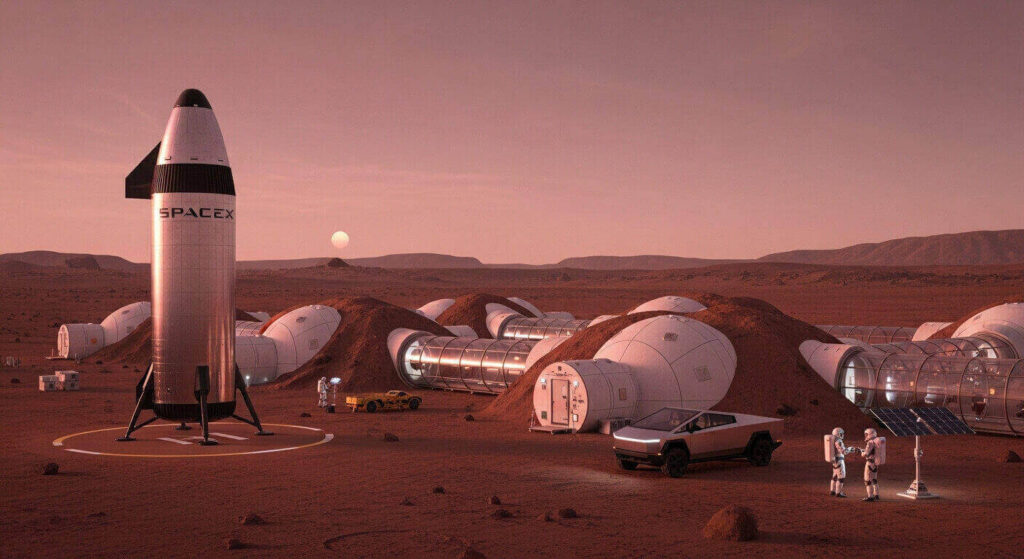
Why Mars? Elon Musk’s “Lifeboat” Philosophy
Before we get to the *how*, we have to understand the *why*. Why Mars? Why not the Moon, which is only three days away? Why not focus on Earth’s oceans?
Musk’s reasoning is existential. He views humanity as a fragile civilization vulnerable to what he calls “extinction-level events.” Whether it’s a super-volcano, a global pandemic far deadlier than COVID-19, nuclear war, or an asteroid strike, his argument is that all of human consciousness is stored on a single “hard drive”—Earth. To ensure long-term survival, we must create a backup. We must become a multi-planetary species.
Mars is the only other planet in our solar system that is even remotely habitable. It has a 24.5-hour day, vast quantities of water ice, a (thin) atmosphere composed mostly of carbon dioxide (useful for plants and fuel), and essential minerals. It’s not perfect, but as Musk sees it, it’s a “fixer-upper” planet. The Moon, lacking an atmosphere and key volatiles, is a much harder place to build a self-sustaining city. For Musk, colonization isn’t an escape plan for the rich; it’s a “lifeboat” for human consciousness itself.
The Engine of Colonization: The SpaceX Starship Explained
This entire grand vision is impossible without one thing: a cheap, reliable, and massive transportation system. This is the **SpaceX Starship**. It is the single most important piece of hardware in the entire Mars colonization plan.
For context, the cost to launch one kilogram to low-Earth orbit (LEO) with the Space Shuttle was over $54,000. With SpaceX’s Falcon 9, it’s around $2,600. Musk’s goal for Starship is to reduce that cost to mere *hundreds* of dollars, or even less. This change in economics is the difference between a few flags-and-footprints missions and an actual city.
Starship’s Architecture: A Two-Stage Behemoth
Starship is not just a rocket; it’s a two-stage, fully reusable launch system. This is what you’re seeing launch (and occasionally explode) from Starbase in Texas.
- Super Heavy (First Stage): This is the massive booster, powered by 33 Raptor engines. Its sole job is to push the upper stage out of the thickest part of the atmosphere. It then performs a “boostback burn” and lands back at the launch site, ready to be refueled for another flight.
- Starship (Second Stage): This is the sleek, stainless-steel spacecraft you see with the fins. It’s both a second stage (with its own Raptor engines) *and* the long-duration vehicle that will carry over 100 people or 150+ tons of cargo to LEO, the Moon, and ultimately, Mars.
The Real Game-Changer: Orbital Refueling
Here’s the part most people miss. A single Starship launch cannot get 150 tons *to Mars*. It can only get it to *orbit*. The true genius of the plan is orbital refueling.
The plan is as follows:
- Launch the “Mars Starship” (with people and cargo) into a parking orbit around Earth.
- Launch multiple “Tanker Starships” filled with propellant (liquid methane and liquid oxygen).
- These tankers rendezvous with the Mars Starship in orbit and transfer their fuel, filling its tanks to the brim.
- Once fully fueled, the Mars Starship ignites its engines for the “trans-Mars injection” burn and begins its 6-to-9-month journey to the Red Planet.
This “tanker” architecture is the key. It makes Starship a truly interplanetary vehicle. As of mid-2024, SpaceX’s successful Integrated Flight Tests (especially IFT-4, which saw both the booster and ship achieve a soft splashdown) prove the fundamental launch and re-entry architecture is viable. The next major hurdle is proving in-orbit propellant transfer.
Musk’s Interconnected Empire: How Tesla, Starlink, and Boring Fit In
It’s a mistake to view Musk’s companies in isolation. As the source material correctly identifies, they are all building critical technologies for a future Mars colonization effort.
Tesla: Energy and Ground Transport
Mars has no fossil fuels. A colony must be fully electric, powered by solar. What company is the world leader in high-efficiency solar panels, industrial-scale battery packs (Megapacks), and rugged electric vehicles? Tesla. The battery and solar technology Tesla is perfecting on Earth is *precisely* what will be needed to power the first Martian habitats, life-support systems, and rovers.
Starlink: The Interplanetary Internet
You can’t run a colony without communication. Starlink provides a high-bandwidth, low-latency satellite internet mesh. This will be used in two phases:
- Phase 1: A Starlink constellation around Mars to provide continuous communication between rovers, habitats, and landing sites on the surface.
- Phase 2: A Mars-to-Earth link, using powerful laser communications to bridge the vast interplanetary distance, connecting the new colony back to Earth.
The Boring Company: Radiation Shielding
As we’ll see in the next section, radiation is a killer. The best protection is mass. The easiest way to get that mass is to go underground. The Boring Company’s mission is to make tunneling fast and cheap. On Mars, this tech won’t be for beating traffic; it will be for digging pressurized tunnels and habitats, using the Martian soil (regolith) itself as a shield against deadly radiation.
The Brutal Realities: The Top 4 Dangers of Mars
This is where the true difficulty of Mars colonization becomes clear. The engineering challenge of Starship pales in comparison to the biological and environmental challenges of Mars itself. It is a profoundly hostile place.
1. The Radiation Problem (GCRs and SPEs)
Mars lost its global magnetic field billions of years ago. This “shield” is what protects Earth from a constant barrage of cosmic radiation. A colonist on Mars would be exposed to two types:
- Galactic Cosmic Rays (GCRs): High-energy particles from distant supernovae. They are constant, pervasive, and extremely difficult to shield against.
- Solar Proton Events (SPEs): Sudden, intense bursts of radiation from our own Sun. A large, unpredicted SPE can deliver a lethal dose in hours.
This radiation shreds DNA, dramatically increases cancer risk, and is known to cause cognitive decline and cataracts. The 6-9 month journey *to* Mars is just as dangerous. Habitats will need to be buried under several meters of regolith or built inside lava tubes just to be safe.
2. The Gravity Problem (0.38g)
We know the human body breaks down in zero gravity (microgravity) from our experience on the International Space Station (ISS). Astronauts suffer bone density loss, muscle atrophy, and vision problems (SANS). But we have *no data* on how the human body will react to long-term life in 38% of Earth’s gravity.
Will bones still degrade, just slower? Can a human pregnancy be carried to term? Can a child born on Mars ever develop bones and muscles strong enough to visit Earth? We simply don’t know. Every colonist will be a lifelong medical experiment.
3. The Atmosphere Problem (0.6% Pressure)
People often say, “Mars has an atmosphere of 95% CO2.” This is true, but deeply misleading. The real problem is the *pressure*. The Martian atmosphere is 100 times thinner than Earth’s (about 0.6% of Earth’s sea-level pressure). This is so thin that it’s below the “Armstrong Limit”—the point at which water boils at human body temperature.
What does this mean? If you stepped outside without a full-body pressure suit, your blood and the moisture in your lungs would literally boil. There is no *The Martian* scenario of taping up a helmet. Any pinhole leak in a suit or habitat is catastrophic.
4. The Toxic Dust Problem (Perchlorates)
Finally, the Martian soil itself is toxic. NASA’s Phoenix lander confirmed the regolith is full of perchlorate salts. This fine, static-charged dust will get *everywhere*—clinging to suits, getting into habitats, and contaminating air and water systems. Perchlorates are known to be harmful to the human thyroid gland. Managing this toxic dust is a major, and often overlooked, health and engineering challenge.
Living Off the Land: The Critical Role of ISRU
Shipping everything from Earth is a non-starter. A Mars colony can only survive if it learns to “live off the land.” This is called **ISRU (In-Situ Resource Utilization)**, and it’s the single most important technology for sustainability.
Fortunately, Mars is a resource-rich environment if you know where to look. The ISRU plan has three main pillars:
- Water: The most valuable resource. Mars has vast underground glaciers and ice deposits, especially at its poles and mid-latitudes. Starship will be sent to land near one of these ice sheets. Robotic miners will dig up the ice, which will be melted to provide drinking water, irrigation for crops, and…
- Oxygen: You get oxygen from two places. First, by splitting water ice (H₂O) into hydrogen and oxygen (electrolysis). Second, you pull it from the air. NASA’s Perseverance rover carried an experiment called **MOXIE** (Mars Oxygen In-Situ Resource Utilization Experiment) that successfully proved it could convert atmospheric CO₂ directly into pure, breathable oxygen. This was a monumental success.
- Fuel: This is the most elegant part. The Sabatier reaction combines CO₂ from the Martian air with the hydrogen (H₂) from water ice. The result? Methane (CH₄) and Oxygen (O₂)—the exact two propellants that power Starship’s Raptor engines.
This is the lynchpin of the entire colonization plan. Colonists can use the Martian environment to create their own air, water, and—crucially—the rocket fuel needed for the return trip to Earth.
The Ethical Hurdle: What If We Aren’t Alone?
As NASA’s rovers find more and more complex organic molecules—the building blocks of life—we face a profound ethical question. What if life *did* arise on Mars? And what if it’s still there, dormant in underground aquifers or soil?
If Mars hosts its own simple, microbial biosphere, our arrival could trigger an extinction event. The “Planetary Protection” protocols are designed to prevent this, but a full-scale colonization effort with 100-person ships and industrial mining makes contamination almost inevitable. How do we balance the survival of our species with the potential destruction of another, however simple?
This is a question with no easy answer, and it’s one that Musk’s accelerated timeline often bypasses in favor of the engineering challenges.
Conclusion: A Generational Bet on Humanity
So, is Elon Musk’s Mars colonization plan feasible? The answer is a qualified **yes**. Not on his famously optimistic timelines, perhaps, but the physics and engineering are sound. The success of Starship’s flight tests has moved the goalposts from “impossible” to “merely” colossally difficult.
Musk is not just building a rocket; he’s attempting to build an entire economic and industrial ecosystem (SpaceX, Tesla, Starlink) to solve an existential problem. He’s building the transportation, the power grid, the communications network, and the tunneling equipment all at once.
The real barriers are no longer just about launch costs. They are biological and medical. Can the human body adapt to 0.38g? Can we shield ourselves from relentless radiation? Can we build a self-sustaining biosphere in a toxic, pressurized environment?
Musk’s 2030s date for a first human landing and 2050 for a city are incredibly ambitious. Many experts, including those at NASA, see this as a 100-year project. But one thing is certain: 100-year projects must be started by someone. Elon Musk, through the sheer force of his will and the power of his interconnected companies, has decided to be that person.
Frequently Asked Questions (FAQ) About Mars Colonization
Q: Why is Elon Musk so focused on Mars instead of fixing Earth’s problems?
A: This is a common and valid question. Musk’s perspective, which he has stated many times, is not “either/or” but “both/and.” He is investing heavily in solving Earth’s problems via Tesla (sustainable energy) and solar. However, he sees Mars colonization as a separate, parallel path necessary to ensure humanity’s long-term survival against existential risks that renewable energy alone can’t solve (like an asteroid impact). He believes it’s wise to “back up the hard drive.”
Q: What is the current status of the SpaceX Starship?
A: As of late 2024, the SpaceX Starship program is advancing rapidly. After several test flights, Integrated Flight Test 4 (IFT-4) in June 2024 was a major success, achieving a soft splashdown for both the Super Heavy booster and the Starship upper stage. This demonstrated a high degree of control during re-entry. The next steps involve mastering the “catch” of the booster with launch tower arms and demonstrating orbital propellant transfer.
Q: How much will it cost to colonize Mars?
A: The numbers are staggering and largely hypothetical. Musk himself has estimated the cost to be anywhere between $100 billion and $10 trillion. The cost is entirely dependent on the success of Starship’s full and rapid reusability. If SpaceX can truly lower the cost of launch by a factor of 100 or 1,000, the “transportation” part becomes affordable. However, the R&D for habitats, life support, and ISRU on Mars will likely cost hundreds of billions more.
Q: Can’t we just terraform Mars to make it like Earth?
A: Terraforming—engineering the entire planet’s atmosphere and climate—is a popular sci-fi concept. However, a 2018 NASA-backed study concluded that Mars does not have enough accessible CO₂ (locked in ice and minerals) to be released back into the atmosphere to create a thick, warm greenhouse effect. At best, it would take centuries or millennia using technologies we haven’t invented. For the foreseeable future, all human life on Mars will be confined to pressurized, enclosed habitats or “domes.”
Q: Who will govern the new colony on Mars?
A: This is a massive legal and ethical question. SpaceX’s Starlink terms of service famously included a clause stating that for services on Mars, the parties “recognize Mars as a free planet and that no Earth-based government has authority or sovereignty over Martian activities.” This suggests Musk favors a self-governing colony, likely based on direct democracy. However, this directly conflicts with the 1967 Outer Space Treaty, which states that all space activities are the responsibility of the nation that launched them (in this case, the USA).