The Ultimate Solar Disappearance Scenario: What truly happens the moment the Sun vanishes? Explore the shocking **8 minutes and 20 seconds** delay, the catastrophic orbital shift, and the rapid onset of a permanent ice age in this detailed scientific simulation based on Einstein’s relativity.
We start every single day basking in the Sun’s light and held securely by its gravity. But honestly, how often do we stop and think about the sheer physics of it all? That beautiful warmth we feel is energy that left the Sun—a colossal 93 million miles (150 million km) away—exactly **8 minutes and 20 seconds** ago! It’s truly mind-blowing. This leads us to one of the most fascinating “what if” scenarios in astrophysics: What if the Sun vanished instantly and completely? This isn’t just a sci-fi thought experiment; it’s a powerful tool for understanding the universe. Let’s dive into the shocking scientific simulation of how Earth becomes a rogue planet.
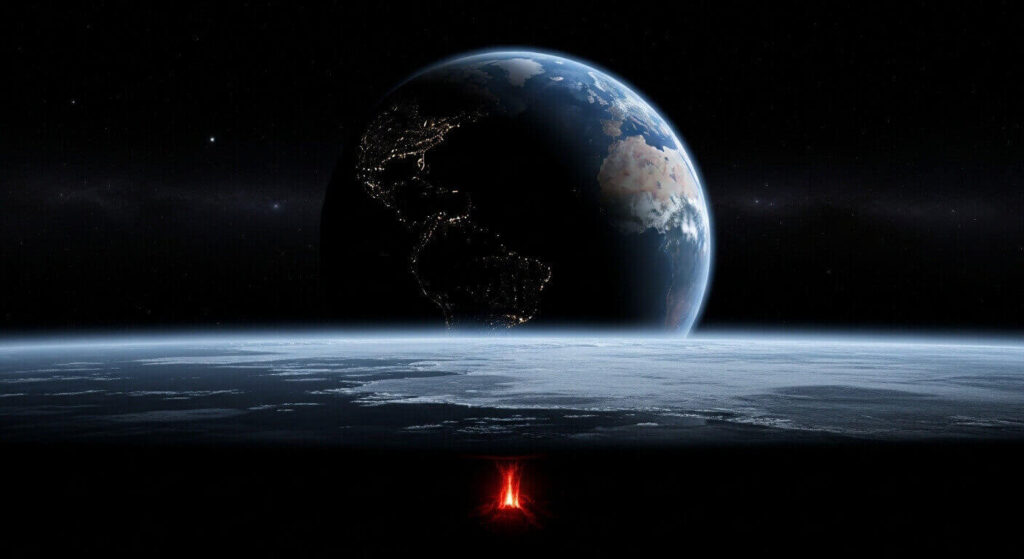
Quick Guide: The Sun’s Final 8 Minutes & Beyond 🚀
- 📌 The Critical Delay: 8 Minutes and 20 Seconds
- 📌 Catastrophic Event: Orbital Ejection and Perpetual Darkness
- 📌 The Long Winter: Temperature Collapse and Ecological Disaster
- 📌 The Last Survivors: Earth’s Core-Powered Life
- 📌 Frequently Asked Questions (FAQ)
The Critical Delay: Why We Get 8 Minutes and 20 Seconds of Grace ⏳
The most surprising fact about this scenario is the short period of calm, the ‘lull before the storm,’ which lasts precisely **8 minutes and 20 seconds**. If the Sun were to instantly vanish right now, Earth would not know it for exactly that duration. Why? It all comes down to the speed limit of the universe.
Understanding Light and Gravity’s Propagation Speed 💡
Before Albert Einstein published his Theory of General Relativity, many scientists assumed gravity’s influence was instantaneous across the cosmos. Thank goodness that’s not the case! Einstein showed that disturbances in the gravitational field—changes in spacetime curvature—propagate outwards as **gravitational waves** at the speed of light.
- The Last Light: The final photons (light particles) emitted by the Sun, before its disappearance, are already on their way to Earth. Since light travels at approximately 299,792 kilometers per second, it takes 8 minutes and 20 seconds to cover the Astronomical Unit (AU)—the distance between the Sun and Earth.
- The Gravity Wave: Simultaneously, the Sun’s gravitational influence—the ‘dimple’ it creates in spacetime—also ceases to affect Earth after the same 8 minutes and 20 seconds. We continue orbiting until that gravity wave hits us.
The Instant Catastrophe: Orbital Ejection and Perpetual Darkness 🌑
When the 8 minutes and 20 seconds are up, the real, undeniable disaster begins. It’s a two-pronged attack: immediate darkness and immediate orbital failure.
Earth Becomes a Rogue Planet (The Catastrophic Mechanics) 💥
Think about swinging a ball attached to a string over your head. The Sun is the person holding the string, and the Earth is the ball. When the string (gravity) is cut, the ball doesn’t just stop; it flies off in a straight line, tangent to its last position.
📌 Key Physics Alert:
At the moment the gravity wave passes, Earth loses its centripetal force. Traveling at approximately **67,000 mph (107,000 km/h)**, the Earth simply obeys Newton’s First Law of Motion: it continues traveling in a straight line. It is now a **”Rogue Planet”** or **”Interstellar Wanderer,”** doomed to drift through the dark, empty space between galaxies.
The immediate darkness would be absolute. The Moon and planets would still be visible for a short time, but only because they were reflecting the sunlight that left the Sun 8 minutes and 20 seconds ago. Within minutes, they would also go black. Honestly, I find the orbital mechanics the most terrifying part—being ejected from the warmth and security of our star system at such an incredible velocity.
The Long Winter: Temperature Collapse and Ecological Disaster 🧊
The loss of light is immediate, but the loss of heat, while rapid, takes a little longer due to Earth’s atmosphere and oceans acting as massive thermal batteries. But make no mistake, the long-term prognosis is grim, leading to a profound ecological catastrophe.
Simulated Temperature Drop: The Onset of a Permanent Ice Age 🥶
Without the constant energy input, the thermal balance of the Earth is destroyed. Here is a simulated timeline of the temperature drop, which demonstrates the shocking speed of the deep freeze:
| Time After Disappearance | Estimated Average Surface Temperature | Major Impact |
|---|---|---|
| 1 Week | ~0°F (-18°C) | Widespread frost, initial freezing of surface water. |
| 1 Month | ~-50°F (-45°C) | Unheated buildings become death traps. Most surface water is frozen. |
| 1 Year | ~-100°F (-73°C) | Atmospheric gases begin to freeze out. The oceans’ surface is completely ice-covered. |
| Thousands of Years | ~-400°F (-240°C) | Equilibrium temperature with Cosmic Microwave Background (CMB). |
Ecological Collapse: The End of Plant and Animal Life ☠️
Photosynthesis, the foundation of almost all surface life, stops instantly. Most plants will die within days or a few weeks, depending on their thermal resistance. This collapses the entire food chain from the bottom up. Herbivores starve, followed quickly by carnivores. The surface of the oceans will freeze, but the sheer volume of water means that the very bottom of the deep ocean will take millions of years to completely freeze solid.
⚠️ Crucial Warning:
The complete freezing of the atmosphere’s gases (Nitrogen and Oxygen) is a real risk over millions of years. This would make the Earth not just frozen, but almost completely airless, compounding the biological disaster.
The Last Survivors: Deep Earth and Hydrothermal Vents 🦠
Is all life doomed? Surprisingly, no. The scientific community points to a small, incredibly resilient group of organisms that have evolved to live completely independent of the Sun’s energy. These are the **Extremophiles**.
Chemosynthesis: Life Powered by the Planet’s Inner Fire 🔥
Case Study: Deep Sea Vents 📝
At the bottom of the deep ocean, far beyond the reach of any sunlight, life thrives around **hydrothermal vents**. These ecosystems rely on **chemosynthesis**, where microorganisms use chemical energy derived from hot, mineral-rich fluids escaping the Earth’s crust (like hydrogen sulfide).
- Location: Deep-sea volcanic rifts, and deep underground caves and rock formations.
- Energy Source: Geothermal heat and chemical reactions (not sunlight).
- Survival: Since the Earth’s core remains hot for billions of years, these environments would be insulated and powered long after the surface freezes over. They would, essentially, be the last beacons of biological activity on our planet.
It gives me chills to think about it—the entire magnificent surface world erased, yet a tiny, rugged community continuing to thrive deep beneath the surface, sustained by the sheer, raw heat of the planet itself. It’s a powerful reminder that life finds a way, even in the most extreme conditions.
Key Takeaways: The Moment the Sun Fails 📝
💡
The 8m 20s Ultimate Survival Checklist
The Time Lag: The universe’s speed limit ensures an 8 minute 20 second delay before we detect the loss of light and gravity.
Immediate Fate: Earth does not stop. It flies off in a straight line, instantly becoming a Rogue Planet at 67,000 mph, ejected from the Solar System forever.
Temperature Timeline: The average temperature drops to **0°F (-18°C)** within a week. Surface life collapses as photosynthesis ceases completely.
Last Hope : Our scientific understanding confirms that Extremophiles and chemosynthetic organisms would survive deep within the crust, powered by geothermal heat.
An illustration of fundamental physics and Earth’s surprising resilience.
Frequently Asked Questions (FAQ) ❓
Q: Is the speed of gravity *really* the same as the speed of light?
A: Yes, based on Einstein’s Theory of General Relativity. This was confirmed empirically by the detection of **gravitational waves** in 2015, which propagated at the speed of light following the merger of two black holes.
Q: What happens to the other planets in the Solar System if the Sun disappears?
A: They would also become rogue planets. Each one would continue moving in a straight line tangent to its current orbit and suffer a catastrophic temperature drop 8 minutes and 20 seconds after the Sun vanishes.
Q: How long could humans survive without the Sun’s heat?
A: Most of humanity would perish within a year due to cold and starvation. Survival would only be possible in deep underground bunkers, military bases, or submersibles that could utilize geothermal energy or the remaining heat from the Earth’s core for power and insulation.
This profound simulation, grounded in solid scientific principles like general relativity, does more than just present a doomsday scenario. It underscores the incredible, delicate balance that sustains our lives every day, courtesy of a star 8 minutes and 20 seconds away. I mean, it truly makes you appreciate that morning sun, right? If you have more questions about rogue planets or the universe’s ultimate speed limit, please feel free to ask in the comments below! 😊