Curious about the cosmos? Here is a precise “what is a black hole simple explanation.” Discover how they form, their anatomy, and why nothing can escape them. Dive in!
Have you ever looked up at the night sky and wondered what secrets are hiding in the dark patches between the stars? Space is filled with incredible mysteries, but none capture our imagination quite like black holes.
I still remember the first time I tried to understand them. I felt completely overwhelmed by the physics jargon—singularities, event horizons, relativity. It sounded like science fiction, not science fact. But here’s the truth: you don’t need a PhD in astrophysics to understand the beauty and terror of these cosmic giants.
If you are looking for a what is a black hole simple explanation without the headache-inducing math, you’ve come to the right place. In this guide, we’re going to break down exactly what these invisible monsters are, how they are born from dying stars, and whether we should be worried about them swallowing the Earth (spoiler: we shouldn’t!). Let’s explore the universe together. 🚀
Table of Contents
- 1. What Is a Black Hole? A Simple Explanation
- 2. How Do Black Holes Form? The Death of Stars
- 3. The Anatomy: Event Horizons and Singularities
- 4. Different Types of Black Holes in the Universe
- 5. What Happens If You Fall In? (Spaghettification)
- 6. How Do Scientists Find Invisible Objects?
- 7. Common Myths vs. Facts
What Is a Black Hole? A Simple Explanation
At its absolute simplest level, a black hole is a place in space where gravity pulls so much that even light cannot get out. The gravity is so strong because matter has been squeezed into a tiny space. This can happen when a star is dying.
Think of it like this: Imagine taking the entire Earth and squeezing it down until it was the size of a marble. The mass (the amount of “stuff”) is the same, but it is packed so tightly that the gravity close to it becomes incredibly intense. That represents the density of a black hole.
Because no light can get out, people can’t see black holes. They are invisible. Space telescopes with special tools can help find black holes. The special tools can see how stars that are very close to black holes act differently than other stars.
Why is the Gravity So Strong?
It all comes down to density. Gravity isn’t just about how heavy something is; it’s about how small you pack that heaviness. Black holes are the champions of the universe when it comes to density. They create a deep “dip” in the fabric of space-time, acting like a bottomless pit for anything that wanders too close.
How Do Black Holes Form? The Death of Stars
To understand how black holes form, we have to look at the life cycle of stars. Not all stars become black holes. Our Sun, for example, is too small. It will eventually end its life peacefully as a white dwarf.
Black holes are born from the dramatic deaths of massive stars—stars that are at least 10 to 15 times more massive than our Sun.
- The Battle Against Gravity: While a star is alive, nuclear fusion (burning hydrogen into helium) creates outward pressure that balances the inward pull of gravity. It’s a constant tug-of-war.
- Running Out of Fuel: Eventually, the massive star runs out of fuel to burn. The outward pressure stops. Gravity instantly wins the war.
- The Supernova: The star collapses in on itself in a fraction of a second, causing a massive explosion called a supernova. This blasts parts of the star into space.
- The Collapse: If the core that remains is roughly three times the mass of the Sun, nothing can stop the collapse. It keeps shrinking and shrinking until it becomes a point of infinite density. A black hole is born.
This process highlights nature’s incredible power: the creation of a black hole is actually the violent ghost of a dead star.
The Anatomy: Event Horizons and Singularities
Even though they are invisible, scientists have identified distinct parts of a black hole. Understanding these terms is key to grasping the black hole simple explanation.
1. The Singularity
This is the very center of the black hole. It is where all the mass is crushed into a single point of infinite density. In the singularity, the laws of physics as we know them (space and time) cease to exist. It’s the ultimate mystery of the universe.
2. The Event Horizon
You’ve probably heard this term in movies. The event horizon is the “point of no return.” It isn’t a solid surface; it’s a boundary.
Imagine you are swimming in a river near a waterfall. If you swim far away, you can paddle back to safety. But if you get too close to the edge, the current becomes faster than you can swim. The event horizon is that edge. Once you cross it, not even light (the fastest swimmer in the universe) is fast enough to escape the current of gravity.
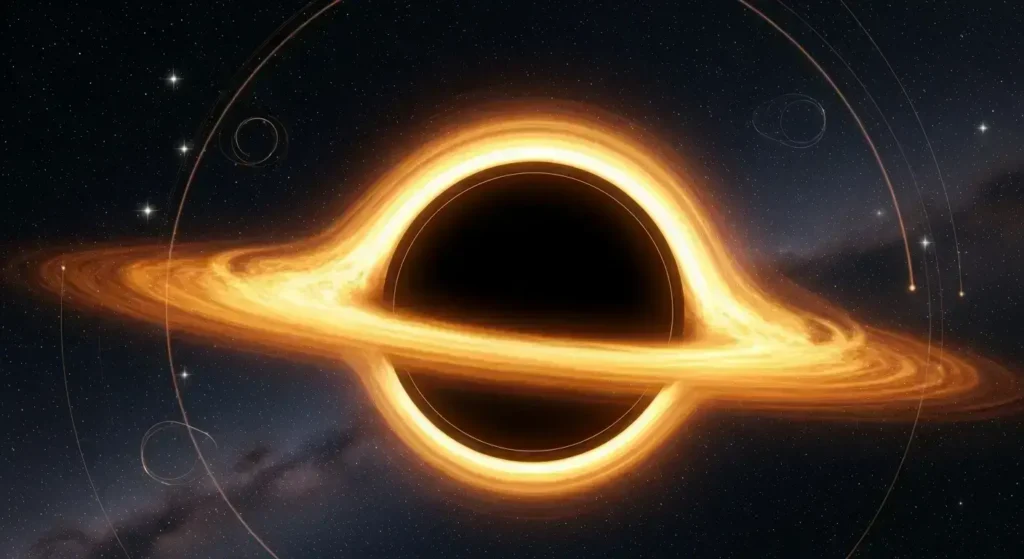
3. The Accretion Disk
Many black holes are surrounded by a glowing ring of gas, dust, and debris. This is called the accretion disk. As this material spirals into the black hole, it spins incredibly fast and heats up, glowing brightly in X-rays. This is often what allows astronomers to “see” the black hole.
Different Types of Black Holes in the Universe
Not all black holes are created equal. Astronomers generally categorize them into three main types based on their mass.
- Stellar Black Holes: These are the “standard” black holes formed by the collapse of a massive star. They can be up to 20 times more massive than the Sun. There could be millions of these in our Milky Way galaxy alone.
- Supermassive Black Holes: These are the giants. They have masses that are millions or even billions of times that of the Sun. Surprisingly, scientists believe there is a supermassive black hole at the center of virtually every large galaxy, including our own (called Sagittarius A*).
- Intermediate Black Holes: As the name suggests, these are the middleweights. They are too big to be stellar but too small to be supermassive. They are rare and somewhat mysterious to scientists.
What Happens If You Fall In? (Spaghettification)
This is my favorite part to explain because the terminology is just so… vivid. If you were brave (or foolish) enough to jump into a stellar black hole, you would experience something called spaghettification.
Because the gravity is so intense and changes so drastically over short distances, the pull on your feet would be much stronger than the pull on your head (assuming you dive feet first). This difference in gravitational pull is called a tidal force.
The result? You would be stretched out vertically like a long noodle of spaghetti and compressed horizontally. It wouldn’t be a pleasant way to go, but it’s a fascinating demonstration of physics at its most extreme.
How Do Scientists Find Invisible Objects?
If a black hole traps light, how do we know they are there? It’s a great question. We can’t see the black hole itself, but we can see the effect it has on the universe around it.
It’s like looking at a window on a windy day. You can’t see the wind, but you can see the trees moving violently. Similarly, scientists look for:
- Stars orbiting nothing: If a star is whipping around empty space at high speeds, it’s likely orbiting a black hole.
- X-ray emissions: As the black hole eats nearby stars (the accretion disk), the material gets hot and releases high-energy X-rays that our telescopes can detect.
- Gravitational Waves: When two black holes collide, they send ripples through the fabric of space-time, which we can detect with observatories like LIGO.
Common Myths vs. Facts
Myth 1: Black holes are cosmic vacuum cleaners.
Fact: Black holes don’t roam the universe sucking things up. They obey the laws of gravity. If you replaced our Sun with a black hole of the exact same mass, Earth wouldn’t get sucked in. We would just keep orbiting it (though it would get very cold and dark!). You have to get very close to the event horizon to be in danger.
Myth 2: Black holes last forever.
Fact: According to physicist Stephen Hawking, black holes slowly lose energy over time through “Hawking Radiation.” Given enough time (trillions of years), they will eventually evaporate and disappear.
Why Do Black Holes Matter?
Understanding what a black hole is helps us answer the biggest questions in science. They challenge our understanding of gravity, time, and the origins of the universe. They are the laboratories where the impossible becomes possible.
While we won’t be visiting one anytime soon, learning about them reminds us of how vast and wonderful our cosmos truly is. It teaches us that there is still so much left to discover.
I hope this simple explanation helped clear up the mystery for you. The universe is a strange place, but that’s exactly what makes it so beautiful.
Got more questions about space? Let me know in the comments below! 🌌
Frequently Asked Questions
Q: Can a black hole kill you?
A: Yes, if you get too close. The intense tidal forces would stretch your body in a process called spaghettification. However, the nearest black hole is thousands of light-years away, so you are perfectly safe on Earth.
Q: Is Earth in danger of being swallowed by a black hole?
A: No. There are no black holes close enough to our solar system to affect us. Even if the Sun became a black hole (which it can’t), Earth would remain in its orbit because the mass would stay the same.
Q: Can light escape a black hole?
A: No. Once light crosses the boundary known as the event horizon, the gravity is too strong for it to escape. This is why black holes appear black.
Q: Who discovered black holes?
A: The concept was predicted by Albert Einstein’s theory of general relativity in 1915. However, the term “black hole” was popularized by John Archibald Wheeler in the 1960s, and the first physical black hole (Cygnus X-1) was identified in 1971.