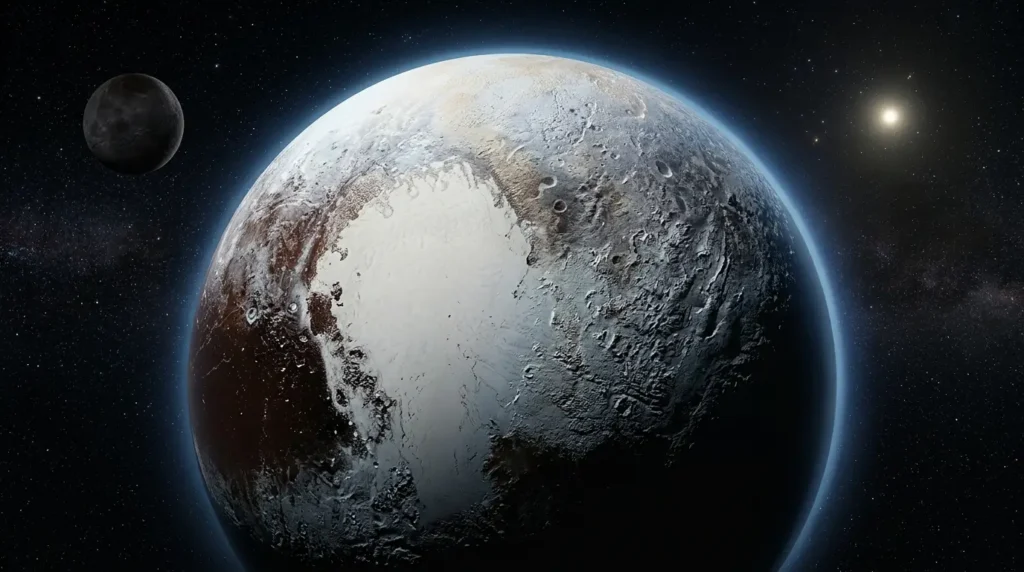
Many of us fondly remember learning the order of the planets in school, carefully memorizing the solar system with Pluto proudly holding the final spot. So, when the news broke in 2006 that Pluto was no longer considered a full-fledged planet, it felt like a strange betrayal. It seemed unfair that astronomers on Earth could simply vote a celestial body in or out of the planetary club at their whim. However, a major development has recently reignited this old sentiment. The leadership at NASA hinted at a formal reconsideration of Pluto’s status. Will our distant friend reclaim its title as the ninth planet? Let’s explore the fascinating scientific and cultural details behind this ongoing debate! 😊
1. How the Controversy Began: A Child’s Letter and NASA’s Response ✉️
This recent spark in the Pluto debate didn’t originate from a complex astrophysical paper or a breakthrough telescope observation. Instead, a pure, handwritten letter from a young student set off a massive ripple effect across the scientific community. The letter, which went viral on social media, pleaded: “I feel sad that Pluto is left out all alone. Please make it a planet again.” In a surprising move, representatives from the National Aeronautics and Space Administration (NASA) publicly acknowledged the sentiment, stating that the agency would keep an open mind regarding the ongoing re-evaluation of Pluto’s planetary status.
This exchange resonates deeply because Pluto holds a special place in modern history, particularly in the United States. Discovered in 1930 by American astronomer Clyde Tombaugh, Pluto was long celebrated as the only planet discovered on American soil, fostering a unique sense of national pride. The cultural attachment is immense—even Walt Disney’s iconic cartoon dog “Pluto” was named in honor of the newly discovered celestial body that same year. Because of these deep cultural roots, any push to bring Pluto back touches both rigorous scientific curiosity and decades of public nostalgia.
When the planet was discovered in 1930, a worldwide call for name suggestions was issued. An 11-year-old girl from Oxford, England, named Venetia Burney, suggested “Pluto”—the Roman god of the underworld who resided in a dark, cold realm. The name was unanimously chosen. Remarkably, both the naming and the modern emotional defense of Pluto began with the pure curiosity of young children!
2. Why Was Pluto Demoted in 2006? 🌌
The most frequently asked question is: “Why exactly did Pluto get kicked out of the solar system?” A common misconception is that Pluto physically shrank or faded away. In reality, Pluto remained exactly the same; what changed was the definition of a planet, driven by our evolving understanding of its dynamical status in space.
In 2006, the International Astronomical Union (IAU) met in Prague to establish the first formal, scientific criteria for what constitutes a “planet.” As telescope technology advanced, astronomers began finding numerous objects similar in size to Pluto in the outer reaches of the solar system, making a strict definition necessary. The IAU established three essential criteria:
| IAU Criterion | Scientific Definition | Pluto’s Status |
|---|---|---|
| 1. Orbiting the Sun | The object must independently orbit the Sun and cannot be a moon of another planet. | Passed (Fully Met) |
| 2. Spherical Shape | It must possess sufficient mass for its self-gravity to overcome rigid body forces, achieving hydrostatic equilibrium (a round shape). | Passed (Fully Met) |
| 3. Clearing the Neighborhood | It must be gravitationally dominant in its orbital zone, clearing out or absorbing other debris and smaller objects nearby. | Failed (Reason for Demotion) |
Pluto passed the first two criteria with flying colors. However, it stumbled critically on the third. Pluto resides in the “Kuiper Belt”—a vast ring of icy debris, comets, and thousands of small, rocky objects. To clear its neighborhood, Pluto would need enough gravitational strength to consume these objects or sling them out of orbit. Instead, Pluto’s total mass is just a fraction of the combined mass of the other objects in its path, and its orbit is heavily influenced by Neptune’s gravity. Consequently, the IAU reclassified Pluto as a “Dwarf Planet,” cataloging it officially as Minor Planet 134340.
3. Scientific Scenarios for Reinstatement—And Their Limits 🔬
Is there a path forward for Pluto to regain its status? Planetary scientists who advocate for Pluto generally pitch two distinct arguments. However, both faces steep pushback from the mainstream astronomical community.
Scenario A: Redefining “Planet” Based on Geology
Many planetary geologists argue that defining a planet by its cosmic clean-up skills (dynamical criteria) ignores the intrinsic nature of the world itself. They propose a geophysical definition: if a celestial body is large enough to be round and exhibits complex internal activity—such as an atmosphere, mountains, flowing ice, or subsurface oceans—it should be a planet. This view gained major support in 2015 when NASA’s New Horizons spacecraft flew past Pluto, revealing a dynamic world with a giant heart-shaped nitrogen glacier, active geology, and towering ice mountains.
Adopting a purely geological definition creates a massive classification problem. If any round, geologically complex body is a planet, then Earth’s Moon, along with Jupiter’s moons (Europa, Ganymede) and Saturn’s moon (Titan), would instantly become planets. This would expand the list of planets in our solar system from 8 to well over 150, forcing textbooks to change drastically.
Scenario B: Proving Pluto’s Unique Atmospheric Profile
The second approach seeks to demonstrate that Pluto is distinctly different from other dwarf planets (such as Eris, Makemake, and Haumea). For years, the primary distinction was Pluto’s thin, layered atmosphere composed of nitrogen, methane, and carbon monoxide. This allowed advocates to argue that Pluto possessed a true planetary climate system. However, recent astronomical data has shattered this defense.
4. The Turning Point: Atmospheric Discovery on Kuiper Belt Object ‘2002 XB93’ 🌠
According to a study published in Nature Astronomy, researchers detected an atmospheric envelope around a much smaller, distant Kuiper Belt object named ‘2002 XB93’.
Observation Data: 2002 XB93 📝
- Estimated Diameter: Roughly 500 km (only a quarter of Pluto’s size)
- Detection Technique: Stellar Occultation (measuring the light of a distant star as the object passes in front of it)
- Evidence of Gas: Instead of a sharp drop, the star’s light dimmed gradually and refracted, indicating a clear, albeit thin, gaseous layer.
- Atmospheric Pressure: Estimated at 200 nanobars (fractions of Earth’s pressure, but definitively present).
This finding challenged long-held assumptions. If an object with a diameter of only 500 km—possessing weak gravity—can hold onto an atmosphere, then a gaseous envelope is not a unique feature reserved for planets or massive dwarf planets. Scientists proposed two primary theories for this phenomenon:
- Collisional Outgassing: A recent impact with another icy body could have unearthed subterranean volatile gases, creating a temporary localized atmosphere.
- Cryovolcanism (Ice Volcanoes): Internal tidal heating or radioactive decay may still drive active plumes of methane or nitrogen from the interior to the surface.
Ultimately, this discovery undermines Scenario B. Having an atmosphere is no longer an exclusive trait that sets Pluto apart from the rest of the Kuiper Belt. It suggests that many icy bodies in the deep solar system share these characteristics, removing the scientific justification for granting Pluto a unique exemption.
🔮 Calculate Your Age on Pluto 🔢
Pluto takes a staggering 248 Earth years to complete a single trip around the Sun.
How old would you be in Pluto years?
Pluto Debate: 3-Minute Quick Summary
5. Core Takeaways: Understanding the Big Picture 📝
To summarize the core dynamics of this celestial debate:
- Cultural vs. Scientific Value: Public interest driven by statements from space agency officials reflects cultural nostalgia rather than a shift in formal astronomical consensus.
- The Importance of Consistency: The IAU maintains strict benchmarks to prevent classification chaos, ensuring that terms describe explicit dynamic rules rather than human affection.
- A New Era for the Kuiper Belt: Rather than viewing the demotion as a loss, astronomers consider Pluto the crown jewel and founding member of an entirely new, incredibly complex region of outer space.
Frequently Asked Questions ❓
Pluto’s orbit around the Sun takes 248 Earth years. Since its discovery in 1930, Pluto has not yet completed a single full orbit. It won’t reach its first full “Pluto New Year” since discovery until the year 2178. From our brief human perspective, Pluto has undergone a dramatic narrative, shifting from an established planet to an exiled world, and now to a subject of renewed debate. Yet, out in the quiet cold of the solar system’s edge, Pluto continues along its path completely indifferent to our taxonomy. Whether we call it a planet or a dwarf planet, its beauty and scientific value remain timeless. Where do you stand on this debate? Should Pluto be brought back into the planetary family? Share your thoughts in the comments below! 😊