In 1970, the Apollo 13 mission, bound for the Moon, became one of the most dramatic moments in space exploration history. Following a catastrophic explosion of an oxygen tank, how did three astronauts manage to survive against all odds? This is an in-depth analysis of the event known as the ‘successful failure’ and the timeless lessons in crisis management it offers.
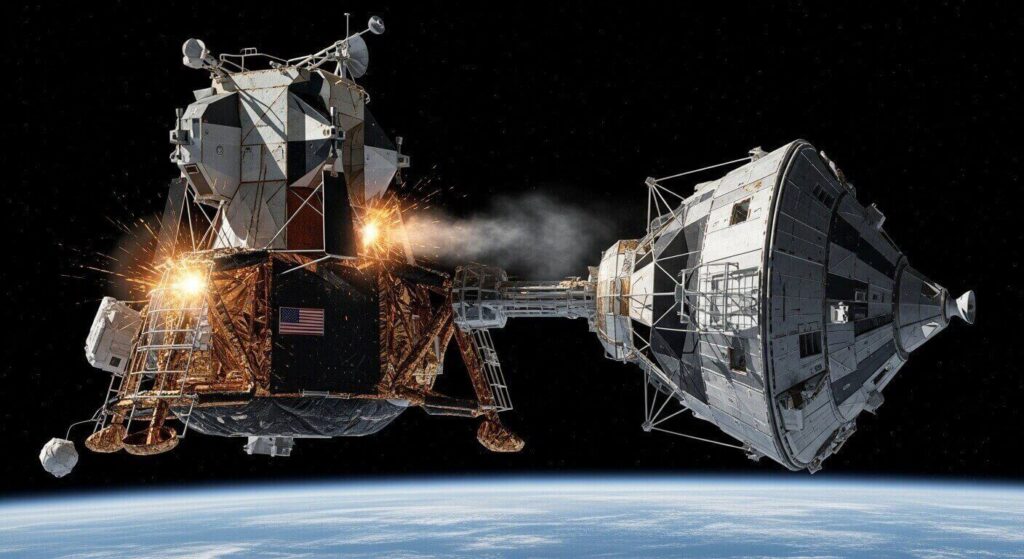
In April 1970, the eyes of the world were fixed on Kennedy Space Center in Florida. At that moment, Apollo 13 was launching towards space, carrying the great mission of humanity’s third lunar landing. But no one could have predicted what was to come. This flight would not be about landing on the Moon, but a desperate saga of survival to bring its stranded astronauts back to Earth. Let’s delve into the tense moments and the great return of the Apollo 13 incident, paradoxically remembered as a ‘successful failure’. 😊
Table of Contents
- A Mission Launched with Ominous Signs
- “Houston, we’ve had a problem”: The Full Story of the Apollo 13 Explosion
- A Lifeboat in the Void: The Lunar Module as a Last Resort
- The Fight to Return Home: Course Correction and Power Issues
- The Lessons and Legacy of a ‘Successful Failure’
A Mission Launched with Ominous Signs 🤔
From the very beginning, the Apollo 13 mission had minor hiccups. The original Command Module Pilot, Ken Mattingly, was replaced by his backup, Jack Swigert, just before launch due to potential exposure to German measles. For the superstitious, the number ’13’ also brought a sense of unease. Apollo ’13’ launched on April 11, 1970, at ’13:13′ Central Time from Launch Pad 39 (a multiple of 13). While superstition was dismissed in the realm of science, these coincidences would be remembered later. Nevertheless, the Saturn V rocket successfully thundered into the sky, and the spacecraft smoothly entered its trajectory toward the Moon.
“Houston, we’ve had a problem”: The Full Story of the Apollo 13 Explosion 💥
The incident occurred nearly 56 hours into the mission, approximately 200,000 miles (320,000 km) from Earth. On April 13, following a routine instruction from Mission Control, Jack Swigert flipped the switch to stir the liquid oxygen tanks in the Service Module (SM). This was a standard procedure to ensure the density of the cryo tanks’ contents remained uniform. But at that moment, a loud ‘bang’ reverberated through the spacecraft, and warning lights began flashing erratically. This was the start of the Apollo 13 explosion accident.
Commander Jim Lovell looked out the window and witnessed a cloud of white gas venting into space. It was their lifeline: oxygen. Oxygen Tank No. 2 had exploded, critically damaging Tank No. 1 in the process. Oxygen was not just for breathing; it was a key component of the fuel cells that generated electricity and water. Losing their oxygen supply was a death sentence for the entire spacecraft system. The calm yet urgent message Lovell relayed to Houston, “Okay, Houston, we’ve had a problem here,” would become one of the most famous phrases in the history of space exploration.
The Root Cause of the Apollo 13 Explosion
A post-accident investigation revealed that the explosion was caused by damaged wiring inside the oxygen tank. During ground testing, the tank’s internal heater, designed for 28-volt power from the spacecraft, had been improperly subjected to 65-volt ground power. This overheated the system and damaged the wire insulation. In space, when the stir was activated, the damaged wires created a spark, instantly turning the pure oxygen-filled tank into a bomb. It was a man-made disaster born from flaws in design and ground procedures.
A Lifeboat in the Void: The Lunar Module as a Last Resort 🚀
With the Command Module (CM) crippled, NASA immediately aborted the lunar landing mission and shifted its focus to a single objective: bringing the astronauts home alive. The only hope was the Lunar Module (LM), ‘Aquarius’, still docked to the CM. This small craft, designed to support two astronauts on the lunar surface for 45 hours, now had to function as a lifeboat for three men for over 90 hours. But the challenges were immense.
- The CO2 Filter Problem: The air inside was quickly becoming toxic with carbon dioxide exhaled by three men. The square filters from the Command Module were incompatible with the round openings in the Lunar Module’s system. In a legendary display of ingenuity, engineers on the ground devised a makeshift adapter—the “mailbox”—using only items available on the spacecraft: plastic bags, duct tape, a sock, and flight manual covers. They relayed the instructions over the radio, and the astronauts successfully built the device, staving off suffocation.
- Cold and Water Shortage: To conserve minimal power, the heating systems were shut down, and the temperature inside the cabin plummeted to near freezing (around 3°C or 38°F). The astronauts battled the intense cold, and condensation formed on all the walls. Drinking water was also severely rationed, leading to dehydration.
The Fight to Return Home: Course Correction and Power Issues 🌏
Even after taking refuge in the LM, the biggest challenge was finding the right path back to Earth. With their original flight plan useless, NASA opted for a “free-return trajectory,” using the Moon’s gravity as a slingshot to send the spacecraft back home. However, to get onto this path correctly, a precise engine burn using the Lunar Module’s descent engine was required.
With the primary navigation systems powered down, the astronauts had to perform the burn manually, aligning the spacecraft using the Earth and the Sun as reference points seen through a small window. Under immense pressure, where a single mistake could leave them drifting in space forever, they successfully executed several manual burns, miraculously placing them on the correct trajectory for Earth. Furthermore, the procedure to power up the Command Module for re-entry was a huge gamble. Engineers on the ground developed an entirely new power-up sequence to run the essential systems on severely limited battery power. The astronauts followed the untried procedure and, against all odds, brought the Command Module back to life.
The Lessons and Legacy of a ‘Successful Failure’ 🏆
On April 17, 1970, after breaking the tense silence of the re-entry blackout, the Apollo 13 Command Module safely splashed down in the South Pacific Ocean. They had failed to land on the Moon, but they had succeeded in returning home alive. The event has since been immortalized in history as a “successful failure.”
The Apollo 13 explosion accident taught NASA an invaluable lesson. In its aftermath, the oxygen tank design was completely overhauled, and emergency procedures and training were significantly enhanced. Above all, the incident proved to the world that even the most advanced technology is useless without human ingenuity, teamwork, and composure under pressure. The story of the astronauts and the ground control team, who worked together to solve impossible problems without losing hope, remains one of the greatest case studies in crisis management to this day.
Frequently Asked Questions about the Apollo 13 Accident ❓
Q: What was the exact cause of the Apollo 13 explosion?
A: The primary cause was damaged wiring inside Oxygen Tank No. 2. The wire insulation was compromised during a pre-flight ground test when an incorrect voltage was applied to an internal heater. During the flight, this faulty wiring created a spark when the tank’s fans were turned on, causing the pure oxygen to explode.
Q: Why is it called a “successful failure”?
A: Because while the mission ‘failed’ in its primary objective of landing on the Moon, it was a spectacular ‘success’ in safely returning three astronauts to Earth from a catastrophic spacecraft explosion. It is regarded as a triumph of NASA’s crisis management skills and the human will to survive.
Q: What would have happened if there was no Lunar Module?
A: Without the Lunar Module ‘Aquarius’ to serve as a lifeboat, the astronauts would not have survived. The Command Module had lost all its oxygen and power, making it uninhabitable. Transferring to the LM was the single most critical factor in their survival.
Q: How did this accident change NASA’s future space missions?
A: After the Apollo 13 accident, NASA implemented sweeping safety upgrades. The oxygen tank was completely redesigned, and emergency procedures and training simulations became far more rigorous and realistic. This experience profoundly influenced the safety philosophy of all subsequent manned spaceflight programs.