Is TON 618 the biggest black hole in the universe? Discover the mind-bending scale of this cosmic titan and meet the new contender challenging its throne.
Let’s be honest for a second. The universe isn’t just big; it is terrifyingly, incomprehensibly massive. Just when we think we’ve wrapped our heads around the scale of our own sun, astronomy throws something like a black hole at us.
For years, one name has dominated the conversation about cosmic giants: TON 618. It’s the heavyweight champion, the monster lurking in the dark, the object so big it breaks our brains just trying to visualize it.
But the question remains: Is TON 618 the biggest black hole in the universe?
If you had asked me this two years ago, I would have said “Yes, absolutely” without hesitation. Today? The answer is a bit more complicated. We are diving deep into the abyss to explore the scale of TON 618, how it compares to our solar system, and to introduce you to the shadowy new contender that might just steal the crown.
Buckle up. We are going deep into the void. 🚀
Table of Contents
- 1. What Exactly is TON 618?
- 2. Visualizing the Size: TON 618 vs. The Solar System
- 3. Is TON 618 the Biggest Black Hole in the Universe Today?
- 4. The New King? Enter the Phoenix A* Black Hole
- 5. How Do Astronomers Measure These Monsters?
- 6. Conclusion: The Limitless Dark
- 7. Frequently Asked Questions (FAQ)
What Exactly is TON 618?
Before we compare it to others, let’s establish what we are looking at. TON 618 isn’t just a black hole sitting quietly in the dark. It is a hyper-luminous broad-absorption-line radio-quiet quasar. That’s a mouthful, right?
In simple terms, TON 618 is an incredibly active galactic nucleus. At its center lies an ultramassive black hole that is feeding so aggressively on surrounding matter that the accretion disk (the swirling ring of gas and dust falling into it) shines brighter than 140 trillion suns combined.
Located in the constellation Canes Venatici, roughly 10.4 to 18.2 billion light-years away (depending on how you measure distance in an expanding universe), it is a relic from the early universe. But the number that makes everyone drop their jaw is its mass.
TON 618 has a mass of approximately 66 billion solar masses.
To put that in perspective, the supermassive black hole at the center of our Milky Way galaxy, Sagittarius A*, is about 4 million solar masses. TON 618 is over 15,000 times more massive than the monster holding our entire galaxy together. It belongs to a rare class known as Ultramassive Black Holes (UMBHs).
Visualizing the Size: TON 618 vs. The Solar System
Numbers like “66 billion” are too abstract for our primate brains to process. We need a map.
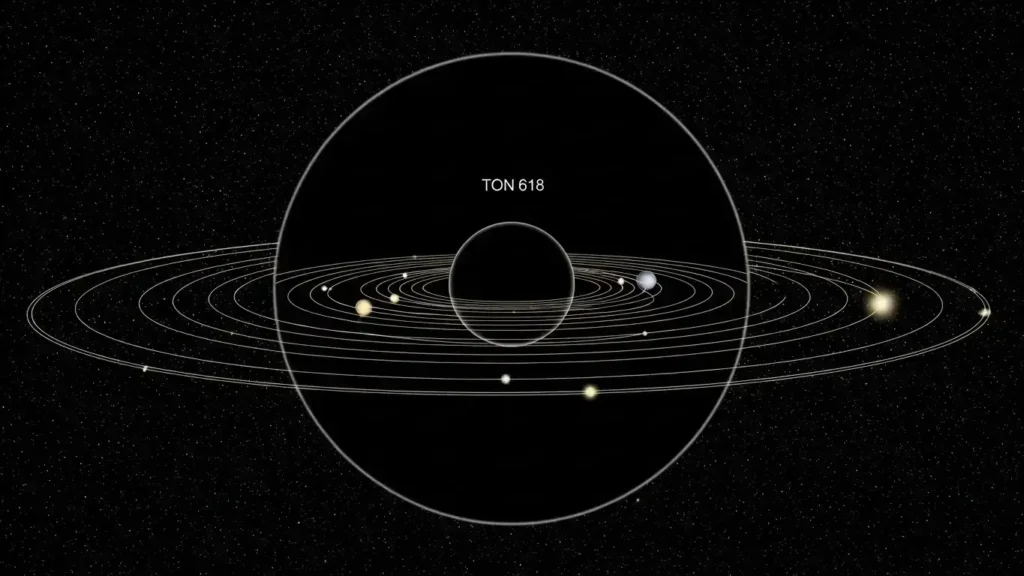
Imagine the Earth. Now imagine the Sun. The Sun is huge compared to Earth. Now, think about the entire Solar System—from the Sun all the way out to Neptune. That distance is about 4.5 billion kilometers.
If you were to replace the Sun with TON 618, where would the “surface” (the Event Horizon) be?
- It wouldn’t just swallow Earth.
- It wouldn’t just swallow Pluto.
- It would extend more than 40 times the distance from the Sun to Neptune.
A beam of light takes hours to cross our Solar System. To cross the diameter of TON 618’s event horizon? It would take light about a week. If you were driving a car at highway speeds (75 mph), it would take you roughly 9 million years just to drive across its shadow.
Is TON 618 the Biggest Black Hole in the Universe Today?
This is the question you came here for. Technically, based on direct measurements via spectral lines from quasars, TON 618 holds the official title in most textbooks and records.
However, science doesn’t stand still. Astronomers are constantly peering deeper into galaxy clusters, utilizing X-ray astronomy and computer modeling to find objects that “shouldn’t exist” according to standard models.
There is a significant difference between “the largest confirmed” and “the largest estimated.” While TON 618 is the undisputed heavyweight champion of quasars (active black holes), there are sleeping giants in the local universe that might be far, far larger. These silent monsters aren’t eating as much, so they aren’t shining as quasars, making them much harder to measure.
The New King? Enter the Phoenix A* Black Hole
Recently, simulations and data from the Phoenix Cluster (a massive galaxy cluster about 5.8 billion light-years away) have revealed something terrifying.
At the center of this cluster lies a central galaxy known as Phoenix A. Researchers have analyzed the movement of gas and the sheer energy output required to maintain the cavity in the cluster’s intra-cluster medium. The models suggest that the central black hole—let’s call it Phoenix A*—is an absolute leviathan.
💡 The Phoenix A* Estimates
While TON 618 is 66 billion solar masses, current theoretical models estimate Phoenix A* could be upwards of 100 billion solar masses.
If these estimates are confirmed, Phoenix A* would not just break the record; it would shatter it. At 100 billion solar masses, it pushes the theoretical limit of how large a black hole can physically grow (known as the accretion limit). It essentially suggests that this object formed not just by eating stars, but by the merging of multiple supermassive black holes over eons.
So, why isn’t it official yet?
We measured TON 618 using the brightness of its quasar light—a fairly direct method. Phoenix A* is currently measured through calorimetric methods and modeling of the surrounding gas density. It’s a very strong “educated guess,” but we haven’t “weighed” it as directly as TON 618.
How Do Astronomers Measure These Monsters?
You might be wondering, “How do you weigh something that is billions of light-years away and invisible?” It’s a valid question. Trust me, astronomers aren’t just pulling these numbers out of a hat.
Here are the two main methods used for comparing TON 618 vs Phoenix A:
- The Quasar Method (Used for TON 618): Because TON 618 is a quasar, it has a bright accretion disk. Astronomers look at the “spectral lines” of the light. By measuring how wide these lines are, they can calculate how fast the gas is spinning around the black hole. If you know the speed of the gas and the distance from the center, gravity physics (Kepler’s laws) tells you the mass.
- The X-Ray Cavity Method (Used for Phoenix A): Phoenix A isn’t shining brightly like a quasar right now. Instead, it shoots out massive jets of particles that push away hot gas in the galaxy cluster, creating giant “bubbles” or holes in the X-ray light. By calculating how much energy is needed to inflate those bubbles, scientists can estimate the mass of the black hole fueling the jets.
Conclusion: The Limitless Dark
So, is TON 618 the biggest black hole in the universe?
Officially and directly measured? Yes, TON 618 is currently the record holder at 66 billion solar masses. It remains the benchmark for cosmic horror and scale.
Theoretically? Probably not. Objects like Phoenix A* suggest that the universe hides monsters in the dark that are even larger—titans reaching 100 billion solar masses, appropriately named “SLABs” (Stupendously Large Black Holes).
What I love about this topic is that it reminds us how little we actually know. Every time we build a better telescope or run a better simulation, the universe says, “Hold my beer,” and shows us something bigger. For now, TON 618 wears the crown, but the Phoenix is rising.
What do you think? Does the idea of a 100 billion solar mass black hole excite you or terrify you? Let me know in the comments below! 🌌
Frequently Asked Questions (FAQ)
Q: Is there anything bigger than TON 618?
A: Currently, Phoenix A* is estimated to be larger, with a potential mass of 100 billion solar masses compared to TON 618’s 66 billion. However, Phoenix A*’s mass is based on theoretical modeling of galaxy clusters rather than direct orbital measurements.
Q: Will TON 618 swallow the Milky Way?
A: No. TON 618 is over 10 billion light-years away. Even if it were moving toward us (which it isn’t; the universe is expanding), it would never reach us in the lifetime of our solar system.
Q: What is a Stupendously Large Black Hole (SLAB)?
A: SLAB is a theoretical class of black holes proposed by researchers to describe objects 100 billion solar masses or larger, significantly bigger than the current Supermassive or Ultramassive classifications.
Q: Can a black hole grow forever?
A: Theoretically, no. There is a proposed “limit” around 50 to 270 billion solar masses where the accretion disk (food source) would break up into stars rather than falling into the black hole, slowing its growth significantly.