Uncover mind-blowing facts about TON 618, the largest black hole ever discovered. Explore its massive size, brightness, and why this cosmic monster defies the laws of physics.
When we look up at the night sky, we often think of the universe as a serene, twinkling expanse. But deep in the cosmos, lurking in the constellation Canes Venatici, exists a monster so terrifyingly large that it challenges our very understanding of how the universe works. I’m talking about TON 618.
If you have ever found yourself spiraling into a YouTube rabbit hole about space, you’ve likely heard this name whispered with a mix of fear and awe. It isn’t just a black hole; it is the King of black holes. As an ultramassive black hole, TON 618 is a celestial titan that makes our own sun look like a sub-atomic particle in comparison.
In this deep dive, we are going to explore the most mind-bending facts about TON 618 the largest black hole known to humanity. We will strip away the complex astrophysics jargon and look at what this object really is, how big it truly is, and why it scares even the most seasoned astronomers.
Table of Contents
- 1. What Exactly is TON 618?
- 2. The Scale: Facts About TON 618’s Size
- 3. Why is TON 618 So Bright? (The Quasar Connection)
- 4. A Brief History of Its Discovery
- 5. Breaking Physics: How Did It Get So Big?
- 6. TON 618 vs. The Milky Way’s Black Hole
- 7. Frequently Asked Questions (FAQ)
1. What Exactly is TON 618?
Before we talk about size, we need to clarify what we are looking at. Technically, TON 618 is a hyperluminous, broad-absorption-line radio-loud quasar. That’s a mouthful, right? Let’s break it down.
A quasar is an “active galactic nucleus.” This means there is a supermassive black hole at the center of a galaxy that is feeding on matter—gas, dust, and even entire stars—at a frantic pace. As this matter spirals into the black hole, it heats up due to friction and gravitational forces, creating an accretion disk that glows brighter than thousands of galaxies combined.
So, when we discuss facts about TON 618 the largest black hole, we are actually talking about the black hole residing at the center of this quasar. It is located approximately 10.4 to 18.2 billion light-years away (depending on how you measure cosmic distance) in the constellation Canes Venatici.
💡 Key Takeaway: TON 618 isn’t just a black hole sitting in the dark; it is the engine powering the brightest lighthouse in the universe, shining with the luminosity of 140 trillion Suns.
2. The Scale: Facts About TON 618’s Size
This is the part where the human brain starts to struggle. The numbers associated with TON 618 are so astronomical that they lose meaning unless we use comparisons.
The Mass of 66 Billion Suns
The most terrifying of all facts about TON 618 the largest black hole is its mass. Scientists estimate that TON 618 has a mass of 66 billion solar masses. To put that into perspective, the black hole at the center of our own galaxy (Sagittarius A*) is only about 4 million solar masses.
If you were to take every single star in the Milky Way galaxy and mash them together, TON 618 would still be heavier.
The Event Horizon
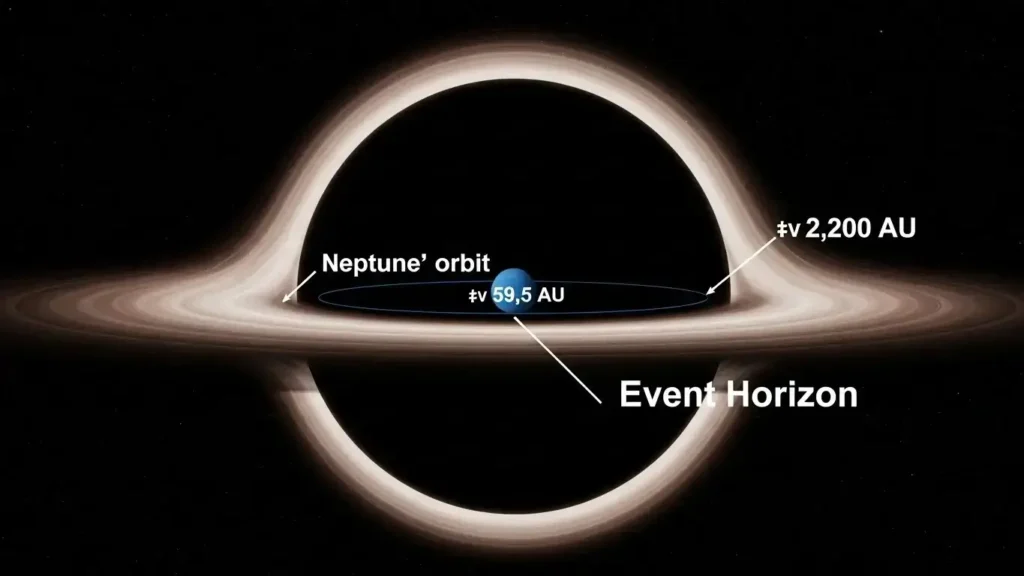
A black hole has a “point of no return” called the event horizon. The radius of this horizon is called the Schwarzschild radius. For TON 618, this radius is about 1,300 Astronomical Units (AU).
Let’s visualize that:
- 1 AU is the distance from the Earth to the Sun.
- Neptune, the farthest known planet in our solar system, is about 30 AU from the Sun.
- Voyager 1, the furthest human-made object, is only about 160 AU away.
This means TON 618 is so large that you could fit our entire solar system inside it, not just once, but roughly 43 times over, side-by-side. A beam of light would take a week to travel across its shadow. It is truly an abyss.
3. Why is TON 618 So Bright? (The Quasar Connection)
One of the most ironic facts about TON 618 the largest black hole is that despite being a “black” hole (which allows no light to escape), it powers one of the brightest objects in the observable universe.
As mentioned earlier, TON 618 is a quasar. The accretion disk swirling around the black hole is moving at immense speeds. The friction generated by this movement heats the gas to millions of degrees.
How bright is it?
It shines with a luminosity of 140 trillion times that of our Sun. If TON 618 were placed at the center of our galaxy, replacing Sagittarius A*, it would likely shine brighter than the full moon in our night sky, essentially deleting the concept of “night” for us—and likely sterilizing the Earth with X-rays and radiation.
⚠️ Warning: The radiation emitted by the accretion disk of TON 618 is so intense that no life as we know it could survive within thousands of light-years of its core. It is a cosmic sterilization engine.
4. A Brief History of Its Discovery
You might be wondering, “How long have we known about this giant?” Surprisingly, we saw it long before we knew what it was.
It was first cataloged in 1957 by astronomers at the Tonantzintla Observatory in Mexico (hence the “TON” in its name). However, back then, photographic plates weren’t advanced enough to reveal its true nature. It appeared violet, leading scientists to classify it as a faint blue star.
It wasn’t until 1970 that radio surveys discovered strong radio emissions coming from TON 618, reclassifying it as a quasar. And it wasn’t until recently, with advanced spectroscopy, that we calculated the mass of the central black hole, realizing we had found the heavyweight champion of the cosmos.
5. Breaking Physics: How Did It Get So Big?
Here is where things get tricky for astrophysicists. When we analyze facts about TON 618 the largest black hole, we run into a “time” problem.
We are seeing TON 618 as it was over 10 billion years ago (due to the time it takes light to travel). This means the universe was relatively young—only about 3.4 billion years old—when TON 618 had already grown to 66 billion solar masses.
The Limit Problem
Black holes usually grow by eating matter. But there is a physical limit to how fast they can eat, known as the Eddington Limit. If they eat too fast, the radiation pushes the food (gas) away. For TON 618 to get this big, this quickly, it must have either:
- Started from a “seed” black hole that was already massive (Direct Collapse Black Hole).
- Merged with other massive black holes early in the universe’s history.
- Found a way to bypass the Eddington Limit (Super-Eddington accretion).
TON 618 is technically classified as an Ultramassive Black Hole (UMBH), a category above “Supermassive,” reserved for the true giants of the universe.
6. TON 618 vs. The Milky Way’s Black Hole
To truly grasp the facts about TON 618 the largest black hole, let’s do a side-by-side comparison with the black hole we know best: Sagittarius A* (Sgr A*), located in our own backyard.
| Feature | Sagittarius A* (Milky Way) | TON 618 |
|---|---|---|
| Mass | 4.3 Million Suns | 66 Billion Suns |
| Diameter | ~23.5 Million km | ~390 Billion km |
| Brightness | Very Faint (Quiet) | Hyperluminous (Quasar) |
| Class | Supermassive | Ultramassive |
Comparing these two is like comparing a grain of sand to a mountain. Sgr A* is a dormant, quiet sleeper. TON 618 is a voracious, screaming beast that dominates its corner of the universe.
Final Thoughts: A Humble Perspective
Studying facts about TON 618 the largest black hole serves as a humbling reminder of our place in the cosmos. We live on a tiny rock orbiting a mediocre star, near a standard black hole. Meanwhile, billions of light-years away, entities like TON 618 exist—objects so large that they defy human comprehension and challenge our laws of physics.
While we are safe from its gravitational grasp, TON 618 stands as a testament to the universe’s ability to create things of terrifying majesty. As telescopes like the James Webb Space Telescope (JWST) peer deeper into the past, who knows? We might one day find something even bigger. But for now, TON 618 remains the undisputed king of the dark.
Do you think there is a limit to how big a black hole can grow? Let me know your thoughts in the comments below! 😊
7. Frequently Asked Questions (FAQ)
Q: Is TON 618 the biggest black hole in the universe?
A: Currently, yes. TON 618 is the largest massive black hole ever discovered, with a mass of 66 billion suns. However, the universe is vast, and larger ones like the theoretical “Phoenix A*” (estimated at 100 billion solar masses) are being studied, though TON 618 remains the most scientifically confirmed giant.
Q: Can TON 618 swallow the Milky Way?
A: Not the whole galaxy at once, but it is massive enough to disrupt it significantly. The mass of TON 618 is actually larger than the total mass of all the black holes in the Milky Way combined. However, its event horizon is much smaller than the diameter of our galaxy.
Q: How far is TON 618 from Earth?
A: TON 618 is located roughly 10.4 billion light-years away (light-travel distance). Because the universe has expanded since that light left, the comoving distance is estimated to be around 18.2 billion light-years.
Q: Will TON 618 ever die?
A: Black holes technically “evaporate” via Hawking Radiation, but for a monster like TON 618, this would take an unfathomable amount of time—roughly 10^100 years. It will likely outlive all the stars in the universe.