When we look up at the night sky, we often feel small. But “small” doesn’t even begin to describe our place in the universe when we start comparing our home to the true monsters lurking in the deep cosmos. You might have heard of black holes—regions of space where gravity is so strong that nothing, not even light, can escape. But there is one that stands above the rest, a celestial titan that defies imagination.
Its name is TON 618.
This isn’t just a black hole; it is an ultramassive beast powering a quasar that shines brighter than 140 trillion suns. However, numbers often fail to convey the true scale of such objects. To truly understand it, we need to bring it home. In this deep dive, we are going to visualize the TON 618 black hole size compared to the solar system, breaking down the physics, the scale, and the sheer existential awe of the largest confirmed reservoir of mass in the known universe.
Buckle up. We are about to take a journey to the edge of Canes Venatici, 10.4 billion light-years away, to meet the king of darkness.
Table of Contents
- 1. Unveiling the Titan: What Exactly is TON 618?
- 2. The Solar System Scale: Establishing a Baseline
- 3. TON 618 Black Hole Size Compared to Solar System: The Visualization
- 4. Mass Beyond Comprehension: 66 Billion Suns
- 5. How TON 618 Stacks Up Against the Milky Way’s Black Hole
- 6. Frequently Asked Questions (FAQ)
Unveiling the Titan: What Exactly is TON 618?
Before we compare sizes, we need to understand what we are looking at. TON 618 is technically classified as a hyper-luminous, broad-absorption-line radio-loud quasar. That is a mouthful of astrophysical jargon, so let’s simplify it.
Imagine a black hole so massive that it is furiously consuming all surrounding matter. As gas and dust spiral into the abyss, they heat up due to friction, creating an accretion disk that glows with the intensity of a trillion stars. This glowing disk is the quasar. At the center of this blinding light sits the ultramassive black hole, the engine of TON 618.
Discovered initially in 1957 but not understood as a quasar until the 1970s, TON 618 sits roughly 18.2 billion light-years away from Earth (comoving distance). It represents a time in the early universe when black holes grew to sizes that modern cosmological models are still struggling to fully explain.
The Solar System Scale: Establishing a Baseline
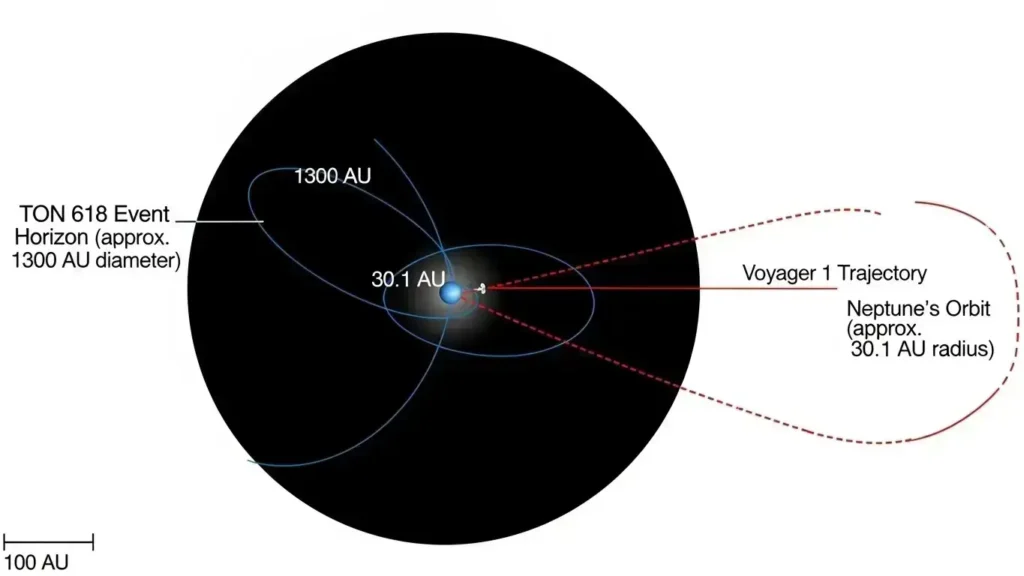
To appreciate the TON 618 black hole size compared to the solar system, we first need to understand how big our own neighborhood is. We often think of space as empty, but the Solar System is vast.
- The Sun to Earth: This distance is 1 Astronomical Unit (AU), roughly 93 million miles (150 million km). Light takes about 8 minutes to travel this distance.
- The Sun to Neptune: Neptune is the farthest major planet, orbiting at about 30 AU. It takes light over 4 hours to reach Neptune.
- The Voyager 1 Probe: As the furthest human-made object, Voyager 1 has been traveling for over 45 years and is roughly 160 AU from the Sun.
Keep these numbers in mind: 30 AU is the radius of our planetary system. 160 AU is the frontier of human exploration.
TON 618 Black Hole Size Compared to Solar System: The Visualization
Now, let’s drop TON 618 into the picture. When we talk about the “size” of a black hole, we are usually referring to its Schwarzschild radius—the radius of the Event Horizon, the point of no return.
The radius of TON 618 is estimated to be approximately 1,300 AU.
Let that sink in for a moment. The distance from the Sun to Neptune is 30 AU. The radius of TON 618 is over 43 times larger than the distance to Neptune. If you were to replace our Sun with TON 618, the event horizon wouldn’t just swallow Mercury, Venus, and Earth. It wouldn’t just swallow Jupiter and Saturn.
The Diameter: A Journey of Weeks
The diameter of TON 618 is roughly 2,600 AU (about 390 billion kilometers). To put this in perspective using the speed of light:
- Light crosses our Solar System (to Neptune) in about 4 hours.
- Light crosses the diameter of TON 618 in roughly two weeks.
If you were driving a car at 60 mph, it would take you over 170 years to drive to the sun. To drive across TON 618? It would take roughly 470 million years. The sheer volume of this black hole is so immense that you could fit millions of Solar Systems inside its event horizon side-by-side.
Mass Beyond Comprehension: 66 Billion Suns
The reason the TON 618 size is so terrifyingly large is directly related to its mass. In astrophysics, mass and radius are linked. The more mass you squeeze into a singularity, the wider the event horizon becomes.
TON 618 has an estimated mass of 66 billion solar masses.
To visualize this, imagine taking every single star in the Milky Way galaxy. There are estimated to be between 100 to 400 billion stars in our galaxy. TON 618 alone weighs as much as a significant percentage of our entire galaxy’s stellar population combined into a single dark sphere.
It is classified as an “Ultramassive Black Hole,” a category reserved for the giants that exceed 10 billion solar masses—a scale that makes “Supermassive” black holes look like dwarfs.
How TON 618 Stacks Up Against the Milky Way’s Black Hole
We have a supermassive black hole in our own backyard: Sagittarius A* (Sgr A*), located at the center of the Milky Way. We’ve even imaged it thanks to the Event Horizon Telescope. But how does our local giant compare to TON 618?
Sagittarius A* vs. TON 618
Comparing these two highlights the terrifying scale of TON 618:
- Sagittarius A* Mass: ~4.3 million Suns.
- TON 618 Mass: ~66 billion Suns.
If Sgr A* were the size of a poppy seed, TON 618 would be the size of a large house. If you placed Sagittarius A* next to TON 618, it would be invisible to the naked eye against the backdrop of the giant’s shadow. TON 618 is more than 15,000 times more massive than the black hole holding our galaxy together.
What about M87*?
You probably remember the famous orange donut image released in 2019—the first picture of a black hole (M87*). M87* is a monster in its own right, weighing in at 6.5 billion solar masses. Yet, even this giant is dwarfed by TON 618. TON 618 is over 10 times more massive than M87*.
The Existential Awe of the Cosmos
Studying the TON 618 black hole size compared to the solar system is a humbling experience. It reminds us that the universe operates on scales that the human brain is not wired to comprehend. Our entire planetary system, the stage for all human history, acts as less than a speck of dust against the event horizon of this ancient quasar.
While theoretical physics suggests even larger black holes could exist (like the hypothesized Phoenix A), TON 618 remains the heavyweight champion of spectroscopically confirmed black holes. It stands as a dark monument to the awesome and terrifying power of gravity.
Frequently Asked Questions (FAQ)
Here are answers to the most common queries regarding the scale and nature of TON 618.
Q: Is TON 618 the largest black hole ever discovered?
A: TON 618 is widely considered the largest confirmed black hole based on spectroscopic data. However, recent studies of the Phoenix cluster (Phoenix A*) suggest a theoretical black hole that could be up to 100 billion solar masses, though this requires further confirmation.
Q: Would TON 618 swallow the entire Solar System?
A: Yes, absolutely. The event horizon radius is 1,300 AU. Neptune orbits at 30 AU. TON 618 would swallow the solar system 40 times over without the planets even touching the edge.
Q: How far away is TON 618 from Earth?
A: It is located approximately 10.4 billion light-years away (light-travel distance). Due to the expansion of the universe, its “comoving distance” is now roughly 18.2 billion light-years from us.
Q: Can we see TON 618 with a telescope?
A: You cannot see the black hole itself (as it traps light), but you can see the quasar it powers. Because it is so bright (140 trillion times the sun’s luminosity), it can be detected by powerful telescopes despite its extreme distance.