On April 12th, the world pauses to look upward. It is a day that marks the moment humanity finally broke the shackles of Earth’s gravity and stepped into the vast, silent theater of the cosmos. Whether you call it the International Day of Human Space Flight or “Yuri’s Night,” this date represents the ultimate triumph of curiosity over fear. As we approach the 45th anniversary of the first Space Shuttle launch, it’s the perfect time to reflect on how far we’ve come—from 108 minutes in orbit to plans for permanent lunar bases. 😊
Table of Contents
- 1. The Dawn of a New Era: Yuri Gagarin and Vostok 1
- 2. Rigorous Preparations: The Science of Survival
- 3. STS-1: Celebrating the 45th Anniversary of the Space Shuttle
- 4. Human Space Flight Today: From ISS to Artemis
- 5. FAQ: Life, Science, and Secrets of Astronauts
The Legacy of the International Day of Human Space Flight 🚀
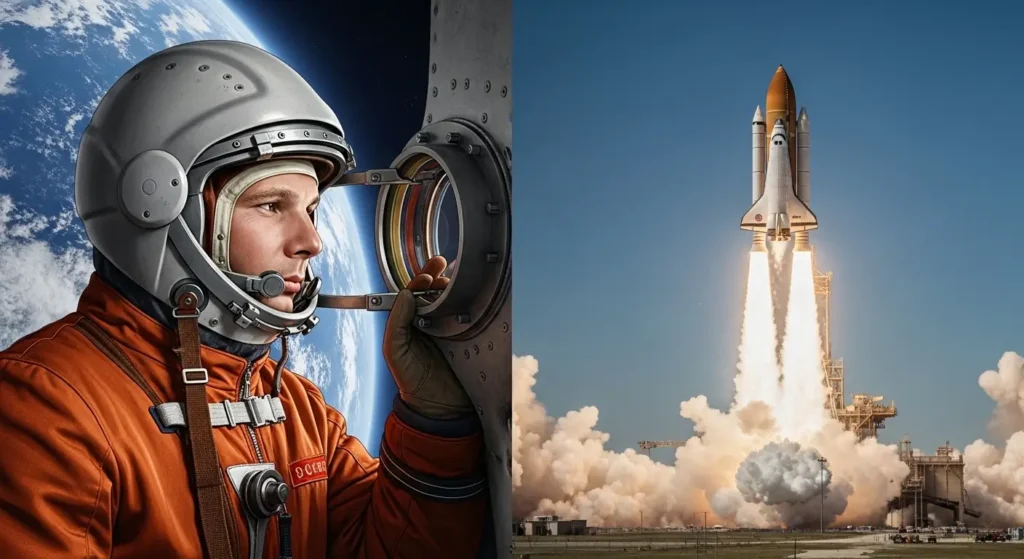
The history of space exploration is often written in cold statistics, but the heart of the International Day of Human Space Flight is a deeply human story. On April 12, 1961, a 27-year-old Soviet pilot named Yuri Gagarin climbed into the Vostok 1 capsule. He didn’t just go into orbit; he changed the collective psychology of our species. Before that moment, the “heavens” were a place for gods or dreams. After Gagarin’s 108-minute flight, they became a destination.
Gagarin’s famous exclamation, “Poyekhali!” (Let’s go!), resonates even today. According to historical archives from NASA and the Russian Space Agency (Roscosmos), the mission was fraught with uncertainty. Engineers at the time were genuinely concerned about whether a human brain could function in microgravity or if the body would simply shut down. Gagarin proved that we could not only survive but also observe and report back. This anniversary is a tribute to that singular, courageous leap.
Preparing for the First Human Mission in Space 🏋️♂️
Becoming the first human in space wasn’t just about bravery; it was about an grueling, unprecedented training regimen. In the early 1960s, there was no “User Manual for Space.” Candidates had to endure extreme centrifugal forces, isolation in sensory deprivation tanks for days, and rigorous psychological testing.
💡 Expert Insight: The Vostok 1 capsule was almost entirely automated because scientists weren’t sure if the pilot would lose consciousness or go insane during the flight. Gagarin was given a sealed envelope with a code to take manual control, but it was intended only for emergencies.
Modern peer-reviewed studies on astronaut health, such as those published in The Lancet, highlight that early spacefarers faced risks we now understand much better: cosmic radiation, bone density loss, and cardiovascular shifts. Yet, the International Day of Human Space Flight reminds us that these risks were the price of progress. The engineering behind the Vostok’s heat shield and the R-7 rocket trajectory set the foundation for every orbital flight that followed.
STS-1: The 45th Anniversary of the First Space Shuttle Launch 🛰️
By an incredible coincidence—or perhaps a poetic alignment of history—exactly 20 years after Gagarin’s flight, on April 12, 1981, NASA launched STS-1. This was the maiden voyage of the Space Shuttle Columbia. As we celebrate the 45th anniversary of the Space Shuttle launch in 2026, we look back at a vehicle that redefined access to space.
Unlike the capsules of the Apollo era, the Space Shuttle was a reusable “space truck.” It launched like a rocket and landed like a glider. John Young and Robert Crippen, the crew of STS-1, took an enormous risk by flying a vehicle that had never been tested in space with a crew on board. Their success paved the way for the construction of the International Space Station (ISS) and the launch of the Hubble Space Telescope.
| Feature | Vostok 1 (1961) | STS-1 Columbia (1981) |
|---|---|---|
| Crew Size | 1 (Yuri Gagarin) | 2 (Young & Crippen) |
| Mission Duration | 108 Minutes | 54 Hours (approx. 2 days) |
| Reusability | None (Expendable) | Partial (Orbiter & SRBs) |
The Evolution of Astronautics: From ISS to Mars 🌌
Today, the International Day of Human Space Flight is less about a single “first” and more about sustained presence. The International Space Station has been inhabited continuously for over 20 years. We are now in the era of “New Space,” where commercial entities like SpaceX and Blue Origin collaborate with NASA to lower the cost of orbit.
The Artemis program, aiming to return humans to the Moon and eventually land on Mars, is the spiritual successor to Gagarin and the Shuttle. Scientific data from the NASA Twins Study has provided critical insights into how long-term space travel affects human DNA and telomeres, ensuring that the next generation of spaceflight participants can journey further than ever before.
Frequently Asked Questions: Life as an Astronaut ❓
Who was the first woman in space?
The pioneering title belongs to Valentina Tereshkova. On June 16, 1963, she piloted Vostok 6, completing 48 orbits of Earth. Her flight proved that women had the same physical and mental endurance for space travel as men.
Who is the youngest person to go to space?
For decades, the record was held by Gherman Titov, who was 25 when he flew on Vostok 2. Recently, commercial flights have seen younger participants, such as Oliver Daemen (18) on Blue Origin’s New Shepard, though Titov remains the youngest to reach orbital flight.
What is the salary of an astronaut?
At NASA, civilian astronaut salaries are based on the Federal Government’s General Schedule (GS) pay scale, typically ranging from GS-13 to GS-15. This currently translates to roughly $105,000 to $160,000 per year, depending on experience and academic standing.
Can you smoke or drink alcohol in space?
Absolutely not. Smoking is a massive fire hazard in a high-oxygen, enclosed environment. As for alcohol, NASA has a strict no-alcohol policy on the ISS because it can interfere with the station’s water recovery system and safety protocols.
Is there Wi-Fi on the ISS?
Yes! Modern astronauts have access to Wi-Fi for laptops and tablets. While the connection can be laggy compared to Earth standards, they use it to email family, browse social media, and stream news.
What happens if an astronaut drifts away during a spacewalk?
NASA astronauts use a “jetpack” system called SAFER (Simplified Aid For EVA Rescue). If their tether breaks, they can use small nitrogen thrusters to fly themselves back to the station.
How much does a space suit cost?
A single NASA Extravehicular Mobility Unit (EMU) can cost between $12 million and $150 million depending on the technology and life-support systems integrated. It is essentially a personalized, one-person spacecraft.
The International Day of Human Space Flight is a celebration of our potential. Every time we look at the stars, we remember that we are a species of explorers. If you have more questions about space history or what it’s like to live in zero-G, feel free to drop a comment below! Let’s keep looking up. 🌌✨