How NASA Will Build The Artemis Moon Base: Discover the comprehensive 3-phase roadmap for lunar habitation, from water ice extraction to 3D-printed habitats. Learn how NASA is establishing a sustainable human presence on the Moon.
Have you ever looked up at the Moon and wondered if we could actually live there? It’s no longer just a scene from a sci-fi movie. NASA’s Artemis program is officially shifting gears from simple “exploration” to “permanent habitation.” As a space enthusiast who has followed every rocket launch from the early Saturn V documentaries to the recent Starship test flights, I can tell you: this time, we aren’t just leaving footprints. We are building a home. In this deep dive, we’ll explore the technical, logistical, and geopolitical framework of How NASA Will Build The Artemis Moon Base. 🚀
Contents: The Roadmap to the Moon
- Phase 1: Establishing the Foundation (2026-2028)
- Phase 2: Developing Critical Infrastructure (2029-2032)
- Phase 3: Achieving Sustainable Lunar Habitation (2033+)
- The Role of Private Partners: SpaceX & Blue Origin
- Scientific Significance & The Lunar Economy
Phase 1: Laying the Foundation for the Artemis Lunar Base 📍
The first step in How NASA Will Build The Artemis Moon Base involves rigorous scouting and site preparation. Between 2026 and 2028, NASA focuses on the Lunar South Pole—a region of strategic importance due to its “peaks of eternal light” and “permanently shadowed craters.”
The VIPER (Volatiles Investigating Polar Exploration Rover) mission is the cornerstone of this phase. Its mission? To map the distribution and concentration of water ice. Why water? Because water isn’t just for drinking; it’s the key to oxygen and hydrogen rocket fuel. Without local water extraction, the cost of maintaining a base would be astronomical. Honestly, it’s like trying to go on a long camping trip without knowing if there’s a stream nearby—preparation is everything. 😊
Key Objectives of Phase 1 📝
- Site Selection: Identifying stable ground near Shackleton Crater.
- Robotic Scouting: Deploying 25+ CLPS (Commercial Lunar Payload Services) missions.
- Power Testing: Deploying small-scale fission surface power systems.
Phase 2: Building Massive Lunar Infrastructure 🏗️
Once the resources are mapped, the heavy lifting begins. Phase 2 (2029–2032) focuses on landing the “hardware” of the base. This isn’t just about small tents; we’re talking about unpressurized and pressurized rovers, and even nuclear reactors.
NASA is collaborating with international partners like JAXA (Japan) to develop a Pressurized Rover. Imagine a high-tech camper van where astronauts can work in shirtsleeves for up to 30 days while traveling hundreds of kilometers across the lunar surface. It’s a game-changer for geological surveys and construction logistics.
| Infrastructure Component | Function in Artemis Base |
|---|---|
| Fission Surface Power | Continuous power during the 14-day lunar night. |
| Lunar Terrain Vehicle (LTV) | Open-air transport for EVA (Extravehicular Activity). |
| Foundational Habitat | Short-term housing for 2-4 crew members. |
⚠️ The Radiation Challenge
The Moon lacks a magnetic field and a thick atmosphere. NASA must use regolith shielding (moon dust) to protect astronauts from solar flares and cosmic radiation.
Phase 3: Sustainable Habitation and the Mars Gateway 🚀
By 2033 and beyond, the goal of How NASA Will Build The Artemis Moon Base reaches its peak: Sustainability. This phase transitions from “visiting” to “living.” NASA plans to utilize In-Situ Resource Utilization (ISRU) technology to print 3D structures using lunar soil (regolith).
This is where the Lunar Gateway—a space station orbiting the Moon—becomes vital. It acts as a communication hub and a staging ground for missions deeper into the solar system, specifically Mars. We are using the Moon as a “sandbox” to learn how to survive on another planet. If we can make it here, we can make it anywhere in the cosmos. 🌌
Artemis Base Strategy Summary 💡
Primary Goal: Sustainable Human Presence
Key Location: Lunar South Pole (Shackleton Crater)
Core Technology: ISRU (In-Situ Resource Utilization)
Partners: SpaceX (HLS), Blue Origin, JAXA, ESA.
NASA’s blueprint for the next giant leap.
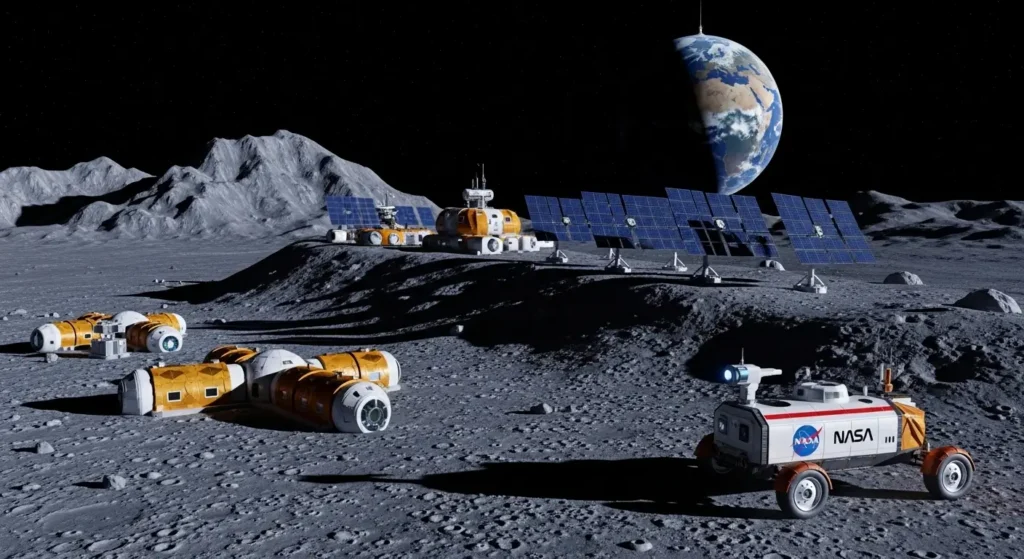
Frequently Asked Questions About the Artemis Moon Base ❓
Q: Why is NASA building the base at the South Pole?
A: The South Pole contains water ice in shadowed craters and constant sunlight on high ridges, providing both life-sustaining resources and solar energy.
Q: How will astronauts breathe on the Moon?
A: Initially, oxygen is brought from Earth. Later, NASA will use electrolysis to extract oxygen from lunar water ice and chemical processes to pull it from lunar regolith.
Q: What is the role of SpaceX in building the Artemis base?
A: SpaceX is providing the Starship Human Landing System (HLS), which will ferry astronauts and heavy cargo from lunar orbit to the surface.
The journey of How NASA Will Build The Artemis Moon Base is more than just a technical roadmap; it’s a testament to human ingenuity. We are witnessing the birth of a multi-planetary species. It’s an exciting time to be alive, and I can’t wait to see the first high-definition video of the base under construction. What do you think is the biggest challenge for living on the Moon? Let me know in the comments! 😊