For centuries, astronomers have stared at the vast, “empty” space between Mars and Jupiter, wondering what should be there. It’s an awkward gap in an otherwise orderly solar system. This region, known as the asteroid belt, is filled with millions of rocky bodies, but their combined mass is surprisingly small—only about 4% of Earth’s Moon.
This cosmic emptiness has given rise to two competing theories: Was this a region where a planet *failed* to form, its growth stunted by the immense gravity of nearby Jupiter? Or, more dramatically, was this the site of a great catastrophe—the graveyard of a fully-formed planet that was later *destroyed*?
For decades, the “failed planet” model was the leading hypothesis. But science, at its best, is a detective story. Sometimes, the most crucial clue falls right into our laps. In 2008, a 4.5-billion-year-old messenger from this exact region of space streaked across the sky and exploded over the Nubian Desert in Sudan. This meteorite, named Almahata Sitta, carried within it the definitive proof we needed.
This wasn’t just another space rock. It was a fragment of a lost world.
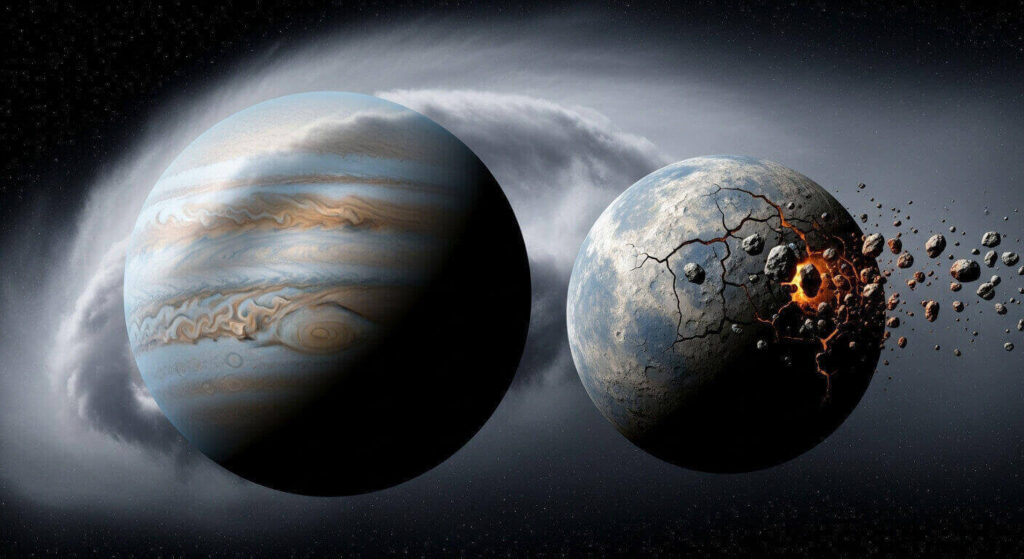
Table of Contents
- The Almahata Sitta Meteorite: A Messenger from the Past
- The “Smoking Gun” Mineral: Why Amphibole Changes Everything
- Reconstructing the Lost Planet: What Was This World Like?
- The Great Collision: What Destroyed This Ancient Protoplanet?
- Conclusion: The Asteroid Belt as a Planetary Graveyard
- Frequently Asked Questions (FAQ) About the Lost Planet
The Almahata Sitta Meteorite: A Messenger from the Past
The story of Almahata Sitta (Arabic for “Station Six”) is unique before we even analyze its contents. It was the first celestial object to be spotted by astronomers *before* it entered Earth’s atmosphere. Telescopes tracked the 9-ton asteroid, designated 2008 TC3, as it hurtled toward Earth, allowing scientists to predict its impact location in Sudan with incredible accuracy.
After the explosion, researchers recovered over 600 fragments of the meteorite. Most meteorites are a single type of rock. Almahata Sitta, however, was a complex collection of different rock types, primarily classified as a “ureilite.” This suggests its parent body was a large, complex object that had undergone geological differentiation—much like a planet—with a core, mantle, and crust.
But the most stunning discovery was buried deep within one of these fragments, a discovery not announced until a detailed analysis was published in *Nature Astronomy* in 2020. Scientists found something that, by all accounts, shouldn’t be there: amphibole.
The “Smoking Gun” Mineral: Why Amphibole Changes Everything
To understand why this mineral is a “smoking gun,” we need a quick geology lesson. Amphibole is a hydrous silicate, meaning it has water (hydroxyl groups) locked into its crystal structure.
Crucially, amphibole can only form under very specific conditions of temperature and pressure. It’s what we call a “Goldilocks” mineral in this context.
- Problem 1: Small Asteroids. The millions of small asteroids in the belt today are far too tiny. They lack the internal pressure and sustained heat needed to form amphibole. Any water present would exist as simple ice.
- Problem 2: Large Planets. Massive planets like Earth or Mars have *too much* internal pressure. At the pressures found deep inside a large planet, amphibole breaks down and transforms into other, more stable minerals like garnet and pyroxene.
The amphibole found in Almahata Sitta could only have formed at a “medium” pressure—specifically between 1.1 and 1.6 Gigapascals (GPa). This pressure is far greater than anything a small asteroid can generate but significantly less than the core pressures of a planet like Earth.
The only possible source? A “lost” planetary body of intermediate size. The Almahata Sitta meteorite is not a building block of a failed planet; it is a shattered piece of a *finished* one.
Reconstructing the Lost Planet: What Was This World Like?
By reverse-engineering the formation pressure of the amphibole, scientists were able to calculate the size of the parent body this meteorite came from. The results are astonishing.
The calculations show the lost world was a water-rich protoplanet with a diameter between 640 and 1,800 kilometers (about 400 to 1,100 miles).
To put that in perspective, the largest object in the asteroid belt today is the dwarf planet Ceres, which is about 940 km across. This means the Almahata Sitta parent body was, at a minimum, the size of Ceres and was quite possibly much larger—a true planetary-scale object that was once a dominant body in its region.
This wasn’t just a big rock. It was a differentiated world. It had a hot, metallic core and a rocky mantle. Critically, it had abundant water, which, combined with the internal heat from its formation, would have driven active geological processes, including the chemical reactions that formed the amphibole.
The Great Collision: What Destroyed This Ancient Protoplanet?
If this large, Ceres-sized protoplanet existed 4.5 billion years ago, where is it now? The evidence points to a violent and catastrophic end.
The early solar system was an unimaginably chaotic place, a “shooting gallery” of massive, colliding bodies. Scientific models, such as the “Grand Tack” hypothesis, suggest that the giant planets (Jupiter and Saturn) migrated significantly in their early orbits. As Jupiter moved, its colossal gravity would have acted like a wrecking ball, scattering the protoplanets in the asteroid belt.
This gravitational chaos would have flung these newly-formed worlds into each other at devastating speeds. The parent body of Almahata Sitta was likely destroyed in one of these ancient, planet-shattering impacts.
The impact was so immense that it obliterated the protoplanet, sending trillions of fragments into orbit—the debris of which we now call the asteroid belt. The Almahata Sitta meteorite was one of these fragments, a tiny piece of that world’s mantle, which drifted through space for 4.5 billion years before finally finding its way to Earth.
Conclusion: The Asteroid Belt as a Planetary Graveyard
The discovery of amphibole in the Almahata Sitta meteorite fundamentally changes our understanding of the asteroid belt. It is not a collection of leftovers that *failed* to form a planet. Instead, it is a planetary graveyard—the final resting place of a generation of large, water-rich protoplanets that were formed and then destroyed.
This single, remarkable meteorite has provided us with the first direct physical evidence of these long-lost worlds. It confirms that the early solar system was capable of forming large, Ceres-sized bodies between Mars and Jupiter, and that their existence was cut short by the violent dynamics of our system’s youth.
Every piece of rock in that belt is a clue. The Almahata Sitta meteorite was just the first one we found that could tell its incredible story: the story of a lost, watery world that was our neighbor, long before we were here to see it.
Frequently Asked Questions (FAQ) About the Lost Planet
Q: What is the Almahata Sitta meteorite?
A: Almahata Sitta (“Station Six”) is a meteorite that fell in the Nubian Desert of Sudan in 2008. It is famous for being the first asteroid tracked in space before it hit Earth. It’s a rare type of meteorite called a ureilite, and it contains a wide variety of minerals from a large, destroyed parent body.
Q: Why is finding amphibole in a meteorite so important?
A: Amphibole is a water-bearing mineral that can only form under specific “intermediate” pressure and temperature conditions. These conditions are not met in small asteroids (too little pressure) or large planets (too much pressure). Its presence is the first physical proof that a large, planetary-sized body (a protoplanet) once existed in the asteroid belt.
Q: How big was this lost planet?
A: Based on the pressure needed to form the amphibole (1.1–1.6 GPa), scientists estimate the parent body was a protoplanet between 640 and 1,800 kilometers (400 to 1,100 miles) in diameter. This makes it comparable in size to, or even larger than, Ceres, the largest object in the asteroid belt today.
Q: Does this mean there was life on this lost planet?
A: The presence of water and moderate temperatures does not automatically mean there was life. While this protoplanet had the key *ingredients* for life (liquid water, organic compounds from the ureilite family, and a heat source), it was likely destroyed very early in the solar system’s history, probably within the first 10-15 million years. This is likely not enough time for life to have emerged.
Q: What is the difference between a protoplanet and a planet?
A: A protoplanet is a large planetary embryo. It’s an object in the early stages of planetary formation that has undergone internal melting to form a core and mantle (differentiation) but has not yet “cleared its orbital neighborhood” of other objects. Many protoplanets in the early solar system either collided to form the planets we see today (like Earth) or were destroyed, as was the case with the Almahata Sitta parent body.