Size of the largest black hole Discover Phoenix A*, the current record-holder for the most massive black hole ever found. Explore its staggering diameter, event horizon scale, and how it compares to our entire solar system in this expert cosmic guide.
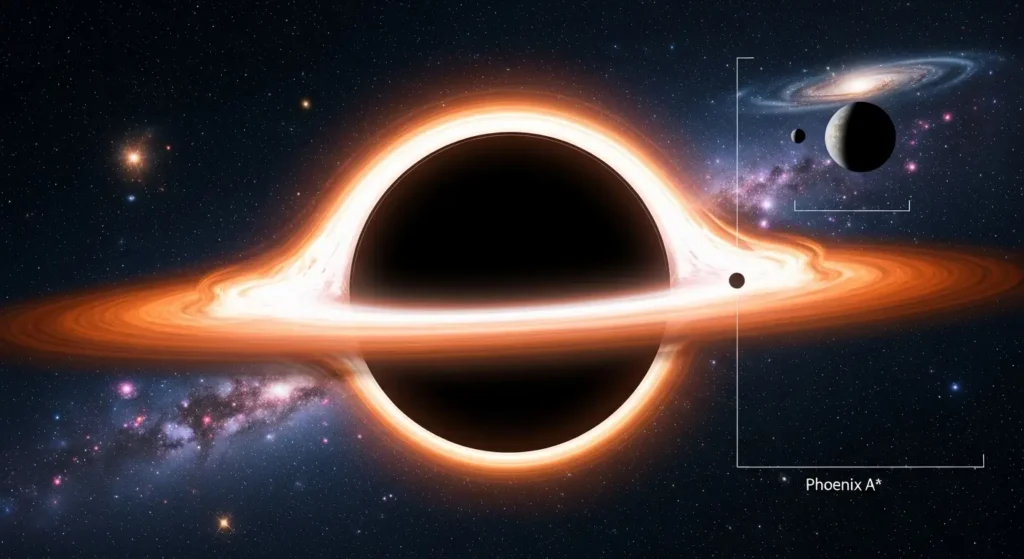
Table of Contents
- 1. Introduction: The Monsters in the Dark
- 2. What is the Size of the Largest Black Hole? (Phoenix A*)
- 3. Comparing the Mass and Scale: Phoenix A* vs. TON 618
- 4. How Do We Measure the Diameter of a Black Hole?
- 5. Can Black Holes Grow Indefinitely?
- 6. Summary: The Final Frontier of Size
The Monsters in the Dark: Understanding Cosmic Scales 🌌
When we talk about the “size” of objects in space, our human intuition often fails us. We think of planets as big, stars as bigger, and galaxies as immense. But then, there are black holes—specifically, Ultramassive Black Holes (UMBHs). These aren’t just collapsed stars; they are gravitational titans that anchor the centers of massive galaxy clusters.
I remember the first time I saw a scale comparison of our Sun to a supermassive black hole. It felt unsettling, almost existential. Today, we are looking at the size of the largest black hole ever detected, an object so large it challenges our very understanding of how matter can accumulate in the universe.
What is the Physical Size of the Largest Black Hole? Meet Phoenix A* 🔭
For a long time, the quasar TON 618 was considered the king of the cosmos. However, recent data and models have pointed towards a new champion: Phoenix A*. Located in the Phoenix Cluster approximately 5.8 billion light-years away, this entity is truly mind-boggling.
The estimated mass of Phoenix A* is roughly 100 billion solar masses. To put that in perspective, the black hole at the center of our Milky Way, Sagittarius A*, is only about 4 million solar masses. Phoenix A* is 25,000 times heavier than our own central black hole.
But how big is it physically? The Schwarzschild radius (the radius of the event horizon) for Phoenix A* is estimated to be around 590 billion kilometers. In terms of diameter, we are talking about 1.18 trillion kilometers. If you placed it at the center of our solar system, the event horizon would extend far beyond the orbit of Pluto and even the Kuiper Belt, reaching into the interstellar void.
Comparing the Most Massive Black Holes in the Known Universe 📊
In the world of astrophysics, the leaderboard of size changes as new observational techniques (like the Event Horizon Telescope) improve. Here is a breakdown of how the biggest contenders compare:
| Black Hole Name | Mass (Solar Masses) | Event Horizon Diameter |
|---|---|---|
| Phoenix A* | ~100 Billion | ~1.18 Trillion km |
| TON 618 | 66 Billion | ~390 Billion km |
| Holmberg 15A | 40 Billion | ~236 Billion km |
| M87* | 6.5 Billion | ~38 Billion km |
💡 Pro Tip: The “size” of a black hole usually refers to its event horizon. The singularity itself is theorized to be a point of infinite density with zero volume, though quantum mechanics might suggest otherwise!
How Do Scientists Measure the Dimension of a Supermassive Entity? 📐
We can’t “see” a black hole directly because light cannot escape it. So, how do we determine the size of the largest black hole? We use three primary methods:
- Stellar Dynamics: Observing the speed of stars orbiting the center of a galaxy. The faster they move, the more massive the central object must be.
- Gas Dynamics: Measuring the rotation of cold gas clouds or hot accretion disks around the event horizon.
- Reverberation Mapping: Measuring the time delay between light from the accretion disk and the light reflected from surrounding gas clouds (used mostly for quasars like TON 618).
For Phoenix A*, scientists used models based on the cooling flow of the galaxy cluster and the X-ray emissions from the surrounding hot gas. It’s a bit like measuring the size of an invisible drain by watching how fast the water swirls around it.
The Limit of Size: Can Black Holes Grow Forever? 🌀
Is there a “maximum” size for a black hole? Theoretically, yes. As a black hole grows, it heats up the gas around it via its accretion disk. If the black hole becomes too massive, the radiation pressure from this disk becomes so strong that it blows away the nearby gas, “starving” the black hole of new material.
This limit is often cited around 50 to 100 billion solar masses. Phoenix A* is sitting right at that theoretical ceiling. This suggests that the universe might not be old enough yet to produce anything significantly larger, or that we have reached the physical limit of how much “food” a black hole can eat before it pushes its plate away.
Final Thoughts on the Scale of the Universe 📝
The size of the largest black hole reminds us how small we are. Phoenix A* isn’t just a celestial object; it’s a structural pillar of the universe, influencing the evolution of thousands of galaxies within its cluster. While TON 618 held the title for decades, the discovery of Phoenix A* shows that the cosmos still has many secrets hidden in its darkest corners.
If you’re as fascinated by these cosmic giants as I am, keep an eye on upcoming missions like the James Webb Space Telescope (JWST) and future iterations of the Event Horizon Telescope. We are on the verge of “seeing” more of these monsters than ever before! 😊
Frequently Asked Questions about the Largest Black Hole ❓
Q: Is TON 618 still the largest black hole?
A: While TON 618 is the most famous and well-measured “ultramassive” black hole, Phoenix A* is currently estimated to be larger (100 billion vs 66 billion solar masses).
Q: Could a black hole eat the whole universe?
A: No. Black holes only pull in objects that get too close to their event horizon. Most of the universe is far too distant to ever be consumed.
Q: What is the diameter of Phoenix A*?
A: Its event horizon diameter is roughly 1.18 trillion kilometers, which is about 100 times the distance from the Sun to Pluto.